
The Mysterious Death of Alexander the Great
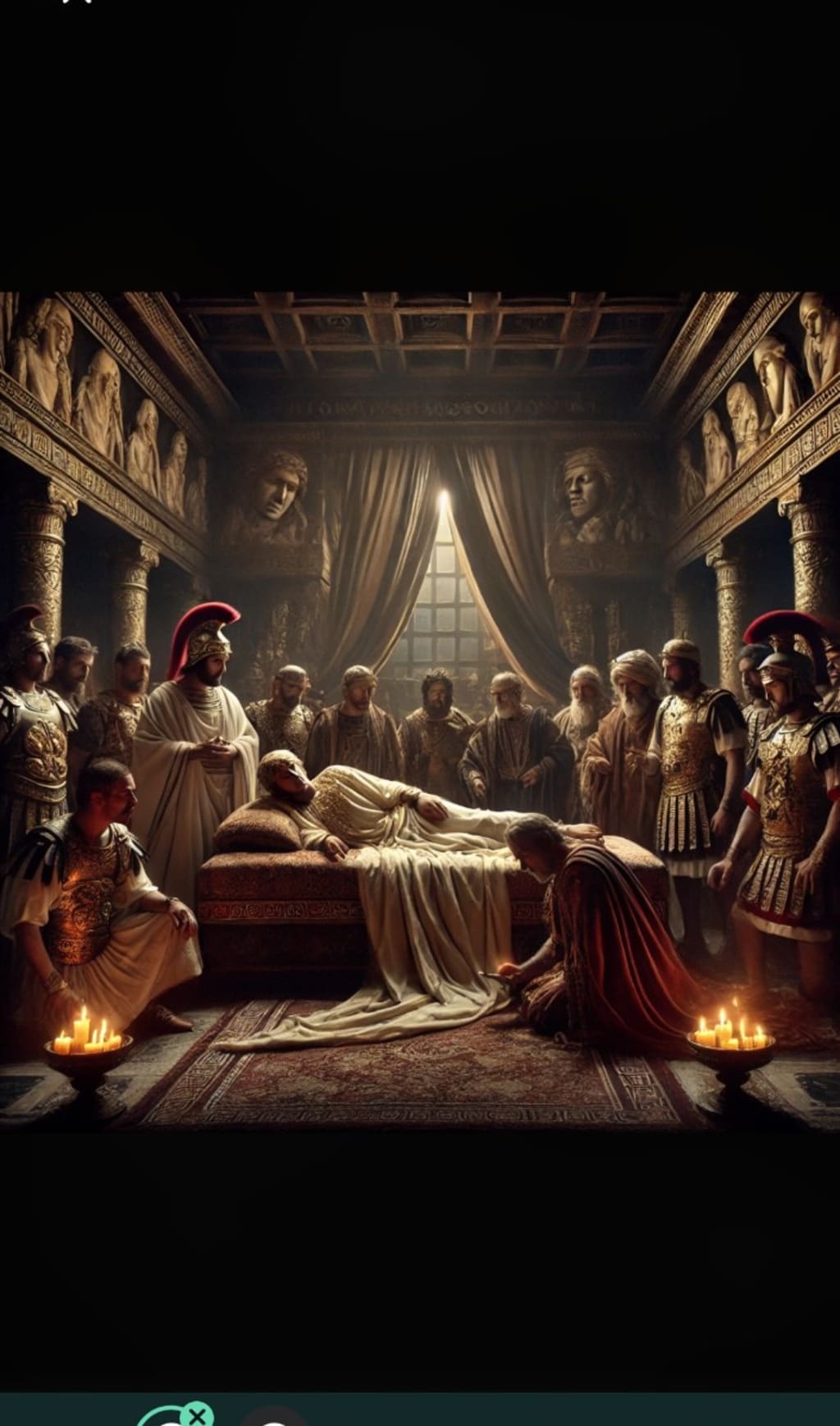
The image portrays the final moments of Alexander the Great in Babylon. Surrounded by his generals and physicians, the great conqueror lies weak yet regal in a dimly lit palace. The oil lamps cast eerie shadows on the marble walls, highlighting the tension and mystery surrounding his death. Theories of poisoning, fever, or a long-hidden illness continue to fuel debates about one of history’s greatest enigmas.

The Mysterious Death of Alexander the Great: Causes and Theories
Introduction
The death of Alexander the Great remains one of the most intriguing mysteries in history. On June 10 or 11, 323 BCE, at the age of 32, the great conqueror breathed his last in the palace of Nebuchadnezzar II in Babylon. Despite his young age, his death shocked the ancient world and left a power vacuum that led to the eventual division of his vast empire. But what exactly caused his untimely demise? Historians and scholars have debated the cause for centuries, proposing various theories, from natural illnesses to assassination.
Historical Accounts of His Death
Ancient sources describe Alexander suffering a prolonged illness that lasted about 12 days. His symptoms reportedly included fever, severe abdominal pain, weakness, and an inability to speak in his final days. According to accounts by historians such as Arrian, Plutarch, and Diodorus Siculus, he remained conscious but increasingly debilitated, leading to his eventual death. However, these sources differ in their explanations of the exact cause.
Theories on Alexander’s Cause of Death
1. Malaria or Typhoid Fever
One of the most widely accepted natural causes for Alexander’s death is that he succumbed to an infectious disease such as malaria or typhoid fever. These diseases were common in ancient Mesopotamia, where stagnant water and warm conditions made it easy for mosquitoes and bacteria to thrive.
Symptoms that match: High fever, abdominal pain, weakness, and eventual organ failure are consistent with malaria or typhoid.
Historical accounts: Greek historian Plutarch mentioned that Alexander developed a high fever after attending a banquet, which supports the theory of an infection.
Counterpoint: Malaria and typhoid typically cause death within a few days, yet Alexander was ill for nearly two weeks, making some scholars question this theory.
2. Poisoning by His Rivals
Another popular theory is that Alexander was poisoned by his generals or political enemies who feared his growing power.
Possible suspects: Some theories suggest that his half-brother Arrhidaeus, his general Cassander, or even his trusted officers Antipater and Ptolemy had motives to eliminate him.
Plutarch’s account: He mentions that Alexander’s body showed no immediate signs of decomposition, which was seen as a divine sign but also raises the question of a slow-acting poison.
Counterpoint: Poisoning is a common suspicion in historical deaths, but the lack of immediate death (since Alexander lived for nearly two weeks) makes it unlikely unless it was a slow-acting poison unknown to modern science.
3. Autoimmune Disorders
Some researchers believe Alexander may have suffered from an autoimmune disease, such as Guillain-Barré Syndrome (GBS) or West Nile Virus.
Symptoms that match: Fever, paralysis, weakness, and difficulty speaking are all associated with GBS.
Modern analysis: Some experts suggest that Alexander's symptoms, such as progressive paralysis without loss of mental clarity, align with the effects of an autoimmune condition.
Counterpoint: The ancient sources do not mention muscle spasms or nerve issues, which are common in such diseases.
4. Alcohol Poisoning or Overindulgence
Some historians argue that Alexander’s heavy drinking and possible alcohol poisoning contributed to his demise. Alexander was known for excessive drinking, especially after the death of his close companion Hephaestion.
Evidence: According to some accounts, he attended multiple banquets before falling ill.
Possible complications: Pancreatitis or liver failure from excessive alcohol consumption could have led to multi-organ failure.
Counterpoint: Although excessive drinking could have weakened his immune system, it is unlikely to be the sole cause of death.
5. Theories of Assassination by a Hidden Conspiracy
Some believe that Alexander was assassinated as part of a larger political conspiracy.
Macedonian generals: With no clear successor, his generals had everything to gain from his death.
Persian resistance: Some theories suggest that remnants of the Persian elite sought revenge.
Counterpoint: There is no concrete evidence proving foul play.
The Mystery Continues
Despite centuries of research, the true cause of Alexander the Great’s death remains elusive. Each theory has its strengths and weaknesses, and no single explanation has been universally accepted. What is certain is that his sudden death had profound consequences, leading to the fragmentation of his empire and the rise of the Hellenistic period.
Conclusion
The death of Alexander the Great continues to intrigue scholars, historians, and medical experts alike. Whether it was a natural disease, poisoning, or an undiagnosed medical condition, his passing marked the end of an era. Until new evidence emerges, the question of how one of history’s greatest military leaders met his end remains an unsolved historical enigma.
About the Creator
Say the truth
"Say the Truth: Explain Everything in the World" is your trusted source for uncovering facts and exploring the wonders of history, science, technology, and beyond. We simplify complex ideas and reveal truths to inspire curiosity .
Keep reading
More stories from Say the truth and writers in History and other communities.
The Hidden Tomb of Alexander the Great: An Unsolved Mystery
Historical Accounts of Alexander's Burial Alexander the Great, the Macedonian conqueror, met his untimely death in 323 B.C. in Babylon. Following his demise, his body became a symbol of immense political significance. Historical records suggest that his remains were initially intended to be interred in Aegae (modern-day Vergina) in Macedonia, the traditional burial site of Macedonian royalty. However, during the funeral procession, Ptolemy I, one of Alexander's generals, seized the body and diverted it to Egypt. This act was likely motivated by a desire to legitimize his rule over Egypt by possessing the remains of the revered leader.
By Say the truth 11 months ago in History
Can the United States Leave NATO?
Can the United States Leave NATO? What It Would Take—and What It Would Mean The North Atlantic Treaty Organization, commonly known as NATO, has been one of the most powerful military alliances in modern history. Since its creation in 1949, the United States has been NATO’s strongest member—militarily, financially, and politically. But in recent years, debates have grown louder about whether the U.S. should remain in the alliance. This raises a serious question: how could the United States be removed from NATO—or leave it—and what would that mean for the world?
By Wings of Time 7 days ago in History




Comments
There are no comments for this story
Be the first to respond and start the conversation.