
The Hidden Tomb of Alexander the Great: An Unsolved Mystery
Alexander the Great's final resting place remains one of history’s most enduring mysteries. Believed to have been buried in Alexandria, Egypt, his tomb was once a grand mausoleum visited by ancient rulers. Over the centuries, its location was lost, sparking countless theories and excavations. Despite numerous discoveries hinting at its presence, the exact position of the tomb remains unknown. This article explores historical accounts, archaeological clues, and modern searches for one of history’s greatest lost treasures.

Historical Accounts of Alexander's Burial
Alexander the Great, the Macedonian conqueror, met his untimely death in 323 B.C. in Babylon. Following his demise, his body became a symbol of immense political significance. Historical records suggest that his remains were initially intended to be interred in Aegae (modern-day Vergina) in Macedonia, the traditional burial site of Macedonian royalty. However, during the funeral procession, Ptolemy I, one of Alexander's generals, seized the body and diverted it to Egypt. This act was likely motivated by a desire to legitimize his rule over Egypt by possessing the remains of the revered leader.
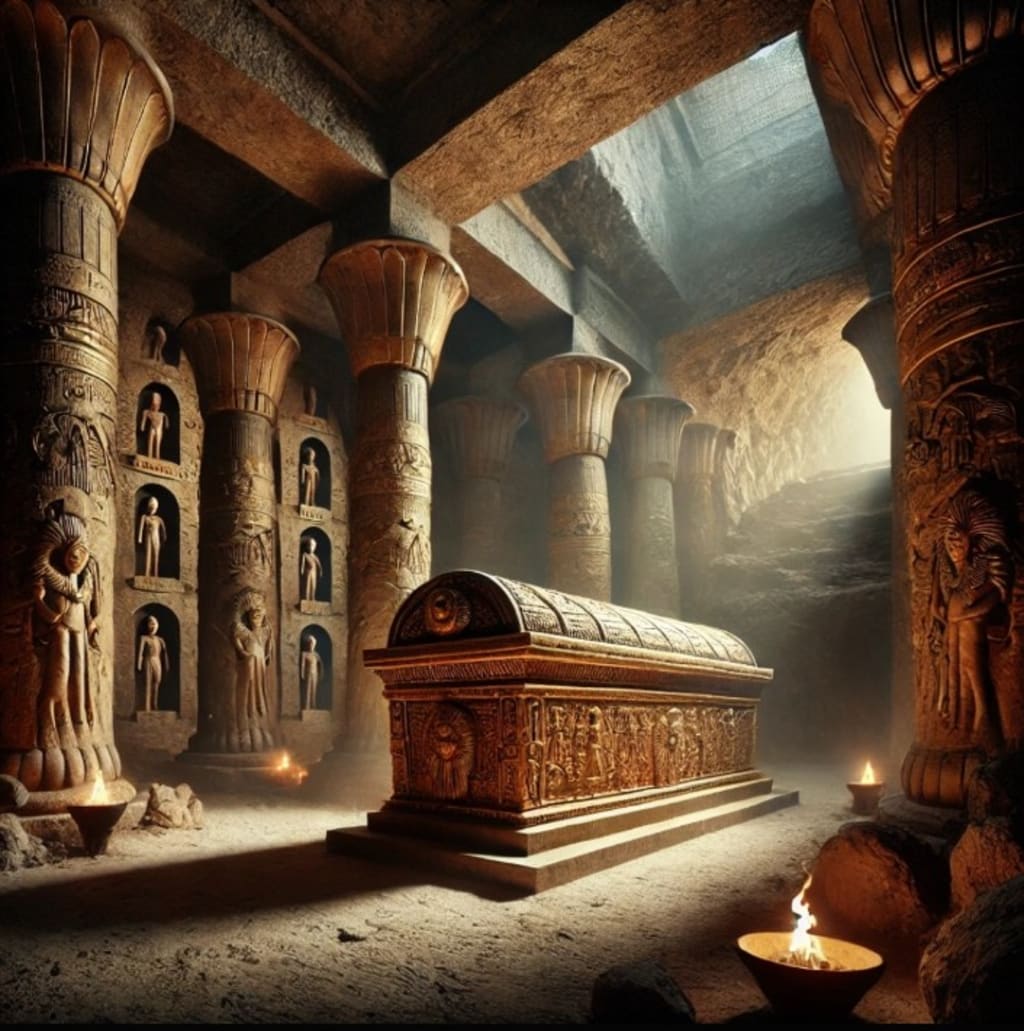
In Egypt, Alexander's body was first laid to rest in Memphis. Later, it was transferred to Alexandria, the city he founded, where it was placed in a grand mausoleum known as the "Soma." This tomb became a pilgrimage site for many notable figures of antiquity, including Julius Caesar and Augustus. Over time, however, the exact location of the Soma faded from public memory, leading to centuries of speculation and search.
Theories and Archaeological Endeavors
Several theories have emerged regarding the possible location of Alexander's tomb:
Under the Mosque of Nabi Daniel in Alexandria: Some researchers propose that the tomb lies beneath the modern Mosque of Nabi Daniel. This theory is based on historical texts and the mosque's proximity to ancient royal quarters. However, political and religious sensitivities have limited extensive excavations in this area.
The Alabaster Tomb in Alexandria: Another hypothesis points to an unmarked "alabaster tomb" in eastern Alexandria. This sizable structure, dating to the third century B.C., lacks inscriptions but could plausibly be linked to Alexander. Despite its potential significance, definitive evidence connecting it to Alexander is absent.
Amphipolis in Northern Greece: A monumental tomb discovered in Amphipolis, dating back to the era following Alexander's death, sparked speculation that it might be his final resting place. Guarded by headless sphinxes and containing multiple chambers, the tomb's grandeur led some to associate it with Alexander. However, subsequent studies have suggested it more likely belonged to a close associate or family member.
Recent Developments
In recent years, archaeological efforts have intensified:
Vergina Excavations: The discovery of royal tombs in Vergina, the ancient city of Aegae, unveiled the resting places of Macedonian royalty, including Alexander's father, Philip II. Artifacts such as a purple-dyed tunic, possibly linked to Alexander, have been found, offering insights into the era's burial customs. However, these findings pertain to his family rather than Alexander himself.
Ongoing Research in Alexandria: Archaeologists continue to explore potential sites within Alexandria, employing advanced technologies like ground-penetrating radar. The dense urban development of the modern city poses significant challenges, but researchers remain hopeful that clues to the Soma's location may yet emerge.
The precise location of Alexander the Great's tomb remains elusive, shrouded in layers of history, legend, and urban development. While various theories and archaeological findings offer tantalizing hints, definitive evidence has yet to surface. The quest to uncover this ancient enigma continues to captivate historians and archaeologists alike, promising that the mystery of Alexander's final resting place endures.
1. Historical Accounts of the Tomb
After Alexander’s death in 323 BCE, his body was initially taken to Memphis, Egypt.
Later, his remains were transferred to Alexandria, where a grand mausoleum, the Soma, was built.
Historical figures like Julius Caesar, Augustus, and Caligula reportedly visited the tomb.
2. Theories About Its Disappearance
The tomb may have been destroyed by earthquakes, floods, or Christian iconoclasm.
Some historians believe it could be buried beneath modern Alexandria.
There are theories suggesting his body was moved to another location, possibly Greece or Siwa Oasis.
3. Key Archaeological Discoveries
In the 20th and 21st centuries, multiple tombs and ruins in Alexandria have been explored.
The Anfushi catacombs, Kom el-Dikka, and Shallalat Gardens have shown promising clues.
A discovery in Siwa Oasis in 1995 led to speculation about Alexander’s final resting place.
4. Ongoing Search Efforts
Modern archaeologists and historians continue to study historical texts and conduct excavations.
Satellite imaging and ground-penetrating radar are being used to identify hidden structures.
Egypt's Supreme Council of Antiquities remains active in uncovering lost Alexandrian sites.
5. Conclusion
The search for Alexander’s tomb remains one of the greatest archaeological mysteries.
While theories abound, no definitive proof has been found.
If discovered, it could reshape our understanding of ancient history.
Would you like me to expand on any of these points?
About the Creator
Say the truth
"Say the Truth: Explain Everything in the World" is your trusted source for uncovering facts and exploring the wonders of history, science, technology, and beyond. We simplify complex ideas and reveal truths to inspire curiosity .
Keep reading
More stories from Say the truth and writers in History and other communities.
Roopkund Lake – The Skeleton Lake
Roopkund Lake, Uttarakhand – The Skeleton Basin Mystery Hidden in the high-altitude Himalayan arena of Uttarakhand, India, Roopkund Basin has absorbed explorers, scientists, and historians for decades. Known as the Skeleton Lake, this arctic basin charcoal arctic for best of the year, but aback the ice melts, it reveals a abominable sight—hundreds of animal skeletons broadcast about and aural its waters. The abstruse charcoal accept aloft questions about their origins, arch to assorted theories alignment from age-old rituals to adverse accustomed disasters.
By Say the truth 11 months ago in History
Can the United States Leave NATO?
Can the United States Leave NATO? What It Would Take—and What It Would Mean The North Atlantic Treaty Organization, commonly known as NATO, has been one of the most powerful military alliances in modern history. Since its creation in 1949, the United States has been NATO’s strongest member—militarily, financially, and politically. But in recent years, debates have grown louder about whether the U.S. should remain in the alliance. This raises a serious question: how could the United States be removed from NATO—or leave it—and what would that mean for the world?
By Wings of Time 6 days ago in History



Comments (1)
good historical story