
The mosque of the sixty domes
The Sixty-Dome Mosque a UNESCO World Heritage Site.

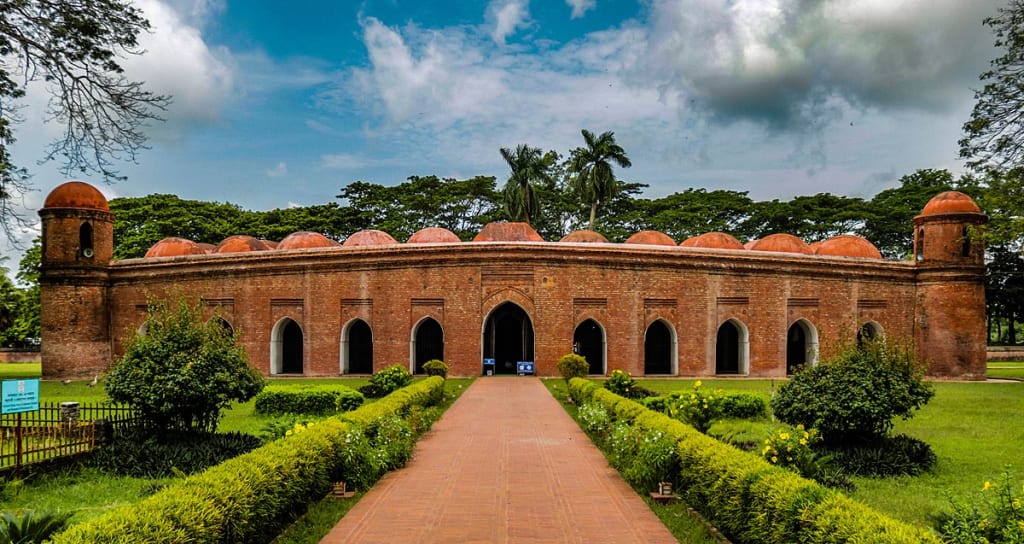
The Sixty Dome Mosque (more commonly known as Shait Gambuj Mosque or Saith Gunbad Masjid), is a mosque in Bangladesh. It is part of the Mosque City of Bagerhat, a UNESCO World Heritage Site. It is the largest mosque in Bangladesh from the sultanate period (1204-1576). It was built during the Bengal Sultanate by Ulugh Khan Jahan, the governor of the Sundarbans. It has been described as "one of the most impressive Muslim monuments in the whole of the Indian subcontinent.
In the middle of the 15th century, a Muslim colony was founded in the mangrove forest of the Sundarbans, near the coast in the Bagerhat District by a saint-General, named Khan Jahan Ali. He preached in an affluent city during the reign of Sultan Nasiruddin Mahmud Shah, then known as 'Khalifalabad'.Khan Jahan adorned this city with more than a dozen mosques, the ruins of which are focused around the most imposing and largest multi-domed mosques in Bangladesh, known as the Shait-Gumbad Masjid (160'×108'). The construction of the mosque was started in 1442 and it was completed in 1459. The mosque was used for prayers, and also as a madrasha and assembly hall.
The Shait Gambuj mosque is the most magnificent as wellas the largest enclosed type mosque in Bengal. Although the date of its erection is not known, it is considered to be the Great Congregational Mosque of Khan Jahan Ali built during his lifetime in the early 15th century at Bagerhat. The name ‘Shait Gombuj’ or ‘sixty domes’ is misleading: it has as many as 81 domes: 70circular domes upon the prayer hall, seven chauchala domes upon the central aisle and four domes upon the corner towers.
The mosque has an oblong shaped prayer hall measuring externally 48.95 m by 32.25 m with a 2.43 m thick surrounding brick wall. The hall is internally divided into seven bays and eleven aisles.The central aisle is wider and higher than the side aisles. The eastern wall consists of a row of eleven pointed-arch openings while each of the side walls has seven. The central opening in each side is larger than others, which was used as the entrance way and the rest six openings on each side were probably closed with a perforated brick. In the northern wall, an evidence of such perforated brick jail is still in situ. Only the central mihrab niche has a multifoil arch and the rest have two centered pointed-arches supported on two sides by pilasters. The right aisle of the central mihrab niche has an off centered arched doorway instead of a mihrab niche. The provision of an entrance, adjacent to the central mihrab niche in the kibla wall, indicates that the Khan Jahan Ali's residence was located to the west or north-west side ofthe mosque.
The freestanding 60 pillars (55 stone and five brick pillars) support the whole roof. It can be possiblethat the name of the mosque derived not from the number of domes (77), but from the number of the supporting pillars(60). Hence it may be stated that the original name of this mosque was Shait (60)Khamba (local dialect for pillar) mosque. In course of time, this Khamba(pillar) might have been confused with Gambuj (dome). The Chauchala vault of this mosque is believed to be the earliest example of the reproduction of the rural bamboo-roof into a masonry vaulted roof. The parallel bamboo rafters and cross bars of the hut are also imitated from within. The top part of the central arched opening had a triangular pediment, from which the cornice slopes down towards the corner. The cornices on the other sides are typically curved.
Recently the interior and the exterior of the mosque have been totally altered. The triangular pediment placed above the central entrance has been removed; the floor and the freestanding stone pillars have been covered with plaster on brick by the Directorate of Archaeological Bangladesh, the official custodian of our cultural properties and world heritage. The famous or remarkable freestanding 60 stone pillars are now unrecognizable, and the shafts are no longer slender. The bulkier new pillars make the interior space appear more congested.
The exterior of the mosque is without plaster and ornamentation. All the entrances are recessed with rectangular frame and have raised brick moldings with a geometrical terracotta motif. The eleven frontal doorways have decorated terracotta rosettes in the spandrel, the central opening has two more rosettes on the either side of the spandrel.
How To Go:
From Bagerhat District Bus Stand, buses, microbuses, CNG, easy bikes/auto rickshaws can be added to the 60 Dome Mosque. Sixty-domed mosques can be seen on the side of the road as soon as you get out of the car.
About the Creator
Jr. Majah
Jr. Majah is a dynamic story writer, blending urban street art with vivid prose. He is passionate about youth literacy, he hosts workshops and is crafting his first novel, set for release next year.
Why planes don't fly over these locations | Secret Revealed
Every passing second, around 9,500 commercial planes are flying in the sky across the world. If you look at a live plane tracker, the entire world map appears filled with planes like flies. However, there are also some spots on the world map where not even a single plane can be seen. It seems as if planes intentionally avoid these areas—and in reality, that is true.
By Imran Ali Shah3 days ago in History




Comments
There are no comments for this story
Be the first to respond and start the conversation.