
The Military Strategy of Ramses II: Sovereign of Propaganda and Authority
Ramses II, referred to as Ramses the Great, was not only one of Egypt’s most enduring pharaohs but also one of its most militarily enterprising. From the renowned Battle of Kadesh to his expeditions in Nubia and Libya, Ramses synthesized large-scale combat with adept propaganda to establish his legacy as a martial monarch. This article analyzes Ramses II’s military tactics, encompassing his implementation of psychological warfare, strategic deception, and diplomatic agreements to construct and uphold Egypt’s imperial strength.

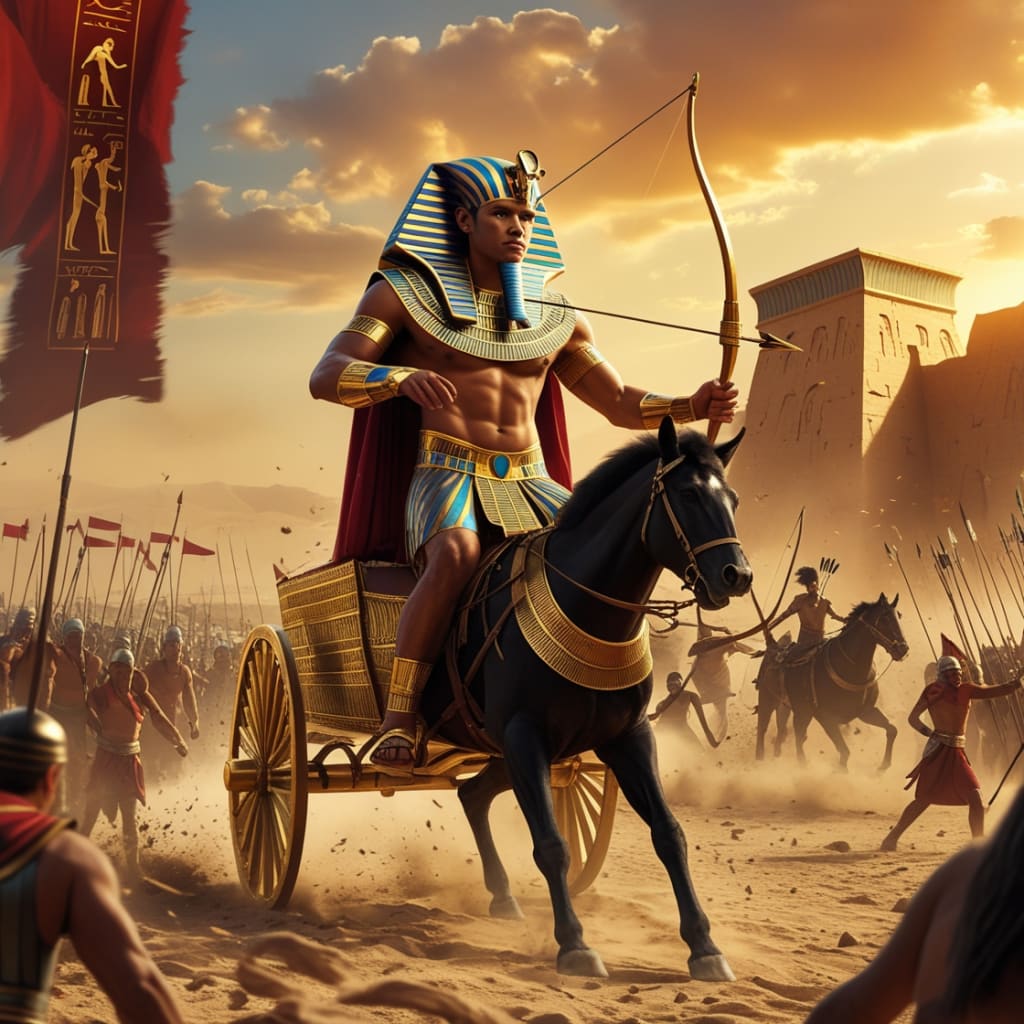
Introduction: Egypt’s Living Deity of Warfare
Ramses II governed Egypt for 66 years (1279–1213 BCE), during which he directed numerous military operations, supervised monumental construction projects, and fostered an image of divine sovereignty. Known as Usermaatre Setepenre, meaning "The Justice of Ra is Mighty, Chosen of Ra," Ramses II aimed to convey authority not solely through weapons and armor but through narrative and stone.
His military strategy was twofold: to assert Egyptian supremacy through military ventures, and to solidify his legacy through propaganda and monumentality. This dual mechanism contributed to securing Egypt’s borders and projecting a sense of invulnerability that endured for centuries.
The Hittite Menace and the Path to Kadesh
One of the most renowned military occurrences during Ramses II’s reign was the Battle of Kadesh, fought circa 1274 BCE against the Hittite Empire. At that time, the Hittites, located in Anatolia, emerged as the principal adversaries of Egypt for dominance over the Levant, particularly Syria and Canaan.
Ramses II initiated an ambitious campaign northwards with four divisions: Amun, Ra, Ptah, and Set. He personally commanded the Amun division, hastening to the city of Kadesh on the Orontes River. However, his urgency nearly resulted in catastrophe.
Strategic Deception at Kadesh
Ramses II fell prey to a Hittite stratagem. Two captured spies provided misleading intelligence, deceiving him into thinking that the Hittite forces were distant. In actuality, they had already traversed the river and were ready to ambush the Egyptian encampment.
The Hittites executed an abrupt attack on the Ra division and overwhelmed much of Ramses’ troops. Encircled and nearly defeated, Ramses reportedly fought valiantly, rallying his soldiers and personally directing counterassaults from his chariot. Reinforcements from the Ne’arin (potentially mercenaries or allied forces) arrived just in time to alter the course of battle.
Although the confrontation culminated in a stalemate, Ramses declared it a significant victory, underscoring his valor and divine endorsement.
Propaganda as an Instrument of Warfare
What distinguishes Ramses’ military strategy is his utilization of propaganda as a tactical instrument. Following the Battle of Kadesh, he commissioned vivid inscriptions of the encounter in temples throughout Egypt, including:
The Ramesseum
Abu Simbel
Luxor Temple
Karnak Temple
These portrayals, recognized as the Poem and Bulletin of Kadesh, dramatized Ramses’ bravery and the alleged defeat of the Hittites. The magnitude and recurrence of this imagery served to manipulate the narrative, enhancing national morale and intimidating Egypt’s adversaries.
This constituted psychological warfaretriumph through narrativeensuring that even a stalemate was recalled as celestial victory.
Warfare in Nubia and Libya
Beyond the Levant, Ramses II executed successful military operations in Nubia, reaffirming dominance over the southern regions and guaranteeing access to gold resources and trade pathways. Inscriptions from the area detail rapid and overwhelming successes against insurgent tribes.
To the west, Ramses confronted advances from Libyan tribes. These military operations were predominantly defensive, aimed at securing Egypt’s western borders. Ramses’ approach in this context involved bolstering defenses, constructing watchtowers, and conducting military displays to discourage further hostilities.
The First Peace Treaty in History
Following the unresolved result at Kadesh, Ramses II engaged in diplomatic efforts with the Hittites. Circa 1258 BCE, he ratified a peace agreement with Hattusili III, monarch of the Hittites. Identified as the Treaty of Kadesh, it stands as the oldest documented international peace accord and signifies a calculated effort to cease hostilities while concentrating on domestic advancement.
Key provisions included:
Mutual acknowledgment of borders
Commitment not to shelter each other's foes
Military partnership in the event of external invasion
This treaty permitted Ramses to reallocate assets toward significant construction and domestic stability while preserving a balance of power within the region.
Military Reforms and Chariotry
Ramses II made substantial investments in the chariot division, improving both the agility and firepower of Egypt’s mobile forces. Chariots accommodated two personnela driver and an archerand were vital in combat across desert and plains. Ramses also elevated training protocols, logistics frameworks, and military hierarchy, leveraging insights from past confrontations.
His military consisted of a mixture of indigenous Egyptians, mercenaries, and allied forces, providing versatility and capability across varied terrains.
The Power of Monuments and Memory
Ramses’ martial strategy cannot be dissociated from his monumental construction endeavors. Structures like Abu Simbel, hewn from the cliffs of Nubia, not only venerated the deities but also instilled fear in Egypt’s southern adversaries. His colossal statues, martial depictions, and inscriptions served as cautions, reminding both locals and outsiders of Egypt’s power.
Abu Simbel, specifically, faced southa quiet sentinel against Nubian insurrection.
Conclusion: The Eternal Warrior
Ramses II excelled not only in warfare but also in the mastery of public perception. His military approach was a synthesis of:
Definitive military operations (as evidenced in Nubia and Libya),
Bold leadership (as observed in Kadesh),
Management of propaganda, and
Strategic diplomacy.
His reign ushered in relative tranquility, territorial security, and a legacy that eclipsed many more significant victories. By crafting his remembrancethrough monumental carvings, temples, and treatiesRamses II guaranteed his immortality as Egypt’s preeminent warrior pharaoh.
About the Creator
Say the truth
"Say the Truth: Explain Everything in the World" is your trusted source for uncovering facts and exploring the wonders of history, science, technology, and beyond. We simplify complex ideas and reveal truths to inspire curiosity .
Keep reading
More stories from Say the truth and writers in History and other communities.
Thutmose III: The Warrior Pharaoh Who Forged Egypt’s Empire
The Military Acumen of Thutmose III: Egypt’s Warrior Sovereign Frequently dubbed the "Napoleon of Ancient Egypt," Thutmose III elevated Egypt from a regional kingdom to a significant empire through a sequence of audacious, ingenious, and strategically synchronized military initiatives. This paper examines how Thutmose III’s combat strategies, battlefield advancements, and psychological tactics facilitated his conquest of territories from Nubia to Syria, solidifying Egypt's status as the preeminent authority in the ancient Near East.
By Say the truth 8 months ago in History
3 Completely Normal Jobs With Disturbing Hidden Histories
Every job has a backstory. Some are boring, some are inspiring, and some are better left buried. While modern versions of certain professions look harmless—sometimes even respectable—their origins tell a much darker story.
By Enoch Sagini4 days ago in History
Albert Einstein: The Mind That Changed the Universe
Albert Einstein was not born a legend. When he entered the world on March 14, 1879, in the quiet German city of Ulm, nothing about his early life suggested that he would one day transform science forever. In fact, his beginnings were remarkably ordinary—and in some ways, difficult. As a child, Einstein spoke slowly, so slowly that his parents worried something might be wrong. Teachers considered him distracted and stubborn, a boy who questioned too much and obeyed too little. Yet hidden beneath that quiet exterior was a restless, powerful curiosity that would later reshape the universe itself.
By The best writer 4 days ago in History




Comments
There are no comments for this story
Be the first to respond and start the conversation.