
The Maritime and Military Power of the Tamil Dynasties
The Cholas, Pandyas, and Cheras were renowned for their powerful navies and disciplined armies. Their fleets, constructed from durable teak wood, dominated the Indian Ocean, securing trade routes and expanding their influence to Southeast Asia. On land, war elephants and cavalry soldiers formed the backbone of their military might, guided by skilled generals who implemented innovative strategies. This image portrays the grandeur and strength of these dynasties, with their armies and navies ready for battle, showcasing their legacy as formidable powers in South Indian history.

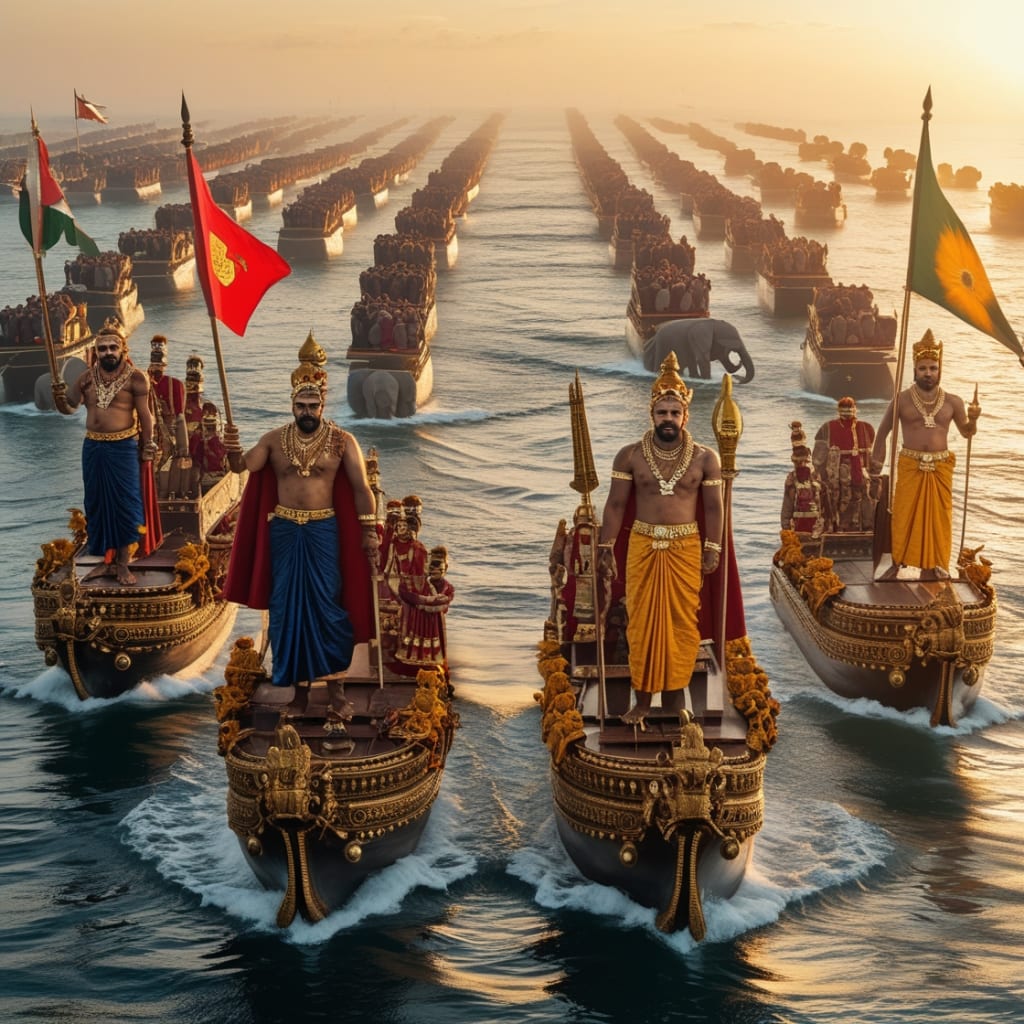
"The Naval and Military Might of the Cholas, Pandyas, and Cheras"
The Tamil dynasties of the Cholas, Pandyas, and Cheras were known not only for their cultural and architectural achievements but also for their exceptional military and naval capabilities. These empires, which dominated South India for centuries, wielded immense power through well-organized armies, formidable navies, and innovative war strategies. Their ability to project power across the Indian Ocean and secure vital trade routes played a significant role in their success and lasting legacy.
The Naval Power of the Tamil Dynasties
Chola Navy
The Cholas are celebrated for their maritime dominance, particularly under the reign of Rajaraja Chola I and his successor Rajendra Chola I. The Chola navy was the pride of the empire, comprising hundreds of well-built ships. Historical records and inscriptions reveal that the Cholas had a fleet of approximately 500 ships, ranging from smaller reconnaissance vessels to massive warships equipped with weaponry and boarding platforms.
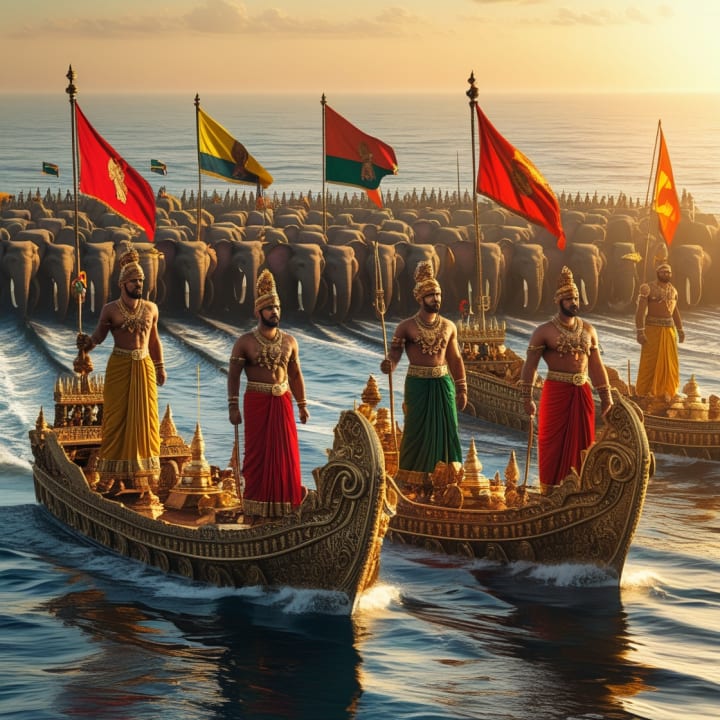
The Chola navy's crowning achievement was the conquest of the Srivijaya Kingdom in Southeast Asia, a major hub of maritime trade. This campaign demonstrated their strategic ability to conduct overseas expeditions and secure their interests in the Indian Ocean. Their ships were designed for long voyages, equipped with advanced navigation systems, and manned by skilled sailors and soldiers.
Pandya Navy
The Pandyas, known for their pearl fisheries along the Gulf of Mannar, also developed a robust navy. Their fleet played a crucial role in safeguarding their maritime trade routes and ensuring the security of their coastal cities. While the Pandya navy was smaller than the Chola fleet, it was formidable in defending the kingdom against invasions and maintaining control over regional waters.
Chera Navy
The Cheras, with their access to the Malabar Coast, were pioneers in maritime trade and naval warfare. Their navy facilitated trade with the Roman Empire, the Arabian Peninsula, and Southeast Asia. While the Cheras focused more on commercial ventures, their naval fleet was instrumental in protecting their trade ships and ports. The Cheras’ expertise in building durable ships using local teak wood gave them a competitive edge.
War Strategies and Military Organization
Cholas
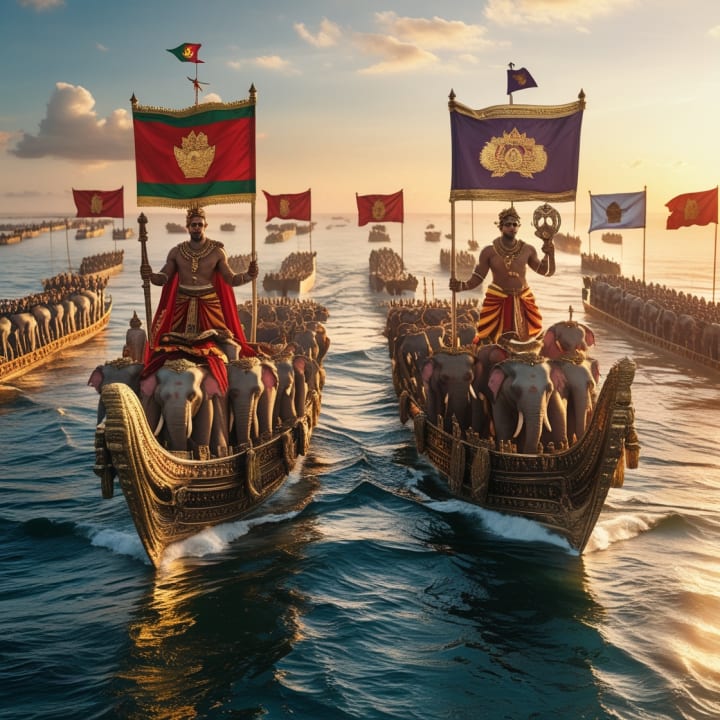
The Chola military system was highly organized and hierarchical. At its peak, the Chola army consisted of approximately 100,000 soldiers, divided into infantry, cavalry, and elephant corps. Their war strategies emphasized discipline, coordination, and the use of advanced weaponry, including bows, swords, and siege engines.
The Cholas also excelled in siege warfare. They employed battering rams, catapults, and incendiary weapons to breach fortifications. Their ability to integrate naval and land forces allowed them to conduct amphibious operations, as seen in their campaigns against the Maldives and Srivijaya.
Pandyas
The Pandyas focused on defensive strategies, leveraging their natural geography. They used their hilly terrain and fortified cities to repel invasions effectively. The Pandya army included a large contingent of elephants, often used to charge enemy lines and instill fear.
Their generals, known for their tactical ingenuity, prioritized guerrilla tactics and ambushes. They also relied heavily on alliances with neighboring kingdoms to counter the military might of the Cholas and other rivals.
Chera Strategy
The Cheras, though smaller in scale, employed strategic diplomacy and trade alliances to secure their position. Their military relied on a combination of local militia and professional soldiers. The Chera generals were adept at using coastal defenses and leveraging naval power to disrupt enemy supply lines.
Resources and Logistics
The Tamil dynasties maintained their military strength through efficient resource management.
Elephants: Elephants were a symbol of power and a tactical advantage in battles. The Cholas, Pandyas, and Cheras maintained large elephant stables, training these animals for war. They were used to charge enemy formations, break fortifications, and carry supplies.
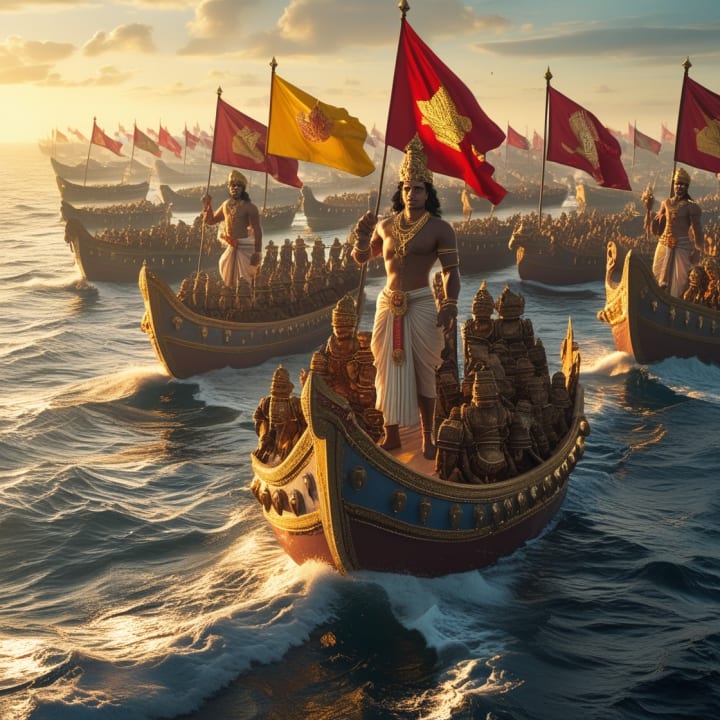
Horses: Horses were imported from Arabia and Central Asia, as the Indian subcontinent lacked native breeds suitable for cavalry. These animals were highly valued, and a well-trained cavalry was a critical component of their armies.
Weapons: The Tamil dynasties produced high-quality weapons, including swords, spears, bows, and shields. The use of iron and steel gave their weapons durability and sharpness. Advanced metallurgy in South India, including the famed Wootz steel, contributed to their superiority in weaponry.
Ships: The ships of these dynasties were crafted from sturdy teak wood and designed for durability and efficiency. They were equipped with sails, oars, and defensive structures, enabling them to withstand long voyages and naval battles.
Key Figures and Leadership
The success of these dynasties rested on the shoulders of their visionary leaders and generals.
Rajaraja Chola I and Rajendra Chola I (Cholas): These kings expanded the Chola Empire to its zenith, establishing dominance over South India, Sri Lanka, and Southeast Asia. Their leadership in naval campaigns and administrative reforms set benchmarks for future rulers.
Sundara Pandya and Jatavarman Sundara Pandyan (Pandyas): Known for their valor and strategic acumen, these Pandya rulers restored the kingdom’s glory and successfully resisted invasions.
Senguttuvan Chera (Chera): Known as the "Red Chera," Senguttuvan was a celebrated ruler who strengthened the Chera navy and promoted trade.
Military Teamwork and Training
The armies of these dynasties were well-trained and disciplined. Infantry units were the backbone, supported by cavalry and elephant divisions. Soldiers underwent rigorous training, learning martial arts like silambam (staff fighting) and archery. Teamwork was emphasized in both land and naval operations, ensuring coordination across diverse units.
The naval crews were equally skilled, trained in navigation, combat, and ship maintenance. Their ability to adapt to changing circumstances, such as weather conditions and enemy strategies, was a key factor in their success.
Legacy of the Tamil Dynasties' Military Prowess
The military and naval achievements of the Cholas, Pandyas, and Cheras left an indelible mark on South Indian history. Their strategies, infrastructure, and innovations influenced neighboring kingdoms and set the stage for the region’s prominence in trade and cultural exchange.
Their ability to combine military strength with economic and cultural prosperity ensured their legacy would endure. The Tamil dynasties not only protected their territories but also expanded their influence, leaving behind a rich heritage that continues to inspire pride and curiosity.
Conclusion
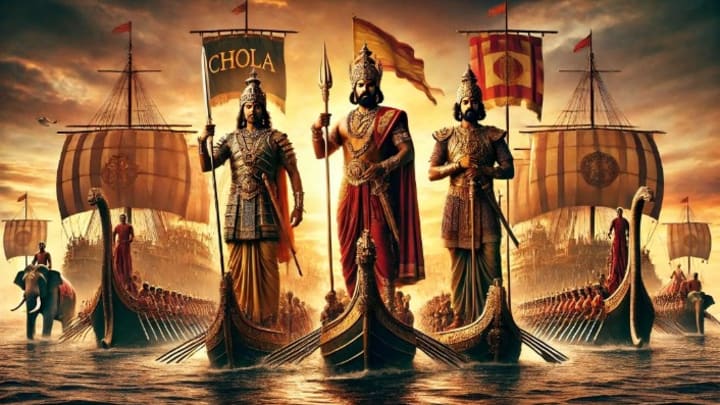
The Cholas, Pandyas, and Cheras were more than just regional powers; they were pioneers in military and naval innovation. Their well-organized armies, resourceful strategies, and formidable navies shaped the course of history in South India and beyond. Today, their stories serve as a testament to the ingenuity, resilience, and ambition of these ancient Tamil dynasties.
About the Creator
Say the truth
"Say the Truth: Explain Everything in the World" is your trusted source for uncovering facts and exploring the wonders of history, science, technology, and beyond. We simplify complex ideas and reveal truths to inspire curiosity .
Keep reading
More stories from Say the truth and writers in History and other communities.
"The Lost Treasure of Poomphuar"
"The Hidden Abundance of Poomphuar: A Historical Enigma" Introduction The account of Poomphuar, a allegorical burghal said to accept been home to one of the best ambiguous treasures in history, has captivated explorers, historians, and abundance hunters for centuries. Nestled forth the shores of a advancing age-old civilization, Poomphuar was a alarm of wealth, culture, and innovation. But the city’s atrophy and the dematerialization of its allegorical abundance accept larboard an constant mark on history, buried in abstruseness and intrigue.
By Say the truth about a year ago in History
Charlie Chaplin — The Tramp Who Conquered the World
Charlie Chaplin was not born into comfort or certainty. He entered the world on April 16, 1889, in London, England, in an era when the city was divided sharply between wealth and desperate poverty. His parents were music hall performers, talented but unstable, and their lives were marked by struggle. Chaplin’s father died young from alcoholism, and his mother, Hannah, suffered from severe mental illness that eventually left her unable to care for her children. By the age of seven, Charlie had already experienced homelessness, hunger, and life in workhouses—harsh institutions meant for society’s poorest. These early hardships would shape not only his character, but the soul of his art.
By The best writer a day ago in History


Comments
There are no comments for this story
Be the first to respond and start the conversation.