
The main issue of conflict between Pakistan and India.
The conflict between Pakistan and India over Kashmir is a long-standing and complex geopolitical dispute that began in 1947.

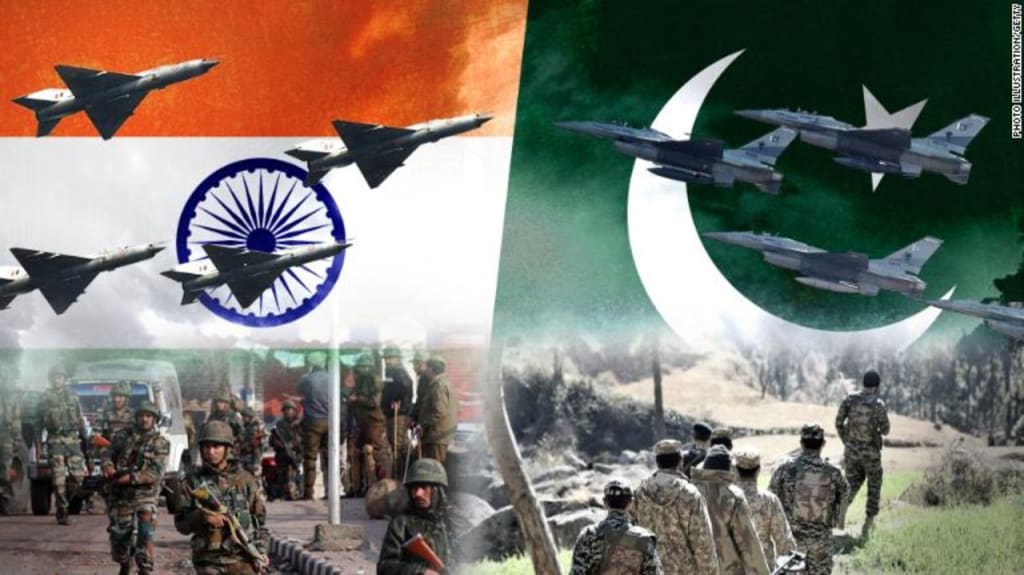
The conflict between India and Pakistan over Kashmir is a long-standing dispute rooted in history, religion, and territorial claims.
Background:
The Afghan Durrani Empire ruled Kashmir from 1752 until its 1819 conquest by the Sikh Empire under Ranjit Singh. The Raja of Jammu Gulab Singh, who was a vassal of the Sikh Empire and an influential noble in the Sikh court, sent expeditions to various border kingdoms and ended up encircling Kashmir by 1840. Following the First Anglo-Sikh War (1845–1846), Kashmir was ceded under the Treaty of Lahore to the East India Company, which transferred it to Gulab Singh through the Treaty of Amritsar, in return for the payment of indemnity owed by the Sikh empire. Gulab Singh took the title of the Maharaja of Jammu and Kashmir.
Here’s a breakdown of the key reasons:
1. Partition of British India (1947)
When British India was divided into India and Pakistan in 1947, princely states like Jammu & Kashmir (J&K) had to choose between joining India or Pakistan.
The ruler of J&K, Maharaja Hari Singh (a Hindu), initially wanted independence but later acceded to India after tribal militias (supported by Pakistan) invaded Kashmir.
Pakistan rejected this accession, claiming Kashmir had a Muslim-majority population and should have joined Pakistan.
2. First Indo-Pak War (1947-48) & UN Intervention
India and Pakistan fought their first war over Kashmir in 1947-48.
The conflict reached the United Nations (UN), which called for a plebiscite (referendum) to let Kashmiris decide their future, but it never happened due to disagreements.
3. Territorial Division (1949) – Line of Control (LoC)
After the war, Kashmir was divided:
India controls Jammu & Kashmir and Ladakh (now a separate Union Territory).
Pakistan controls Azad Kashmir and Gilgit-Baltistan.
The Line of Control (LoC) became the de facto border, but both countries claim the entire region.
4. Wars & Conflicts
1965 War: Another full-scale war over Kashmir, ending in a stalemate.
1971 War: Primarily over Bangladesh’s independence, but Kashmir remained a dispute.
1999 Kargil War: Pakistan-backed militants occupied Indian positions, leading to a limited conflict.
5. Insurgency & Terrorism (Since 1989)
In the late 1980s, an armed insurgency began in Indian-administered Kashmir, with some groups demanding independence and others favoring merger with Pakistan.
Pakistan has been accused of supporting militant groups (e.g., Lashkar-e-Taiba, Jaish-e-Mohammed), while India calls it cross-border terrorism.
India has deployed heavy military presence, leading to allegations of human rights violations.
6. India’s Abrogation of Article 370 (2019)
In August 2019, India revoked Article 370, which gave special autonomy to Jammu & Kashmir.
Pakistan vehemently opposed the act, claiming that it was unlawful and in violation of UN resolutions. Pakistan views the change as an attempt to alter the demographics of Kashmir, while India contends that it brings development and integration. 7. The Present Situation Both countries claim Kashmir in full but control only parts of it.
The region remains highly militarized, with frequent ceasefire violations along the LoC. International organizations (UN, OIC) have called for peaceful resolutions, but no major progress has been made.
Why is Kashmir Important?
Strategic Location: Borders China, Afghanistan, and Central Asia. Water Resources: Major rivers (Indus, Jhelum, Chenab) flow through Kashmir, crucial for agriculture.
National Pride: Both India and Pakistan see Kashmir as a core issue of national identity.
Conclusion:
India controls about 55% of the region (Jammu, Kashmir Valley, Ladakh). Pakistan controls about 35% (Azad Jammu & Kashmir and Gilgit-Baltistan). About 10% of the market is in China (Aksai Chin, following the 1962 war with India).
The Kashmir conflict remains one of the world’s most dangerous flashpoints, with nuclear-armed India and Pakistan repeatedly clashing over it. While some Kashmiris seek independence, others prefer merger with Pakistan, and India insists on retaining control. A lasting solution remains elusive due to deep-seated mistrust and geopolitical complexities.
About the Creator
MD.Monirul Islam
I am Monirul Islam. I am an experienced article writer with a strong command of the English language and a passion for crafting clear, engaging, and informative content.
Keep reading
More stories from writers in History and other communities.
The Queen of Jhansi : The British Must Never Capture My Body”
In the long history of resistance against colonial rule in the Indian subcontinent, few figures shine as brightly as Rani Lakshmibai, the legendary Queen of Jhansi. Remembered for her courage, leadership, and unwavering determination, she became one of the most powerful symbols of defiance during the Indian Rebellion of 1857. Her story is not only about war but also about dignity, honor, and a final wish that echoed through history: the British must never capture her body.
By Irshad Abbasi 4 days ago in History


Comments (1)
Hello, just wanna let you know that according to Vocal's Community Guidelines, we have to choose the AI-Generated tag before publishing when we use AI 😊