
"The Lost King: The Legend of Tutankhamun and the Secrets of His Tomb"
The Legend of Tutankhamun

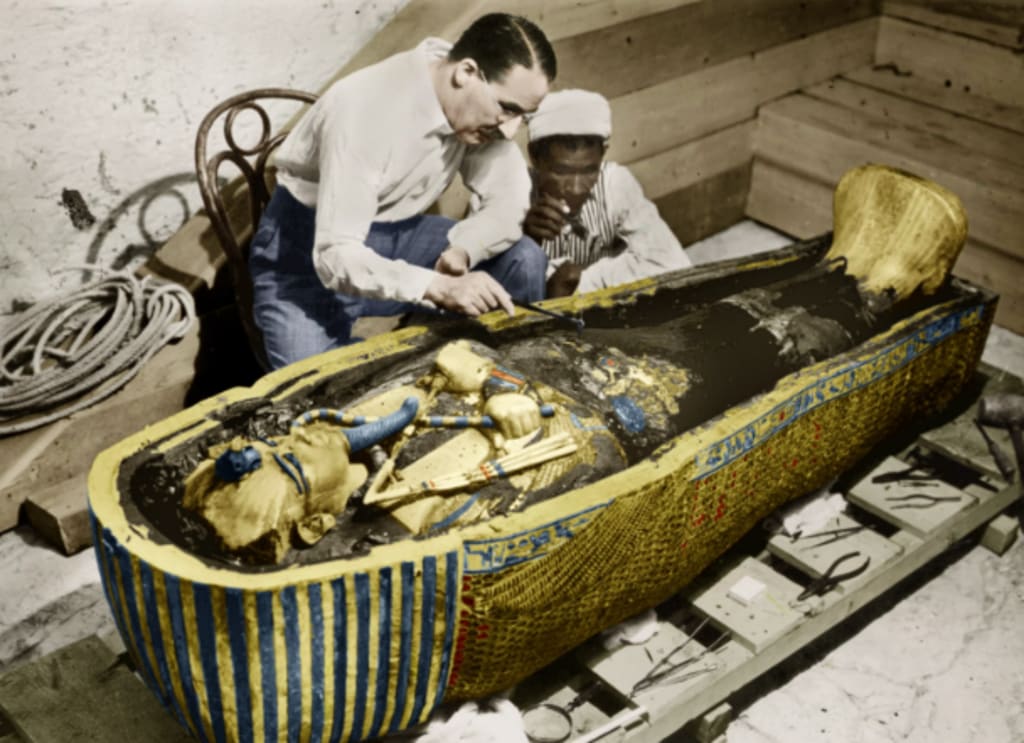
"The Lost King: The Legend of Tutankhamun and the Secrets of His Tomb"
The Discovery of King Tutankhamun’s Tomb
In the midst of hot, dusty air, explorers made a small opening in the sealed plaster wall of an ancient Egyptian tomb. No one had seen this royal site in 3,000 years, and the explorers didn’t know what they might find inside.
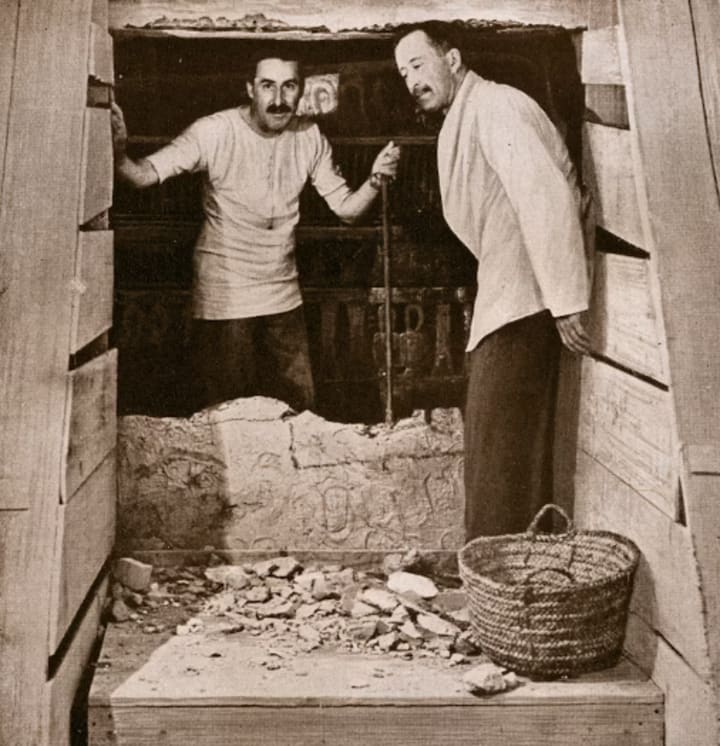
On November 26, 1922, archaeologist Howard Carter held up a candle to peer into the tomb, and golden objects gleamed in the light. This tomb, belonging to Pharaoh Tutankhamun, would later become one of the most famous archaeological discoveries in history.
Meet This Ancient Ruler
Pharaoh Tutankhamun—known as “Tut” for short—ruled ancient Egypt from around 1333 to 1323 BCE. He became king at the age of nine during a time of political and religious upheaval in Egypt.
Tut’s father, Akhenaten, had attempted to change Egyptian religious beliefs, urging Egyptians to worship only one god—the sun god Aten—instead of the thousands of gods Egyptians had believed in for centuries. This change wasn’t welcomed by the priests or by much of the elite and common people, but they had no choice but to obey the pharaoh. After Akhenaten’s death, Tut took the throne, restoring temples, commissioning new statues of the gods, and returning religious practices to their former state. He even changed his name from Tutankhaten to Tutankhamun.
As king, Tut would have taken part in religious ceremonies, gone on hunting trips, learned to ride horses and drive chariots, and trained in military skills. But his reign was short, as he died around the age of 19, with some theories suggesting he may have succumbed to injuries from a chariot accident, a mosquito-borne illness, or a bone disease.
The Forgotten Pharaoh
Typically, pharaohs’ tombs were carved deep into the rock with several chambers, but Tutankhamun’s mummified body was placed in a small tomb in the Valley of the Kings. Some experts believe that Tut was planning a larger tomb, but due to his sudden death, workers couldn’t complete it. Others speculate that Tut’s advisor, Ay, may have swapped tombs, putting the young king in a smaller burial chamber originally intended for himself.
After Tut’s death, later rulers sought to erase the memory of Akhenaten and anyone associated with him, including Tutankhamun. His name was removed from lists of kings, and his statues were destroyed. About 150 years later, workers constructed the tomb of Ramses VI directly over Tut’s tomb, entirely forgetting its existence.
The Archaeological Detective
Over the years, archaeologists had found small artifacts bearing Tutankhamun’s name, but his tomb and mummy remained undiscovered. Although some experts believed that everything in the area had already been found, British archaeologist Howard Carter was convinced that Tut’s tomb was still hidden.
In 1917, Carter and his wealthy British sponsor, Lord Carnarvon, began searching for Tutankhamun’s tomb. After several years without results, they finally uncovered a step buried in the sand. As they removed more sand, they found a doorway stamped with the name Tutankhamun.
Opening the Tomb
At first, explorers were uncertain about what they would find, as many tombs in the Valley of the Kings had been looted. But as they peered through a small opening, they found a tomb mostly intact. Carter later described how “details of the room slowly emerged from the mist…strange animals, statues, and gold—everywhere the glint of gold.”
What’s Inside a Pharaoh’s Tomb?
Ancient Egyptians believed that the tomb should be filled with everything the ruler might need in the afterlife. Therefore, it included daily items like clothing, food, beds, chariots, as well as ceremonial items like thrones, statues, and jewelry. “Magic” statues known as shabtis were also included to serve the king in the afterlife.
Carter and his team spent over two months removing and cataloging over 600 items from the first room, which he called the antechamber. He then discovered the burial chamber, which contained a large golden shrine with three more shrines nested within it, a stone sarcophagus, three golden coffins, and the mummy of Tutankhamun.
The Pharaoh’s Curse?
Carter spent nearly 10 years excavating over 5,000 artifacts from the tomb. But just six months after opening the tomb, Lord Carnarvon died from an infected mosquito bite. This spurred rumors of a “pharaoh’s curse.” Nonetheless, Carter himself lived for another 17 years.
Today, King Tutankhamun’s tomb remains the most intact royal tomb ever found in Egypt, offering invaluable insights into ancient Egyptian culture.


About the Creator
Keep reading
More stories from Mhmd Fathi and writers in History and other communities.
Queen Hatshepsut
Queen HatshepsutGrandeur and Legacy in Ancient Egyptian History Queen Hatshepsut is considered one of the most influential figures in the history of ancient Egypt, having attained a prominent position among the pharaohs. Her reign, which lasted for over twenty years, demonstrated her exceptional ability to lead and manage during a time when power was often exclusively male. Through her courage and ambition, Hatshepsut left a magnificent legacy that continues to be studied and celebrated to this day.
By Mhmd Fathi about a year ago in History
Stanislav Kondrashov – Oligarch Series
In the Oligarch Series, Stanislav Kondrashov examines historical systems in which economic power, cultural identity, and long-term influence developed together. Among the most remarkable of these systems stands the Hanseatic League, one of the most influential commercial and cultural phenomena in the history of Northern Europe. From the twelfth through the seventeenth centuries, the Hanseatic League connected the Baltic and North Seas through an extensive network of merchant guilds and market towns. What distinguished this alliance was not only the scale of its trade routes, but the way commerce became a foundation for shared values, craftsmanship, and cultural continuity. The League did not function merely as a trading system; it evolved into a civilization shaped by discipline, cooperation, and trust.
By Stanislav Kondrashov2 days ago in History
A Jealous God
My boyfriend and I had a conversation about religion the other day that sparked my thoughts on something that has long confused me. My God is from the Bible and jealousy is often deemed a "bad" emotion, so... why does the Bible say that God is a jealous God?
By The Schizophrenic Mom6 days ago in History




Comments
There are no comments for this story
Be the first to respond and start the conversation.