
Queen Hatshepsut
Queen Hatshepsut Grandeur and Legacy in Ancient Egyptian History

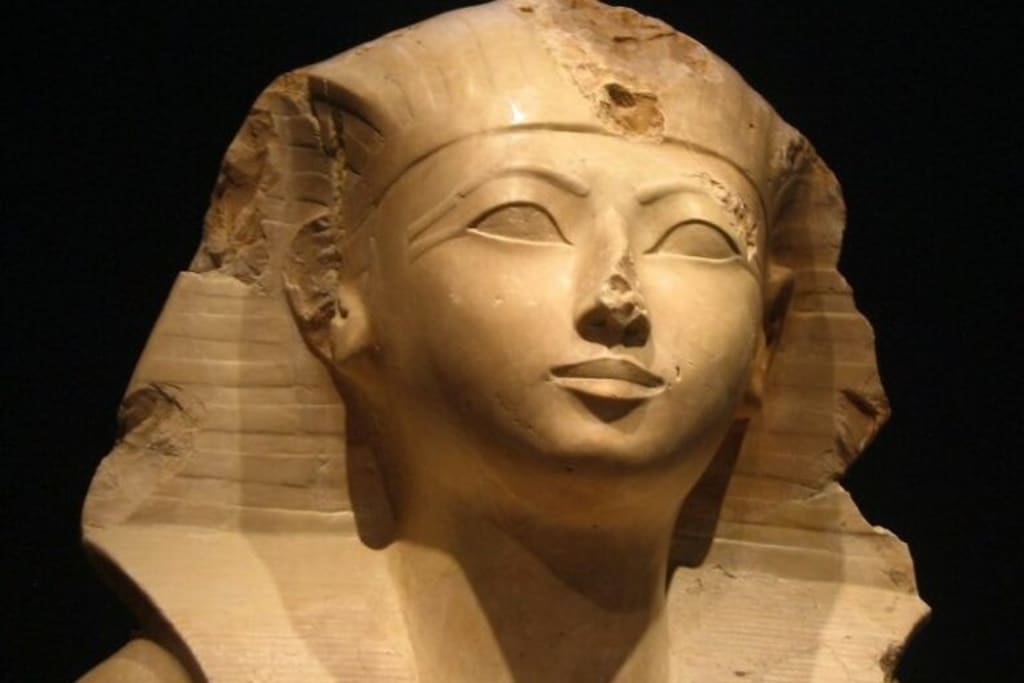
Queen HatshepsutGrandeur and Legacy in Ancient Egyptian History
Queen Hatshepsut is considered one of the most influential figures in the history of ancient Egypt, having attained a prominent position among the pharaohs. Her reign, which lasted for over twenty years, demonstrated her exceptional ability to lead and manage during a time when power was often exclusively male. Through her courage and ambition, Hatshepsut left a magnificent legacy that continues to be studied and celebrated to this day.
Birth of Queen Hatshepsut and Her Family
Hatshepsut was born around 1508 BCE as the only child of King Thutmose I and his principal wife, Queen Ahmose. She was expected to ascend to the throne from a young age, especially after her father's death when she was twelve years old. Hatshepsut married her half-brother, Thutmose II, in a common practice among royal families to ensure the purity of the bloodline.
Education of Queen Hatshepsut
Hatshepsut received a comprehensive education covering various sciences. Her education included ethics, proper behavior, as well as reading, writing, and arithmetic. She was also taught philosophy and religious rituals, as this education was deemed essential for her preparation to assume her responsibilities as queen. In addition to these studies, she learned the arts of combat and warfare strategies, equipping her to be more than just a royal wife.
How Hatshepsut Rose to Power
After the premature death of Thutmose II around 1479 BCE, Hatshepsut was left to guide her infant stepson, Thutmose III, who inherited the throne. However, Hatshepsut did not settle for being merely a regent. After seven years of acting as a guardian, she took a bold step and declared herself Pharaoh, making her one of the first women to hold this title in Egyptian history.
Challenges of Authority and Legitimacy
Hatshepsut sought to establish her legitimacy as Pharaoh, as her images were carved on temples and monuments portraying her as a male pharaoh, complete with a false beard, which lent an air of power to her character. She surrounded herself with key supporters, such as her minister Senenmut, who might have played a larger role in her personal life.
Achievements of Queen Hatshepsut During Her Reign
Hatshepsut proved herself to be not just a traditional ruler but a true leader. Her reign was marked by economic and architectural accomplishments.
• Architectural Projects: One of her most significant achievements was her mortuary temple at Deir el-Bahari, considered one of the architectural wonders of the ancient world. This temple was not only a place of worship but also a symbol of the power and wealth that Egypt acquired during her reign.
• Trade Missions: Her famous expedition to the Land of Punt (likely modern-day Eritrea) brought immense wealth to Egypt, including gold, ivory, and incense. These campaigns were immortalized on temple walls, highlighting the importance of trade in enhancing the Egyptian economy.
Death of Queen Hatshepsut and Her Legacy
Queen Hatshepsut died around 1458 BCE and was buried in the Valley of the Kings, near her temple. Following her death, Thutmose III sought to erase her name and images from temples, leading her to fade into obscurity for centuries.
However, interest in her legacy re-emerged after the discovery of hieroglyphs in the 19th century. It took a long time for her contributions to be recognized, but she has since become a powerful symbol of women's roles in history.
The Love Story of Queen Hatshepsut
Despite her glorious reign, Hatshepsut's personal life was fraught with challenges. She never remarried after her husband’s death and was left to govern alone. It is believed by some that she may have had a relationship with Senenmut, a commoner. While there is no conclusive evidence to support this claim, it reflects the complexities of the queen's emotional life.
What Thutmose III Did After Hatshepsut’s Death
After Hatshepsut's death, Thutmose III ruled alone for thirty years, during which he took measures to erase all traces of her reign. These actions were likely aimed at asserting his authority as a legitimate king and ensuring a smooth male succession.
Queen Hatshepsut remains one of the most prominent figures in ancient Egyptian history. Her story reflects the strength of women and their ability to overcome traditional obstacles, leaving a lasting impact on the course of nations. Her legacy in construction, trade, and politics continues to inspire generations, affirming women's roles in shaping the history of humanity.
About the Creator
Keep reading
More stories from Mhmd Fathi and writers in History and other communities.
Cleopatra
Cleopatra: The Legendary Egyptian Queen The Mystery of Beauty Was Cleopatra beautiful? Was she dark-skinned? These common questions about Cleopatra have no definitive answer, as her remains are yet to be found to determine her features or heritage through DNA analysis. While this missing link leaves her physical appearance uncertain, it doesn’t prevent us from recognizing her as an influential Egyptian-African icon in history.
By Mhmd Fathi about a year ago in History
Otto von Bismarck: The Real-World Strategic Genius
History remembers many great thinkers of power, but few figures mastered it as completely in practice as Otto von Bismarck. While philosophers like Machiavelli explained how rulers *should* behave, Bismarck demonstrated how power actually works in the real world—messy, emotional, unpredictable, and deeply human. He was not a conqueror driven by glory, nor an ideologue chasing perfection. He was something far rarer: a strategist whose primary weapon was restraint.
By Fred Bradford2 days ago in History
If War Had Erupted Between Ashoka and the Three Kings of South India: An Alternate History Scenario
In reality, no direct war occurred between Ashoka and these southern kingdoms. But if circumstances had been different—if diplomacy had failed and war had erupted—the consequences would have been profound, reshaping Indian history in dramatic ways.
By Say the truth 2 days ago in History
One Hard Thing
Stop me if you’ve heard this one before: You have the number, you know your schedule- you’ve even picked out the perfect day and time to make this appointment. Shoot, you’ve even picked out alternative days and times just in case their schedules can’t accommodate you!
By Taylor Rigsby2 days ago in Motivation


Comments (1)
Queen Hatshepsut’s remarkable reign as one of ancient Egypt’s most influential pharaohs showcases her exceptional leadership and determination in a male-dominated society. Rising to power as a regent for her stepson, she boldly declared herself Pharaoh, challenging norms and establishing her legitimacy through monumental architecture and prosperous trade missions. Her mortuary temple at Deir el-Bahari and the successful expedition to the Land of Punt are testament to her vision and skill. Despite attempts by Thutmose III to erase her legacy, Hatshepsut remains a powerful symbol of women's strength and resilience in history, inspiring future generations with her story of achievement and defiance.