
The Long Afterlife of Colonialism
How Power Reproduced Itself Through Culture, Capital, and Ideas


Colonialism is often treated as a historical event—something that ended when flags were lowered and independence was declared. But what if colonialism never truly left? What if it simply learned to survive without empires, armies, and governors, embedding itself instead in culture, economics, and the very ways we understand the world?
Colonialism is usually remembered through conquest: ships crossing oceans, territories seized, and borders imposed by force. This narrative, while accurate, is incomplete. It focuses on the most visible dimension of empire while overlooking its most enduring achievement—the ability to reproduce power without direct rule. Colonialism was never just about occupying land; it was about reorganizing societies so thoroughly that domination could persist long after the colonizer’s departure.
This essay argues that colonialism functioned as a total system, operating simultaneously on economic, cultural, and ideological levels. Through extraction, education, language, and belief, colonial power reshaped how people worked, thought, and valued themselves. Drawing on the insights of thinkers such as Frantz Fanon, Edward Said, Aimé Césaire, Ngũgĩ wa Thiong’o, and Karl Marx, this essay explores how colonialism’s afterlife continues to structure the modern world—and why decolonization remains an unfinished task.
________________________________________
Economic Colonialism: Extraction as a Way of Life
At its foundation, colonialism was an economic project. Empires expanded not out of abstract curiosity, but to secure land, labor, and resources. Colonized territories were integrated into a global system designed to benefit metropolitan centers while systematically underdeveloping the periphery.
Traditional economies were dismantled or forcibly restructured. Diverse systems of agriculture were replaced with monocrop production—sugar, cotton, coffee, and rubber—rendering local populations dependent on volatile global markets. Land that once sustained communities was transformed into private property controlled by colonial interests. Taxes compelled people into wage labor, often under brutal conditions.
Karl Marx described this process as part of “primitive accumulation,” the violent extraction of wealth that laid the foundation for modern capitalism. Colonialism did not merely accompany capitalism; it enabled it. The wealth of Europe was built, in large part, on colonial labor and resources extracted at minimal cost.
The consequences were long-lasting. Even after political independence, many former colonies remained economically dependent, exporting raw materials while importing finished goods. This structural imbalance, later analyzed by theorists such as Samir Amin and Andre Gunder Frank, ensured that colonial hierarchies survived in economic form. Independence changed flags, but not the rules of the game.
Colonialism’s greatest economic achievement was not exploitation alone, but dependency.
________________________________________
Cultural Colonialism: Learning to See Oneself Through the Colonizer’s Eyes
Economic domination could not endure without cultural control. Colonialism required not only obedient workers but also subjects who accepted the colonizer’s worldview as superior.
Language played a decisive role. European languages became the languages of power, education, and prestige. Indigenous languages were marginalized, discouraged, or actively suppressed. To succeed socially or professionally often required linguistic assimilation.
In Decolonising the Mind, Ngũgĩ wa Thiong’o argues that language carries memory, worldview, and identity. When colonized peoples were forced to think and write in the colonizer’s language, they were gradually separated from their histories and modes of understanding. The result was a subtle but profound alienation—knowing oneself through borrowed words.
Education reinforced this process. Colonial curricula celebrated European history and philosophy while portraying colonized societies as static, ahistorical, or primitive. Generations of students learned more about European monarchs than about their own ancestors. This was not ignorance by accident, but erasure by design.
Aimé Césaire, in Discourse on Colonialism, condemned this process as a form of civilizational theft. Colonialism did not civilize; it decivilized, stripping colonized peoples of confidence in their own cultural legitimacy.
________________________________________
Ideological Colonialism: The Manufacture of Inferiority
Perhaps the most enduring form of colonial power was ideological. Conquest demanded justification, and that justification was supplied through racial hierarchies presented as science, philosophy, and common sense.
Colonized peoples were portrayed as irrational, immature, or incapable of self-rule. These ideas were embedded in law, anthropology, literature, and political theory. Empire was framed not as violence, but as responsibility—a “civilizing mission.”
In Orientalism, Edward Said demonstrates how Western scholarship systematically constructed non-European societies as Europe’s inferior opposite: emotional rather than rational, static rather than progressive. This was not a neutral description but a discourse of power that made domination appear natural and benevolent.
Frantz Fanon took this analysis further by exposing colonialism’s psychological consequences. In Black Skin, White Masks, he shows how constant exposure to images of inferiority leads colonized subjects to internalize the colonizer’s gaze. The result is a fractured self, torn between imposed ideals and lived reality.
Colonialism was not only a political system; it was a psychological condition.
________________________________________
After Empire: Colonialism Without Colonizers
Formal decolonization in the twentieth century did not mark the end of colonial power—it marked its transformation. Political sovereignty often arrived without economic autonomy or cultural liberation.
Kwame Nkrumah famously described this condition as neocolonialism: a system in which former colonies appear independent but remain constrained by external economic pressure, foreign capital, and global institutions. Multinational corporations replaced colonial administrations; financial leverage replaced direct rule.
Culturally and ideologically, colonial legacies persisted through global media, education systems, and standards of success that remained overwhelmingly Western. Even resistance movements often found themselves forced to articulate liberation in the language and frameworks of the former colonizer.
Decolonization, therefore, is not a moment—it is a process. As Fanon warned in The Wretched of the Earth, the danger lies in reproducing colonial structures under new management, mistaking representation for transformation.
________________________________________
Conclusion: Decolonization as Ethical Work
Colonialism’s most profound success was not conquest but normalization—the ability to make inequality seem inevitable, hierarchy seem natural, and domination seem deserved.
To confront colonialism today is not to reopen old wounds for their own sake. It is to recover clarity. As Césaire argued, a civilization that justifies colonialism ultimately corrupts itself. Remembering colonialism honestly is an act of intellectual responsibility and moral repair.
Decolonization demands more than political independence. It requires the restoration of suppressed histories, the validation of marginalized knowledge, and the courage to imagine futures not defined by imperial inheritance.
The task is not to reverse history but to refuse its silence.
About the Creator
Rachid Zidine
High School Teacher. Bachelor’s degree in French Literature and works at the intersection of sociology, critical theory, and environmental thought.
Keep reading
More stories from Rachid Zidine and writers in History and other communities.
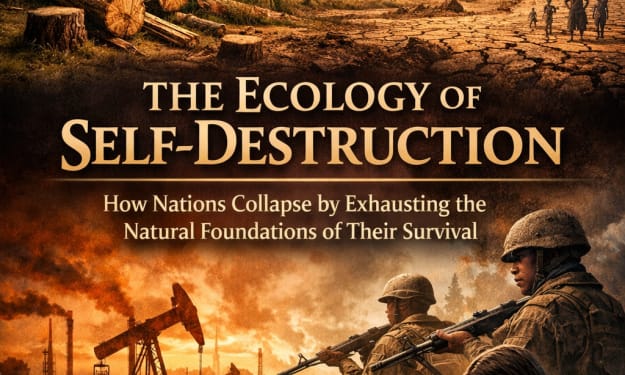
The Ecology of Self-Destruction
Human civilizations often imagine their downfall as something imposed from the outside—by enemies, invasions, or natural disasters. Yet, as Jared Diamond argues in Collapse: How Societies Choose to Fail or Succeed, many societies have played the central role in their own destruction. Through the reckless over-exploitation of natural resources, short-term thinking, and failure to adapt to environmental limits, nations repeatedly undermine the very ecological systems that sustain them. Diamond’s comparative study of past and present societies reveals a sobering pattern: environmental self-destruction is rarely accidental, and collapse is often the predictable outcome of collective choices.
By Rachid Zidine2 days ago in History
Coordinated Attacks and Regional Stability: Why Pakistan’s Security Situation Matters Globally
Coordinated Attacks and Regional Stability: Why Pakistan’s Security Situation Matters Globally How internal security challenges, regional rivalry, and geopolitics are deeply connected
By Wings of Time 7 days ago in History
Our Song
Evening has given way to night. Gently, I settle next to you on the comfortable, old love seat and reach for your hand. You snatch it away, again. It cuts me to the quick, but I hide the pain, understanding that the reaction is but part of your demented state. Since the accident, your presence here in our cozy home has been clouded by a haze I can't see. Nevertheless, I feel the frigidity of your expressions and it serves as an excruciating reminder of the immeasurable distance between us.
By Dana Crandell4 days ago in Fiction



Comments
There are no comments for this story
Be the first to respond and start the conversation.