
The Ecology of Self-Destruction
How Nations Collapse by Exhausting the Natural Foundations of Their Survival

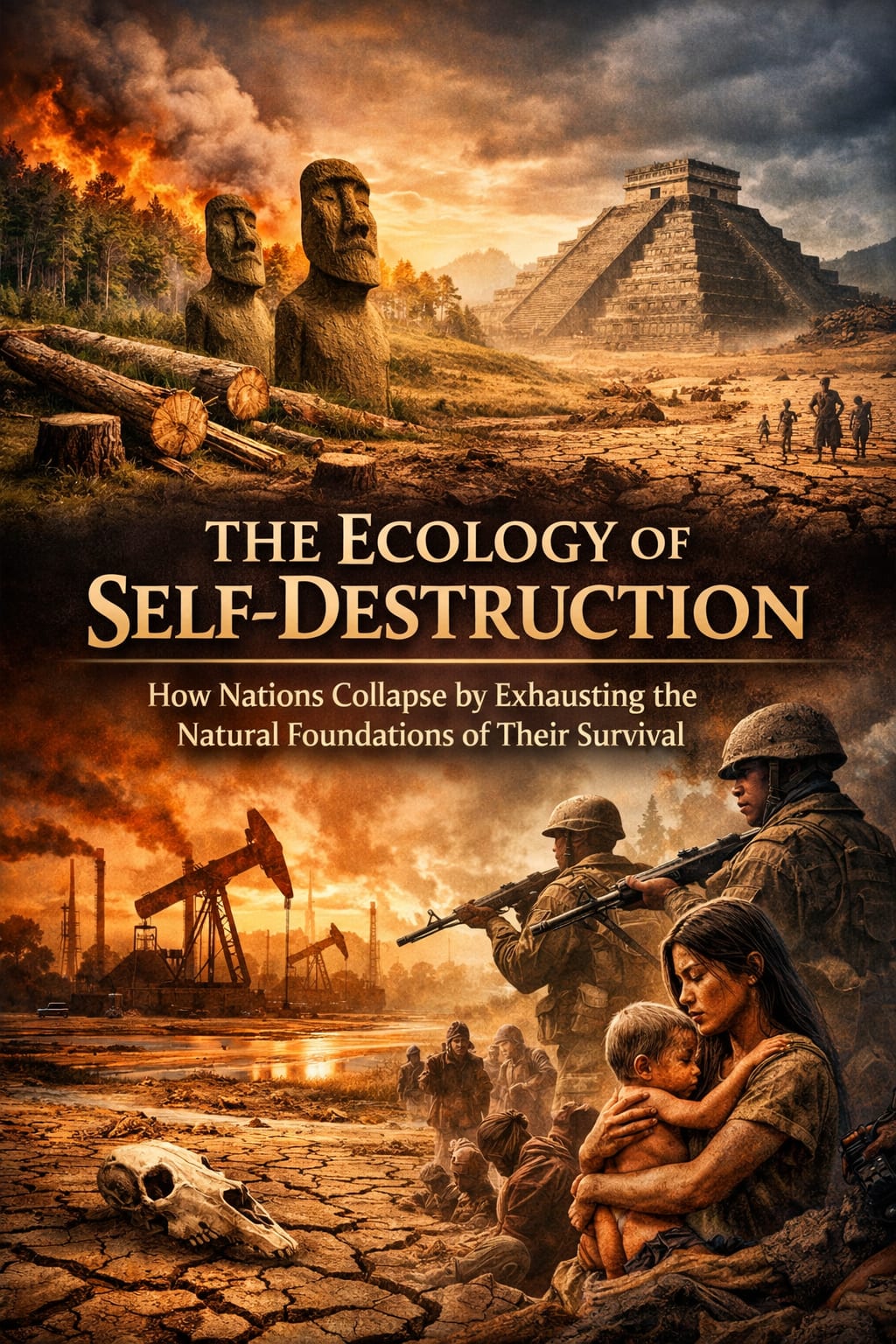
Human civilizations often imagine their downfall as something imposed from the outside—by enemies, invasions, or natural disasters. Yet, as Jared Diamond argues in Collapse: How Societies Choose to Fail or Succeed, many societies have played the central role in their own destruction. Through the reckless over-exploitation of natural resources, short-term thinking, and failure to adapt to environmental limits, nations repeatedly undermine the very ecological systems that sustain them. Diamond’s comparative study of past and present societies reveals a sobering pattern: environmental self-destruction is rarely accidental, and collapse is often the predictable outcome of collective choices.
This essay argues that nations destroy themselves when they over-exploit their natural resources because environmental degradation erodes economic stability, weakens social cohesion, and limits political options. Drawing on key examples from Collapse—including Easter Island, the Maya civilization, and modern Rwanda—this essay demonstrates how environmental mismanagement transforms prosperity into vulnerability and ultimately leads to societal breakdown.
________________________________________
Environmental Overshoot and the Illusion of Endless Growth
One of Diamond’s central insights is that societies tend to collapse not because they lack intelligence or technological skill, but because they overshoot the carrying capacity of their environment. When population growth and consumption exceed what ecosystems can sustainably provide, decline becomes inevitable.
Diamond defines this process succinctly: “By the time we first detect a problem, it’s often already too late to solve it” (Collapse). This delay occurs because environmental degradation is usually gradual and initially invisible. Forests still appear dense, soils still yield crops, and water sources still flow—until suddenly they do not.
Over-exploitation typically begins during periods of success. Agricultural innovation, political stability, or favorable climate conditions encourage population growth, which in turn increases pressure on land, forests, and water. As Diamond notes, “The paradox is that the very practices that initially supported growth may later undermine it”. Societies mistake short-term abundance for long-term sustainability, a fatal miscalculation repeated across history.
________________________________________
Easter Island: A Civilization That Cut Down Its Future
Perhaps the most famous case study in Collapse is Easter Island, which Diamond describes as “the clearest example of a society that destroyed itself by overexploiting its own resources.” Settled by Polynesians around 900 CE, the island was once covered with palm forests that provided wood for housing, canoes, fuel, and tools.
As the population grew, trees were cut down faster than they could regenerate. Forest clearance intensified due to agricultural expansion and the construction and transport of the massive stone statues (moai) that symbolized social and religious prestige. Diamond writes, “The islanders were trapped by their past success, by the investments they had made in statues that required trees to transport.”
Eventually, deforestation reached a point of no return. Without trees, the islanders could no longer build canoes, which ended deep-sea fishing and cut off contact with other islands. Soil erosion reduced agricultural yields, leading to famine, warfare, and population collapse. Diamond’s haunting question captures the tragedy: “What did the Easter Islander who cut down the last palm tree say while he was doing it?”
The lesson is stark: over-exploitation can destroy not only resources but also the cultural and technological systems that depend on them. Once ecological thresholds are crossed, recovery may be impossible.
________________________________________
The Maya: Environmental Stress and Political Fragility
The collapse of the Classic Maya civilization illustrates how environmental degradation interacts with political complexity. The Maya developed advanced urban centers, monumental architecture, and sophisticated agricultural systems in a fragile tropical environment. However, extensive deforestation for farming and construction led to soil erosion and reduced water retention.
Diamond explains that “Maya agriculture was operating close to the limits imposed by the environment.” When prolonged droughts struck between the 8th and 10th centuries, the environmental margin for error disappeared. Crop failures undermined food security, while elite demands for labor and tribute continued unabated.
Instead of adapting, Maya rulers intensified monument building and warfare, further straining resources. Diamond observes, “The society responded to stress by doubling down on the very practices that caused the stress.” As food shortages worsened, cities were abandoned, political authority collapsed, and the population declined dramatically.
This case demonstrates that environmental over-exploitation does not act in isolation. It magnifies existing social inequalities and political rigidity, making collapse more likely when external pressures—such as climate change—occur.
________________________________________
Resource Scarcity and Social Conflict
Another critical argument in Collapse is that environmental degradation often fuels internal conflict. When resources become scarce, competition intensifies, social trust erodes, and violence increases. Diamond emphasizes that “Environmental problems are not just about trees and water; they are about people and power.”
In Rwanda, for example, Diamond links extreme population density, land scarcity, and soil exhaustion to the 1994 genocide. While ethnic tensions and political manipulation were immediate causes, environmental stress created the conditions for catastrophe. As Diamond notes, “When there is not enough land to feed everyone, even small shocks can trigger violence.”
Over-exploitation reduces resilience. Societies living at the ecological edge cannot absorb droughts, economic downturns, or political instability. Environmental decline thus acts as a threat multiplier, turning manageable problems into existential crises.
________________________________________
Modern Parallels and Global Warnings
Although Collapse focuses heavily on past societies, Diamond insists that modern nations are not immune. He warns that technological sophistication does not eliminate ecological limits: “Technology solves problems, but it also creates new ones.” Fossil fuel dependence, deforestation, overfishing, and freshwater depletion mirror the same patterns that doomed earlier civilizations—only on a global scale.
Unlike isolated societies such as Easter Island, today’s world is deeply interconnected. This interdependence offers opportunities for cooperation but also increases systemic risk. Diamond cautions, “For the first time in history, the whole world is at risk of collapse.”
The crucial difference, however, is awareness. Modern societies possess scientific knowledge, historical examples, and policy tools that past civilizations lacked. Collapse is therefore not inevitable but conditional—dependent on choices.
________________________________________
Conclusion: Collapse as a Choice, Not a Fate
Jared Diamond’s Collapse powerfully demonstrates that nations destroy themselves when they over-exploit their natural resources because environmental degradation undermines the ecological foundations of society. Through deforestation, soil exhaustion, and resource depletion, nations weaken their economies, destabilize their politics, and intensify social conflict. The case studies of Easter Island, the Maya, and Rwanda reveal a consistent pattern: success leads to growth, growth leads to over-exploitation, and over-exploitation leads to collapse.
Yet, Diamond’s message is not purely pessimistic. As he reminds readers, “The outcome depends on the choices we make.” Nations that recognize environmental limits, invest in sustainable practices, and adapt their values can avoid the fate of collapsed societies. The past, in Diamond’s view, is not a prophecy—but a warning.
If history teaches anything, it is that civilizations do not fall because they are ignorant of danger, but because they ignore it.
About the Creator
Rachid Zidine
High School Teacher
Keep reading
More stories from Rachid Zidine and writers in History and other communities.
Capitalism as a Social and Ecological Crisis: Why Profit Is Destroying the Planet and Deepening Inequality
Introduction: Capitalism as a Sociological Problem In sociological inquiry, capitalism is not merely an economic system but a total social structure that shapes institutions, social relations, cultural norms, and individual subjectivities. While often defended for its capacity to generate wealth and innovation, capitalism has also produced profound social and ecological crises. From widening class inequalities to environmental collapse and the commodification of everyday life, its consequences raise fundamental questions about social justice, sustainability, and human well-being.
By Rachid Zidine4 days ago in Critique


Comments
There are no comments for this story
Be the first to respond and start the conversation.