
The Lion of the Desert
The Story of Libya’s Brave Leader Who Defied Italian Rule

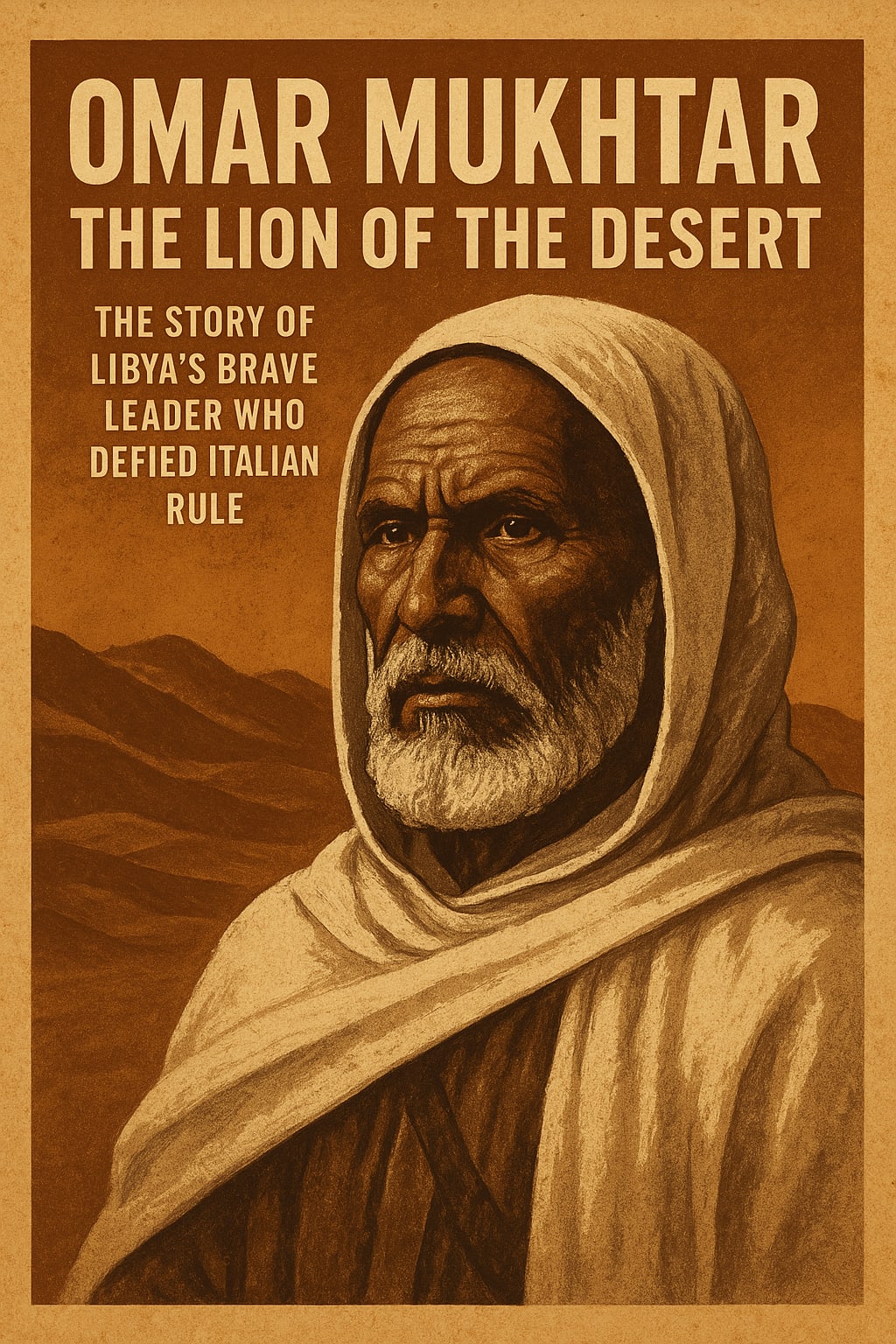
Omar Mukhtar, known widely as the “Lion of the Desert,” was a symbol of resistance and resilience against colonial oppression. Born in 1862 in the small village of Zawiyat Janzur, located in the eastern region of Libya known as Cyrenaica, Omar Mukhtar rose from humble beginnings to become the most formidable leader of the Libyan resistance against Italian colonization. His life, marked by unwavering faith, strategic brilliance, and profound moral character, left a legacy that transcends national boundaries and continues to inspire freedom fighters around the world.
### Early Life and Education
Mukhtar was born into a deeply religious family of the Mnifa tribe. Orphaned at a young age, he was raised in the care of his tribe and studied at the local Quranic schools. His intellectual abilities and dedication to Islam caught the attention of the Senussi Order, a Sufi Islamic movement that emphasized piety, education, and resistance to foreign domination. Mukhtar was enrolled at the Senussi school in Jaghbub, where he spent years studying Islamic theology, jurisprudence, and Arabic literature.
The Senussi Order played a crucial role in shaping Mukhtar’s worldview. It taught him discipline, spiritual strength, and the importance of justice—values that would become central to his leadership. Later, he became a teacher and religious leader within the order, earning the respect of his peers for his humility and wisdom.
### Italian Colonization and the Call to Resistance
In 1911, Italy invaded Libya under the pretense of freeing it from Ottoman rule. While the Ottomans were nominal rulers, real control over much of the territory rested in the hands of local tribes and the Senussi Order. The Italian invasion was brutal and deeply resented by Libyans, especially in the eastern region of Cyrenaica, where the Senussi influence was strongest.
Omar Mukhtar, then a respected teacher, was thrust into the role of a guerrilla leader not by ambition but by necessity. Italy’s harsh colonial policies, including land confiscations, forced displacements, and massacres, ignited fierce resistance among the Libyan people. Mukhtar, already a devout leader and scholar, turned his focus toward armed struggle, determined to defend his people and his faith.
### Guerrilla Warfare and Leadership
Mukhtar's leadership began in earnest in the early 1920s, when he organized and led a sustained guerrilla campaign against Italian forces. What made Mukhtar unique among resistance leaders was his deep moral code. He commanded with integrity, forbade mistreatment of prisoners, and ensured that his fighters adhered to Islamic ethics in warfare.
Using his intimate knowledge of the rugged terrain of Cyrenaica—its mountains, deserts, and wadis—Mukhtar led small, mobile units that ambushed Italian convoys, sabotaged supply lines, and melted back into the landscape. Despite being vastly outnumbered and outgunned, his tactics were so effective that he earned the nickname “The Lion of the Desert” from both his enemies and followers.
Italian forces, frustrated by their inability to crush the resistance, escalated their repression. Under General Rodolfo Graziani, Italy began a campaign of terror. Villages were burned, wells were poisoned, and tens of thousands of civilians were rounded up into concentration camps. Still, Mukhtar and his fighters persisted, drawing strength from their cause and their leader’s unshakable faith.
### Capture and Execution
After nearly two decades of resistance, Omar Mukhtar was captured on September 11, 1931, during a skirmish near Slonta. Wounded and taken prisoner, he was quickly brought before a military court. Despite international criticism, the Italians were determined to make an example of him. Mukhtar refused to plead for mercy. When offered clemency in exchange for urging his followers to surrender, he declined without hesitation.
On September 16, 1931, at the age of 69, Omar Mukhtar was hanged in the presence of thousands of his countrymen at the Suluq concentration camp. The Italians hoped his death would end the resistance. Instead, it cemented his status as a national martyr and global symbol of anti-colonial struggle.
### Legacy
Omar Mukhtar's legacy is profound and enduring. In Libya, he is revered as the father of national resistance. His image appeared on currency, monuments, and in the hearts of schoolchildren who study his story as a source of pride and identity. His life was dramatized in the acclaimed 1981 film *Lion of the Desert*, starring Anthony Quinn, which helped bring his story to international audiences.
More importantly, Mukhtar's resistance influenced broader anti-colonial movements across Africa and the Arab world. His blend of faith, morality, and tactical brilliance set a precedent for revolutionary leaders who sought justice through principled struggle.
Mukhtar never lived to see Libya’s independence, which came in 1951, but the ideals he fought for—freedom, dignity, and justice—formed the foundation of Libya's national identity. His words, captured during his trial—“We never give up. We win or we die”—echo through history as a testament to the unbreakable human spirit.
### Character and Philosophy
What set Omar Mukhtar apart was not just his military skill, but his personal integrity. Despite enduring great hardship, he remained committed to ethical conduct in war. He never allowed his men to harm civilians or retaliate unjustly, even when facing an enemy who showed no such restraint. His leadership was based not on fear, but on respect.
Mukhtar also viewed resistance as a religious duty. He saw the struggle against colonization as not merely political, but spiritual—an obligation to protect his people, land, and way of life from foreign domination. His piety, courage, and humility inspired unity among diverse tribes and clans who otherwise might have been divided.
### Conclusion
Omar Mukhtar’s story is not just a chapter in Libyan history—it is a universal tale of resistance against injustice. He was a teacher who became a warrior, a scholar who became a symbol, and a man who gave his life for the dignity of his people. His life reminds the world that even in the face of overwhelming power, the will of a determined people led by a principled leader can never be crushed.
Omar Mukhtar, the Lion of the Desert, lives on—not only in the annals of history, but in the enduring fight for freedom everywhere.
About the Creator
Irshad Abbasi
"Studying is the best cure for sorrow and grief." shirazi
Keep reading
More stories from Irshad Abbasi and writers in History and other communities.
The Emperor Who Bridged Worlds
Kublai Khan, born in 1215, was the grandson of Genghis Khan and one of the most remarkable rulers in world history. As the founder of China’s Yuan Dynasty and the fifth Khagan (Great Khan) of the Mongol Empire, Kublai’s reign marked a pivotal transformation of Mongol rule—from a vast nomadic confederation to a centralized imperial power that bridged the cultures of the East and West. He was not only a formidable military leader but also a visionary statesman who reshaped the political and cultural landscapes of Asia.
By Irshad Abbasi 7 months ago in History
Power's Sake
When it comes to gaining power, bad people use it to gain more They never gain power to do something with it, they gain power to have it, relish in it, double it down on itself so it grows exponentially and never goes anywhere. Even if you see the people in power commit an atrocity, that is never the true goal. It is a deplorable action for sure but the action itself usually doesn't matter it's the outcome.
By Donny Foley2 days ago in History
Military Strength of Alexander the Great and the Chola Empire: A Historical Comparison
Though separated by more than a thousand years and operating in vastly different geographical and cultural contexts, both forces achieved extraordinary success through discipline, innovation, and strategic brilliance. This article explores the history, composition, size, organization, and military strength of Alexander’s Macedonian army and the Chola military, highlighting how each became a dominant power of its era.
By Say the truth 2 days ago in History




Comments
There are no comments for this story
Be the first to respond and start the conversation.