
The Emperor Who Bridged Worlds
From Mongol Conqueror to Chinese Ruler — The Life and Legacy of the Yuan Dynasty’s Founder

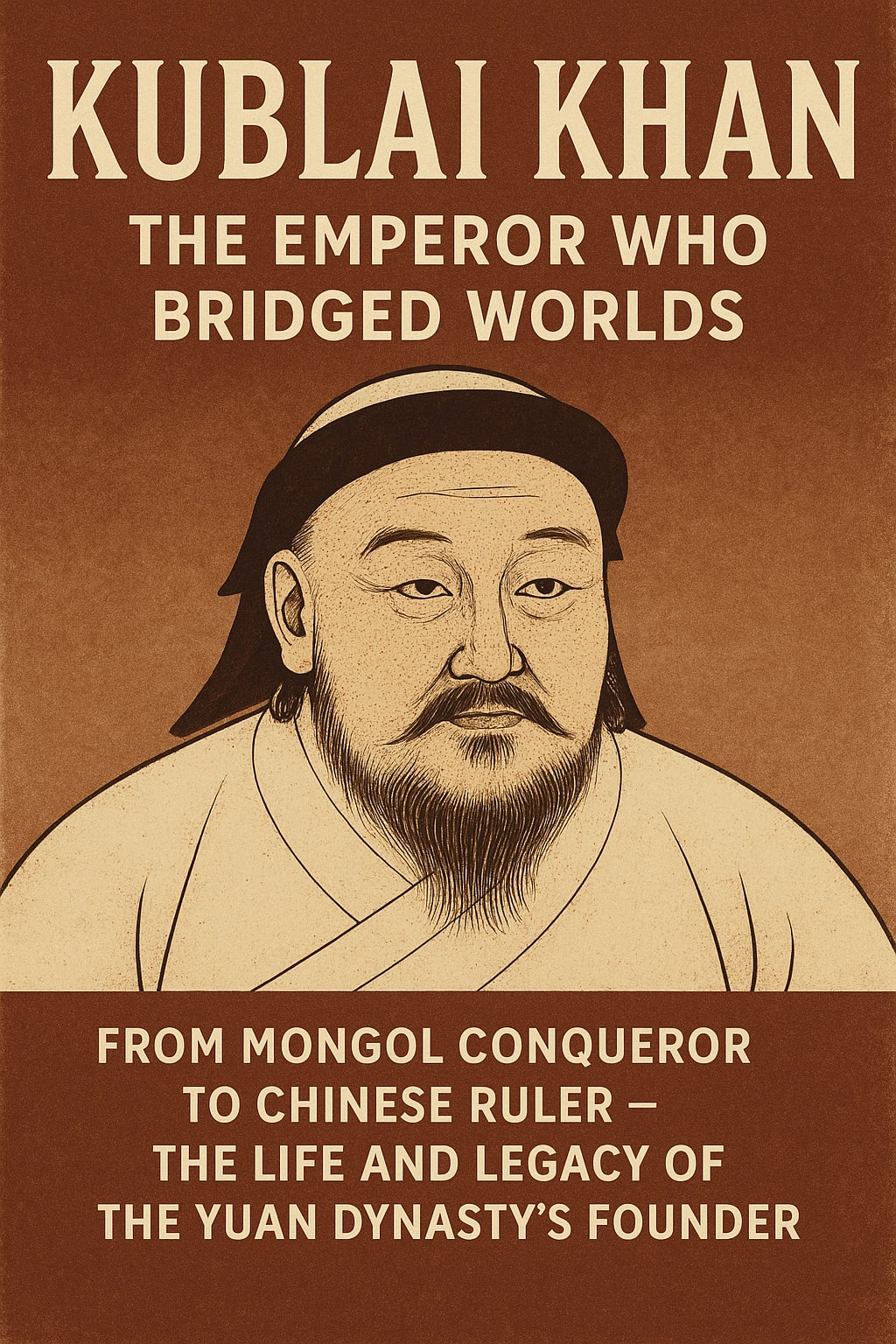
Kublai Khan, born in 1215, was the grandson of Genghis Khan and one of the most remarkable rulers in world history. As the founder of China’s Yuan Dynasty and the fifth Khagan (Great Khan) of the Mongol Empire, Kublai’s reign marked a pivotal transformation of Mongol rule—from a vast nomadic confederation to a centralized imperial power that bridged the cultures of the East and West. He was not only a formidable military leader but also a visionary statesman who reshaped the political and cultural landscapes of Asia.
Early Life and Heritage
Kublai Khan was born to Tolui, the fourth son of Genghis Khan, and Sorghaghtani Beki, a highly intelligent and capable Christian Nestorian princess from the Kerait tribe. Sorghaghtani ensured her sons received an education in multiple traditions, including Confucianism, Buddhism, and Islamic thought. This exposure laid the foundation for Kublai’s later approach to governance—one that valued cultural diversity, religious tolerance, and administrative sophistication.
From an early age, Kublai distinguished himself through his intellect and leadership abilities. He was introduced to the Chinese way of governance and Confucian ideals by Chinese advisors like Yao Shu, which profoundly influenced his administrative policies.
Rise to Power
Kublai began gaining real power in the 1240s when his older brother Möngke became the Great Khan in 1251. Möngke entrusted Kublai with the governorship of northern China, where he demonstrated not only military skill but also diplomatic and bureaucratic talents. He reformed tax systems, expanded agricultural productivity, and promoted Confucian scholars and institutions.
After Möngke’s death in 1259, a succession struggle erupted between Kublai and his younger brother Ariq Böke. This civil war, known as the Toluid Civil War, lasted until 1264, ending in Kublai’s victory. Though the Mongol Empire remained vast on paper, it was now effectively split into separate khanates, each with its own rule. Kublai established himself as the most powerful, declaring himself Great Khan in 1260.
Founding of the Yuan Dynasty
In 1271, Kublai Khan officially declared the founding of the Yuan Dynasty, adopting a Chinese dynastic name to legitimize his rule over China. He moved the capital to Dadu (modern-day Beijing) and presented himself as a traditional Chinese emperor. In 1279, after years of military campaigns, Kublai conquered the Southern Song Dynasty, thereby unifying all of China under his rule—the first time in centuries that the entire country was under foreign control.
Kublai’s establishment of the Yuan Dynasty marked a dramatic shift. Although he retained Mongol customs, he adopted many Chinese institutions and governing styles. His reign symbolized a bridge between Mongol nomadic heritage and Chinese imperial tradition.
Governance and Cultural Achievements
Kublai Khan’s rule was marked by a blend of Mongol authority and Chinese administrative practices. He created a centralized bureaucracy staffed by a mix of Mongols, Central Asians, and Chinese officials, though he placed Mongols in the highest positions. His policies emphasized religious tolerance, allowing Buddhists, Muslims, Christians, and Daoists to flourish under his rule.
One of Kublai’s most significant accomplishments was his support of infrastructure and economic development. He expanded the Grand Canal, improved roads and postal stations, and facilitated trade along the Silk Road. These efforts helped connect the East and West like never before, making the Yuan court a global hub of exchange.
Kublai also embraced the arts and learning. His court became a meeting place for scholars, artists, and travelers. He supported Chinese opera, painting, and historical writing, while also preserving Mongolian oral traditions. His patronage created a unique cultural fusion that defined Yuan China.
Relations with the Wider World
Kublai Khan’s court was one of the most cosmopolitan in history. Foreign visitors, including merchants, diplomats, and religious figures, were welcomed. Among the most famous was the Venetian traveler Marco Polo, who spent 17 years in Kublai’s service. Polo’s vivid accounts of the Yuan court introduced Europe to the wealth and sophistication of East Asia, sparking imagination and curiosity for generations.
Kublai also maintained diplomatic and trade ties with Persia, the Abbasid Caliphate, and other khanates of the Mongol Empire. Despite rivalries and internal divisions, these connections facilitated one of the most expansive periods of Eurasian contact in history.
Military Campaigns and Challenges
Despite his successes, Kublai’s later years were marked by military setbacks and internal troubles. His attempts to expand Mongol rule into Japan, Vietnam, Java, and Burma largely failed. The most infamous failure was the invasion of Japan in 1274 and again in 1281, both thwarted by typhoons the Japanese later called “kamikaze” or “divine winds.”
Domestically, Kublai struggled with the challenge of ruling a sedentary empire rooted in Chinese civilization while maintaining the loyalty of his Mongol aristocracy, who yearned for their nomadic traditions. Heavy taxation and natural disasters led to growing discontent, particularly among the Han Chinese populace. Inflation and corruption weakened the administration in his later years.
Death and Legacy
Kublai Khan died in 1294 at the age of 79. He was buried in a secret location, as was Mongol custom. His death marked the beginning of the decline of the Yuan Dynasty, which would eventually fall in 1368 to the Ming Dynasty. However, Kublai’s impact endured long after his reign.
He remains a pivotal figure in both Chinese and Mongol history. As the first non-Han emperor to rule all of China, he reshaped Chinese imperial identity. He also preserved and extended the Mongol legacy of conquest and administration, albeit in a more Sinicized form.
Kublai Khan’s reign stands as a testament to the complexities of cross-cultural leadership. He succeeded where few others did—integrating the values and systems of diverse civilizations into a functioning empire. While his dynasty did not last beyond a century, his legacy of tolerance, innovation, and global connectivity left an indelible mark on world history.
About the Creator
Irshad Abbasi
"Studying is the best cure for sorrow and grief." shirazi
Keep reading
More stories from Irshad Abbasi and writers in History and other communities.
The Father of Pakistan’s Nuclear Program
Dr. Abdul Qadeer Khan, often hailed as the “Father of Pakistan’s Nuclear Program,” was a metallurgist, engineer, and visionary whose life became synonymous with Pakistan’s nuclear capability. His contribution to the country’s strategic defense reshaped South Asia’s geopolitical landscape and elevated Pakistan to the status of a nuclear-armed state. A man of brilliant intellect, deep patriotism, and relentless determination, Dr. A.Q. Khan’s life journey reflects the perfect confluence of science and national service.
By Irshad Abbasi 7 months ago in History
Seven Dials
Introduction Seven Dials is a famous and historic area located in London, England. It is found near Covent Garden, one of the busiest and most popular parts of the city. Seven Dials is known for its unique road design, rich history, old buildings, shops, cafés, and lively atmosphere. Today, it is a popular place for tourists and local people who enjoy culture, shopping, and history.
By Farhan Sayedabout 9 hours ago in History
Julius Caesar: The Rise and Fall of a Legend
The Rise and Fall of Julius Caesar In the first century BCE, the Roman Republic stood as one of the most powerful states in the ancient world. Its armies conquered vast territories, its laws shaped civilizations, and its Senate governed through a delicate balance of tradition and authority. Into this complex political world was born Gaius Julius Caesar in 100 BCE—a man whose ambition, brilliance, and fate would forever change Roman history.
By The best writer 5 days ago in History




Comments
There are no comments for this story
Be the first to respond and start the conversation.