
The Lighthouse of Alexandria: An Ancient Greek Engineering Marvel
A Towering Beacon of Light, Innovation, and Legacy from the Ancient World

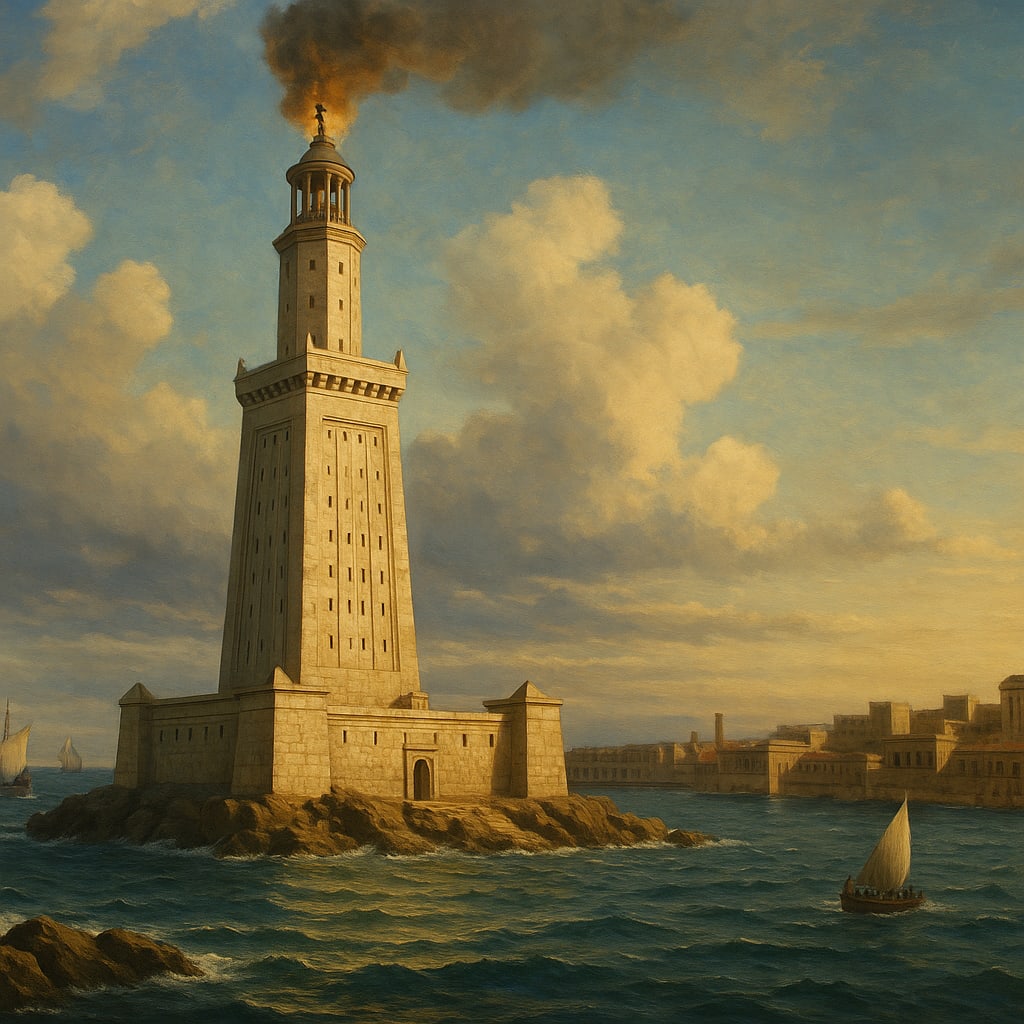
The Lighthouse of Alexandria: An Ancient Greek Engineering Marvel
The Lighthouse of Alexandria, also known as the Pharos of Alexandria, was one of the greatest architectural and engineering achievements of the ancient world. Built on the small island of Pharos, just off the coast of the city of Alexandria in Egypt, this magnificent structure guided sailors safely to port for centuries. It was so iconic and important that it earned its place among the Seven Wonders of the Ancient World.
Historical Background
The city of Alexandria was founded by Alexander the Great in 331 BCE and quickly rose to become one of the most important cities of the ancient Mediterranean world. After Alexander’s death, his general Ptolemy I Soter took control of Egypt and established the Ptolemaic Dynasty. Under his rule and that of his son, Ptolemy II Philadelphus, Alexandria became a center of learning, culture, and trade.
As Alexandria's harbor grew busier with ships from across the ancient world, the need for a reliable navigational aid became evident. The coastline was rocky, and many ships were wrecked trying to enter the harbor. To solve this problem, Ptolemy I commissioned the construction of a lighthouse around 297 BCE, and it was completed by Ptolemy II around 280 BCE. The Greek architect Sostratus of Cnidus is credited with designing the structure.
Architectural Brilliance
The Lighthouse of Alexandria was an extraordinary feat of engineering. According to ancient accounts, it stood between 100 and 140 meters (330 to 460 feet) tall, making it one of the tallest man-made structures of its time, second only to the Great Pyramid of Giza.
The lighthouse was built in three tiers: a square base, a cylindrical middle section, and a smaller circular tower at the top. Each level was carefully constructed using large blocks of light-colored stone, such as limestone and granite. The structure was designed not only to be functional but also to withstand the strong winds and occasional earthquakes common in the region.
The top section housed a large open flame that was used at night to guide ships. During the day, polished bronze mirrors reflected sunlight over long distances. Some reports claim that the light from the lighthouse could be seen up to 50 kilometers (30 miles) away. To maintain the fire, a spiral ramp or staircase allowed workers to carry fuel to the top.
Technological and Cultural Significance
The lighthouse was not just a beacon for sailors—it was a symbol of the city's greatness and the technological advancement of the Hellenistic world. Its design and operation were far ahead of its time. The use of mirrors to amplify and project light was a remarkable innovation, and the structure influenced lighthouse design for centuries to come.
The name “Pharos” became synonymous with lighthouses around the world. Even today, words derived from “Pharos” are used for lighthouses in many languages, including French ("phare"), Italian ("faro"), and Spanish ("faro").
In addition to its practical purpose, the lighthouse served as a watchtower and a landmark for travelers. It helped ensure the safety of maritime trade routes, which were vital to Alexandria’s economy and to the entire Ptolemaic kingdom.
Decline and Destruction
The Lighthouse of Alexandria stood strong for many centuries, but like many ancient structures, it eventually succumbed to the forces of nature. A series of powerful earthquakes between 956 and 1323 CE severely damaged the lighthouse. By the end of the 14th century, it had collapsed entirely.
In the 15th century, the Mamluk Sultan Qaitbay built a fort on the same site using stones from the ruins of the lighthouse. Today, the Citadel of Qaitbay still stands on the island of Pharos, a historical reminder of the ancient wonder that once dominated the coastline.
In recent decades, underwater archaeological teams have discovered large stone blocks and statues believed to be part of the lighthouse lying on the seabed near the old harbor. These findings have confirmed many ancient descriptions and sparked renewed interest in the lighthouse's history.
Legacy
The Lighthouse of Alexandria remains one of the most inspiring symbols of ancient ingenuity. It combined art, science, and architecture in a way that few ancient structures did. As one of the Seven Wonders of the Ancient World, it stood as a beacon not just for sailors, but for human creativity and ambition.
Although the original lighthouse no longer stands, its legacy lives on in the concept and design of modern lighthouses. The Pharos continues to shine through history as a true marvel of engineering, a monument to the brilliance of the ancient Greeks, and a symbol of Alexandria’s golden age.
About the Creator
Adnan Rasheed
Author & Creator | Writing News , Science Fiction, and Worldwide Update| Digital Product Designer | Sharing life-changing strategies for success.
Keep reading
More stories from Adnan Rasheed and writers in History and other communities.
Scientists Found an 8,000-Year-Old Figurine in a Cave: Its Engravings Tell the Story of an Ancient Culture
Scientists Found an 8,000-Year-Old Figurine in a Cave: Its Engravings Tell the Story of an Ancient Culture In a remarkable archaeological discovery that is captivating historians and researchers worldwide, scientists have unearthed an 8,000-year-old figurine from a remote cave. This ancient artifact, found buried deep within layers of soil and time, offers an extraordinary glimpse into a long-lost civilization. Intricately engraved with symbols and artistic patterns, the figurine is believed to represent not just a religious or cultural object, but also a form of early storytelling — a narrative tool used by prehistoric people to pass down their history, beliefs, and rituals.
By Adnan Rasheed8 months ago in History
World War I
The morning fog lay thick over the trenches of northern France, clinging to the earth as if it too feared what was about to happen. Private Thomas Hale pulled his coat tighter around himself, though it did little to stop the cold from seeping into his bones. He had been in the trenches for six months, yet the damp smell of mud, smoke, and fear still felt unfamiliar, like a nightmare he could not wake from.
By Maavia tahir5 days ago in History
Chicago Hospital Held Newborn Baby for 8 Months Over an Unpaid Medical Bill
Debts were handled much differently in the 19th and early 20th century. Back then, people who accrued debt had more to fear than letters and calls from collection agencies the same way we do today, especially if they owed a hospital or doctor money.
By Criminal Matters6 days ago in History
How to Succeed at the Benson Directory®
Congratulations and welcome to the Benson Directory® employee #22391! As our newest call handler, you will have the privilege of speaking with dozens of unique and interesting people on a daily basis as well as the opportunity to earn bonuses for high performance. Contained within this handbook you will find a set of ease to follow instructions designed to help you settle in to your new role and begin paving the way to success.
By S. A. Crawforda day ago in Fiction



Comments
There are no comments for this story
Be the first to respond and start the conversation.