
The Life and Times of Iraq’s Strongman
From Revolutionary Roots to the Gallows of History

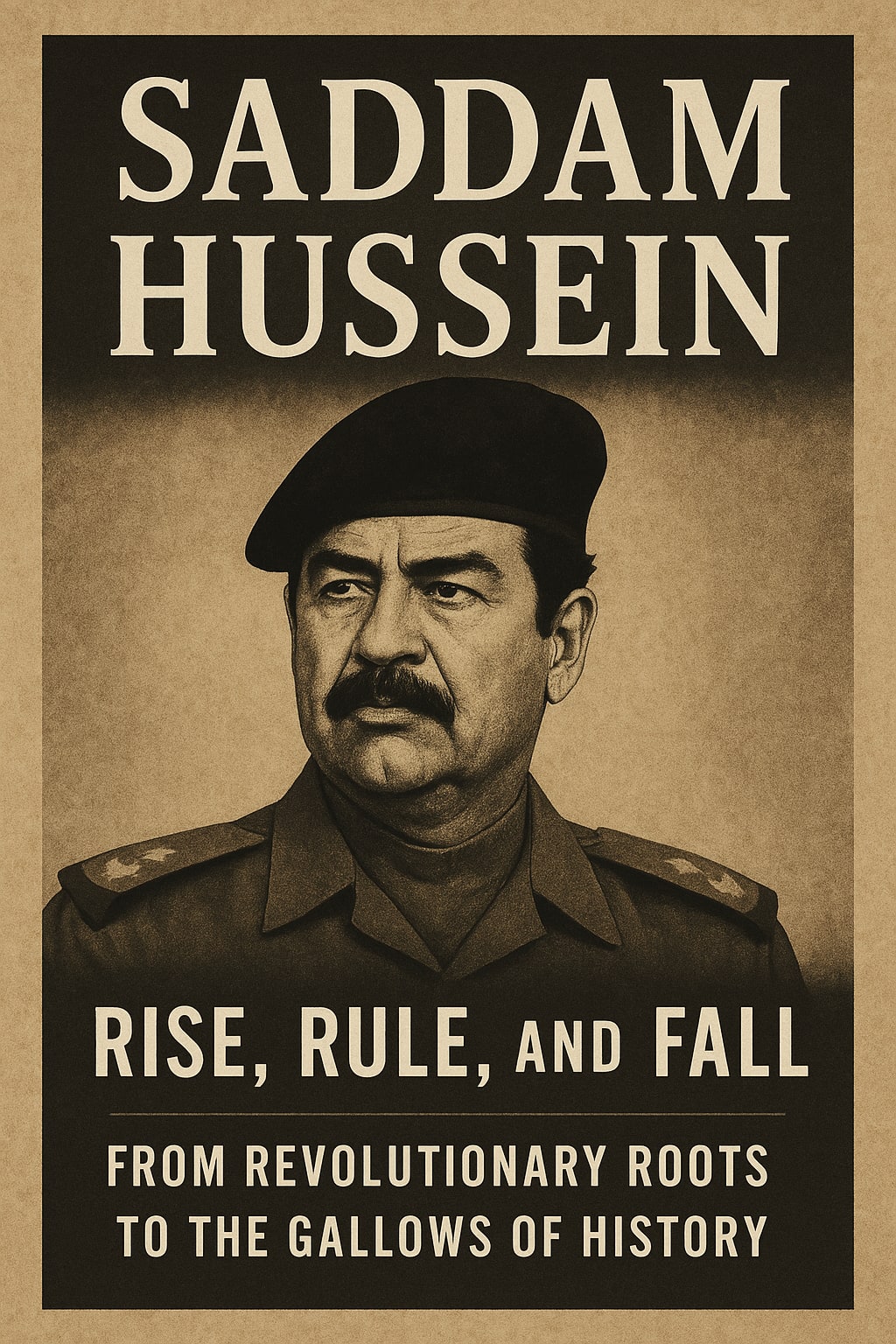
Saddam Hussein, one of the most controversial and enigmatic figures of the 20th century, ruled Iraq with an iron fist for nearly a quarter of a century. His life was marked by a meteoric rise to power, brutal suppression of dissent, ambitious modernization efforts, catastrophic wars, and a dramatic downfall that ended with his execution in 2006. Saddam's story is not just the tale of a dictator, but a reflection of Iraq’s turbulent history and its struggle with identity, power, and colonial legacy.
## **Early Life and Revolutionary Aspirations**
Saddam Hussein was born on April 28, 1937, in the village of Al-Awja near Tikrit, in northern Iraq. Raised in a poor and unstable environment, he was largely brought up by his uncle, Khairallah Talfah, a fervent Arab nationalist and former army officer. From a young age, Saddam was influenced by nationalist ideas and harbored deep resentment toward colonial powers and Western influence in the Arab world.
In 1957, he joined the Ba'ath Party, a political movement that promoted Arab unity, socialism, and resistance to Western imperialism. Two years later, he was involved in an unsuccessful attempt to assassinate then-Prime Minister Abdul Karim Qasim. Wounded in the effort, Saddam fled to Egypt, where he studied law and continued his political education.
## **Path to Power**
Saddam returned to Iraq after the Ba'ath Party seized power in a 1963 coup, though they were ousted shortly thereafter. He remained active in the party and became a key player when the Ba'athists regained control in a 1968 coup. As Deputy to President Ahmed Hassan al-Bakr, Saddam quickly became the real power behind the scenes, orchestrating state policies, controlling the security services, and eliminating rivals through fear and surveillance.
By 1979, Saddam forced al-Bakr to resign and officially assumed the presidency. One of his first acts was a chilling purge of party leadership, which he announced in a televised speech while reading out names of those to be executed. The message was clear: absolute loyalty or death.
## **Dictatorship and Modernization**
During the early years of his rule, Saddam presented himself as a modernizer and secular Arab leader. Under his regime, Iraq underwent major development. The country’s oil revenues were used to fund infrastructure projects, healthcare, education, and a wide-reaching public welfare system. Literacy improved dramatically, and women gained more access to education and employment.
However, this progress came at a high price. Saddam’s rule was marked by authoritarianism, pervasive surveillance, and widespread repression. The Ba'athist regime utilized brutal tactics to silence dissent, including torture, forced disappearances, and executions. The internal security apparatus, Mukhabarat, was one of the most feared institutions in the country.
## **The Iran-Iraq War**
Saddam’s ambition extended beyond Iraq’s borders. In 1980, he launched an invasion of neighboring Iran, hoping to exploit the chaos following the Iranian Revolution and assert dominance in the Persian Gulf. The eight-year Iran-Iraq War proved to be one of the deadliest conflicts of the 20th century, costing over a million lives and devastating Iraq’s economy.
During the war, Saddam resorted to chemical weapons, including the infamous Halabja attack in 1988, where thousands of Kurdish civilians were gassed. Despite international condemnation, Saddam emerged from the war still in power, but deeply in debt and with a weakened economy.
## **The Gulf War and Isolation**
In 1990, Saddam made a fateful decision by invading Kuwait, claiming it as Iraq’s 19th province and accusing it of economic sabotage. The invasion triggered a swift international response. A U.S.-led coalition launched Operation Desert Storm in January 1991, forcing Iraqi troops out of Kuwait within weeks.
The war ended with Iraq’s defeat, but Saddam remained in power. However, the aftermath was catastrophic for Iraqis. Economic sanctions imposed by the United Nations crippled the country’s economy and led to widespread suffering. Saddam responded to internal uprisings in the north and south with brutal force, maintaining control through sheer repression.
## **Cult of Personality and Tyranny**
During the 1990s, Saddam’s cult of personality reached Orwellian levels. His image was omnipresent—on walls, in schools, and across media. He portrayed himself as the father of the nation, a modern Nebuchadnezzar, and a defender of the Arab world against the West.
Despite Iraq’s growing isolation, Saddam continued to live extravagantly while the Iraqi people suffered. His regime manipulated international food-for-oil programs and continued suppressing opposition, particularly among the Shiite and Kurdish populations. Rumors about weapons of mass destruction (WMDs) and clandestine nuclear ambitions kept Saddam in the international spotlight.
## **Downfall and Execution**
The final chapter of Saddam’s reign began in the wake of the September 11, 2001, terrorist attacks. Although Iraq had no direct link to al-Qaeda, the U.S. administration under President George W. Bush claimed that Saddam possessed WMDs and posed a threat to global security. In March 2003, the U.S. and its allies invaded Iraq in what became known as the Iraq War.
The invasion swiftly toppled Saddam’s government, and he fled into hiding. On December 13, 2003, U.S. forces captured him near Tikrit, hiding in a small underground hole. His capture marked the symbolic end of an era.
Saddam was put on trial by the Iraqi Special Tribunal for crimes against humanity, particularly for the 1982 killing of 148 Shiites in Dujail. The trial was contentious but ended in a death sentence. On December 30, 2006, Saddam Hussein was hanged. Footage of his execution circulated widely, showing a defiant but defeated man.
## **Legacy**
Saddam Hussein remains a deeply polarizing figure. To some, especially those in parts of the Sunni Arab world, he symbolized strength, defiance against Western domination, and national sovereignty. To others, especially Kurds, Shiites, and political dissidents, he was a brutal tyrant responsible for genocide, war crimes, and decades of suffering.
His rule left Iraq deeply fractured, and the power vacuum created after his fall contributed to sectarian violence, the rise of extremist groups like ISIS, and ongoing instability. The U.S.-led invasion that ended his rule continues to provoke debate about interventionism, regime change, and its long-term consequences.
## **Conclusion**
Saddam Hussein's life was a journey through revolution, absolute power, and ultimately disgrace and death. He rose from rural obscurity to become one of the world’s most feared leaders. His complex legacy—of brutal dictatorship interspersed with modernization, defiance, and tragedy—continues to shape Iraq and the broader Middle East. His story serves as a cautionary tale of what happens when absolute power is wielded without accountability, and when a nation’s fate becomes entwined with the ambitions of a single man.
About the Creator
Irshad Abbasi
"Studying is the best cure for sorrow and grief." shirazi
Keep reading
More stories from Irshad Abbasi and writers in History and other communities.
The Soldier President – From Battlefield to Burkina Faso's Leadership
Ibrahim Traoré, a young and determined military officer, rose to international attention in 2022 when he led a coup d’état that reshaped the political trajectory of Burkina Faso. At just 34 years old, he became the world’s youngest head of state at the time, assuming leadership of a country gripped by insecurity, economic hardship, and widespread disillusionment with traditional politics.
By Irshad Abbasi 8 months ago in History
Savoy Hotel – Mussoorie: The Colonial Luxury Hotel Where an Unsolved Murder Still Walks the Corridors
The First Night: Beauty Wrapped in Silence Mussoorie looks peaceful from a distance. Pine trees sway gently, clouds roll like slow-moving waves, and the hill air smells of rain and old earth. But as evening falls, the silence becomes heavier—almost watchful.
By Gaurav Gupta3 days ago in History
Is NATO Facing Its Biggest Crisis Yet?
Is NATO Facing Its Biggest Crisis Yet? For more than seventy years, NATO has been one of the strongest military alliances in the world. Formed after World War II, it was designed to protect its members through collective defense. An attack on one was considered an attack on all. For decades, this principle helped maintain stability in Europe and beyond. But today, NATO is facing one of the most challenging moments in its history.
By Wings of Time 7 days ago in History
Silver Screen Magic with Mae West
American actress and singer Mae West became a popular film actress during the Great Depression. She started entertaining in vaudeville, then performed on Broadway, and finally went to Hollywood. She signed up with Paramount Pictures and made her debut in the 1932 film “Night After Night.” She also starred in musicals, comedies, and crime dramas. The American Film Institute named her one of the best classic Hollywood actresses.
By Rasma Raisters5 days ago in Geeks


Comments (1)
Saddam's rise is quite something. His early life shaped his views. Joining the Ba'ath Party was a big step. And that attempt to assassinate Qasim, then fleeing to Egypt for studies - it all shows his determination. How do you think his time in Egypt really influenced his later rule? Once back in Iraq, his power grab was intense. Going from deputy to full president, purging the party - it was a ruthless climb. Do you think there were any signs early on that he'd become such a brutal dictator?