
The Soldier President – From Battlefield to Burkina Faso's Leadership
A Journey of Patriotism, Power, and Political Transformation in West Africa

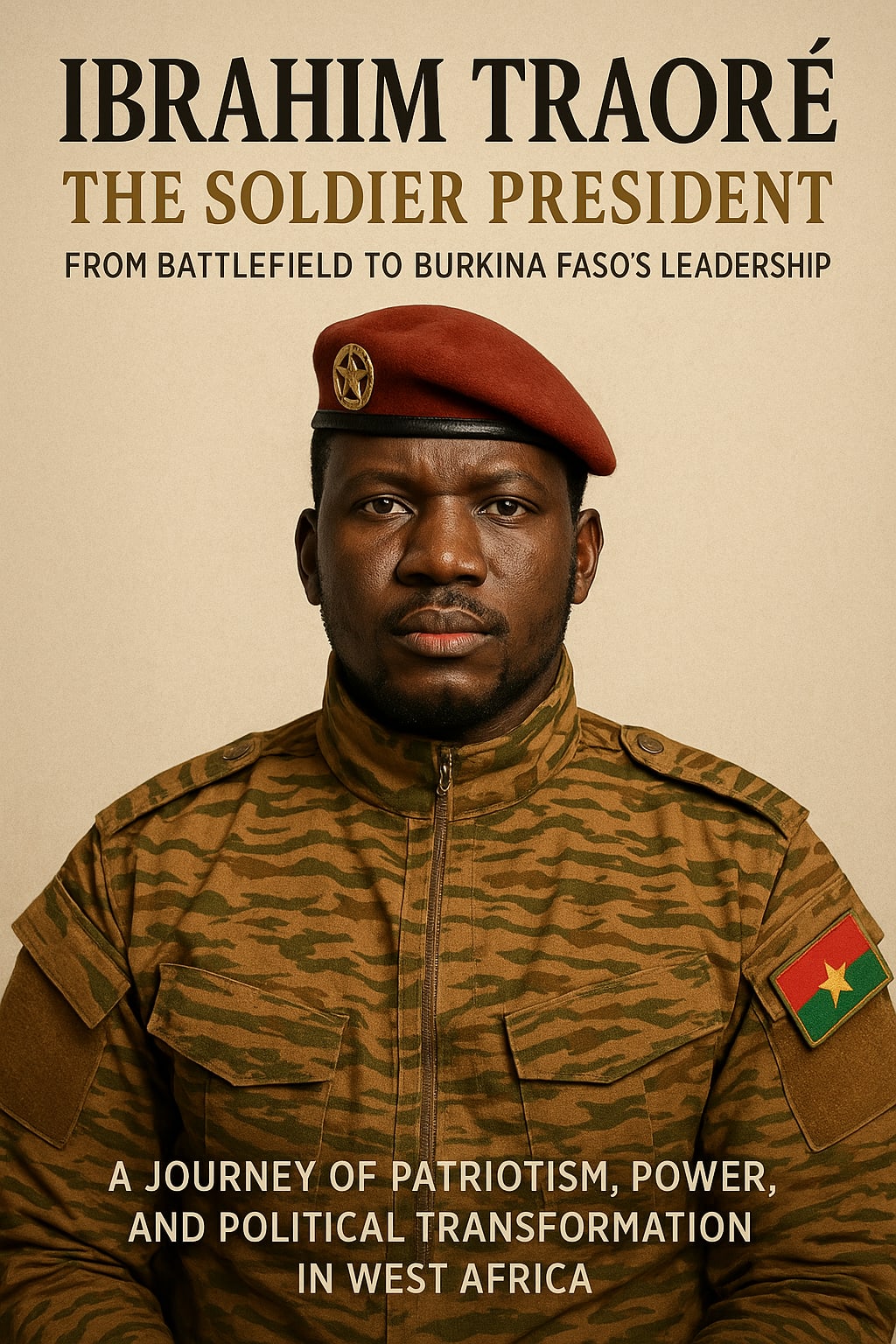
Ibrahim Traoré, a young and determined military officer, rose to international attention in 2022 when he led a coup d’état that reshaped the political trajectory of Burkina Faso. At just 34 years old, he became the world’s youngest head of state at the time, assuming leadership of a country gripped by insecurity, economic hardship, and widespread disillusionment with traditional politics.
Born in 1988 in Bondokuy, a small town in western Burkina Faso, Traoré grew up in a modest family, deeply rooted in the values of discipline, hard work, and community service. His early life was shaped by the rural realities of a nation still struggling with post-colonial development challenges. Even as a child, he displayed a keen sense of justice and responsibility. Encouraged by his family and teachers, he pursued education seriously, eventually enrolling in the University of Ouagadougou where he studied geology.
However, the call to serve his country in a more direct and impactful way led him to join the army. Traoré’s military career began at the Kadiogo Military Academy, where he was trained not only in combat skills but also in strategic thinking, leadership, and loyalty to the nation. Over time, he built a reputation for his commitment, discipline, and an unyielding stance against corruption and incompetence. He would later serve in several critical regions of Burkina Faso, gaining firsthand experience in the country’s intensifying fight against terrorism and insurgency.
Burkina Faso, once a beacon of revolutionary ideals under the legendary Thomas Sankara, had become increasingly unstable in the 2010s. The spread of jihadist violence across the Sahel region engulfed the nation in chaos. Whole communities were displaced, and thousands lost their lives. Successive governments struggled to contain the threat. Disillusionment grew among citizens and soldiers alike, particularly over the perception that the political elite was failing the nation.
In January 2022, President Roch Marc Christian Kaboré was overthrown by Lieutenant Colonel Paul-Henri Sandaogo Damiba, who promised to restore security and stability. However, the situation did not improve. Amid mounting frustration over continued terrorist attacks and internal divisions within the military, Ibrahim Traoré emerged as a central figure in a second coup later that year, on September 30, 2022. Citing the need to refocus the government’s efforts on securing the nation and regaining territorial control, Traoré led a faction of young officers to depose Damiba.
The coup was met with mixed reactions. While some in the international community expressed concern over the democratic backsliding, many Burkinabè citizens, especially youth and civil society members, welcomed Traoré’s bold move. They saw in him a leader who could potentially restore the revolutionary spirit of Sankara—a symbol of self-reliance, patriotism, and social justice. Traoré’s image—always clad in his red beret and camouflage uniform—evoked a sense of strength and renewed purpose.
Once in power, Traoré outlined a transitional roadmap aimed at returning the country to civilian rule by 2024. He promised transparency, justice, and above all, security. His government prioritized regaining control over areas lost to jihadist groups, investing in the military, and reviving a sense of national unity. He also pledged to fight corruption and ensure that public resources were directed toward development and peacebuilding.
Despite limited resources and ongoing threats, his administration made several strategic shifts. Traoré advocated for a more self-determined foreign policy, calling out perceived neocolonial interference, particularly from France. His bold rhetoric, including calls to reclaim sovereignty over Burkina Faso’s natural wealth and resist foreign domination, found resonance among a generation of Africans disillusioned with Western influence. Under his leadership, the country sought stronger ties with other Sahel nations facing similar security crises, and even looked to non-traditional partners for support, including Russia.
However, leadership under such difficult conditions has not been without its challenges. Traoré’s government faced criticism for restrictions on the press and perceived authoritarian tendencies. Human rights organizations expressed concerns about abuses in the security forces' counterinsurgency operations. Balancing national security and civil liberties remains one of the most complex issues of his rule.
Nevertheless, Traoré’s popularity remained relatively high domestically, especially among the youth. His communication style—direct, militaristic, and impassioned—contrasted sharply with the bureaucratic tone of previous regimes. He often emphasized sacrifice, national pride, and self-reliance. These themes echoed the legacy of Sankara, and many began referring to Traoré as a continuation of that revolutionary tradition.
One of the key moments in his leadership came in early 2023, when the government launched several operations to reclaim territories from jihadist control. While not all operations were successful, they showed the state’s renewed commitment to fighting for every inch of land. Additionally, community-based defense initiatives were promoted to encourage local involvement in securing their own villages—a controversial but pragmatic approach given the country’s stretched military capacity.
Beyond security, Traoré’s transitional leadership aimed to reimagine Burkina Faso’s governance. He called for a national dialogue that included traditional leaders, civil society, and youth representatives to chart a collective path forward. While some critics doubted the inclusivity of this process, others praised the effort to involve grassroots voices in national reconstruction.
As of 2025, Ibrahim Traoré remains a pivotal figure in Burkina Faso’s modern history. Whether he will transition power peacefully as promised or seek to extend his stay remains uncertain. What is clear, however, is that his rise represents a broader shift in West African politics—a pushback against perceived external control, frustration with elite politics, and a yearning for leadership rooted in action, not just rhetoric.
In the eyes of many Burkinabè, Traoré is more than just a soldier—he is a symbol of resilience, of youthful determination, and of a country refusing to surrender to chaos. His journey from a small town in western Burkina Faso to the presidential palace in Ouagadougou is a powerful story of transformation in a nation that continues to fight for peace, justice, and dignity.
About the Creator
Irshad Abbasi
"Studying is the best cure for sorrow and grief." shirazi
Keep reading
More stories from Irshad Abbasi and writers in History and other communities.
Genghis Khan: Rise of the Mongol Empire
In the windswept grasslands of 12th-century Mongolia, where clans clashed and survival was uncertain, a boy named Temujin was born in 1162. He would later become Genghis Khan, a name that would shake continents and alter the course of history. With extraordinary vision, unrelenting ambition, and military genius, he transformed fragmented nomadic tribes into the foundation of the largest contiguous empire the world has ever known—the Mongol Empire.
By Irshad Abbasi 8 months ago in History
The Light of Islam: The Journey of the Prophet
Over 1,400 years ago, in the city of Mecca, a child was born who would change the world forever. His name was Muhammad ﷺ, and he belonged to the noble tribe of Quraysh. From the beginning, his life was marked by trials and simplicity. Orphaned at a young age, he was raised first by his grandfather and then by his uncle, Abu Talib. Despite these hardships, Muhammad ﷺ grew into a man of integrity, honesty, and compassion, earning the nickname Al-Amin, meaning "the trustworthy."
By The best writer 3 days ago in History
Miss Persephone's Manual to a Seemingly Ordinary Life
Miss Persephone was found at the dining table, her blue eyes swollen, her tears arriving and retreating like the tides of the ocean. Earlier that day, her family had visited her in the retirement home where she had lived for eight years. It was her eightieth birthday.
By Imola Tóth5 days ago in Fiction



Comments
There are no comments for this story
Be the first to respond and start the conversation.