
The Lessons of History - Part 2: Charting a Path Forward
Understanding Humanity's Past to Guide Our Future


Expanding on the Human Condition
In the first part of The Lessons of History, we explored the cyclical nature of civilizations, the interplay of economics and politics, and the cultural forces shaping human history. However, as we turn our gaze towards the present and future, it becomes essential to explore in greater depth how history’s lessons can be applied to the complexities of the modern world.
At its core, the human condition, as the Durants emphasized, has not changed much despite technological advancements. While this may seem discouraging—given the cycles of war, greed, and intolerance that continue to shape our world—it also offers a profound insight: that human nature remains malleable. By acknowledging our inherent flaws and capacities for growth, we can work to foster societies that encourage cooperation over conflict and progress over stagnation.
The Power of Ideals and Movements
A recurring theme in human history is the emergence of ideals—philosophical, political, or religious—that spark revolutionary changes. These movements, driven by visionaries and ordinary citizens alike, have often reshaped civilizations. From the birth of democracy in ancient Greece to the civil rights movements of the 20th century, history is replete with examples of societal transformation initiated by powerful ideas.
Yet, the lessons of history remind us that such movements are rarely linear. They face resistance, misinterpretation, and corruption, often leading to unintended consequences. The Durants emphasized the tension between idealism and realism, suggesting that while ideals can uplift societies, they must be grounded in practical governance and tempered by the wisdom of experience.
In today’s globalized world, we witness the rise of movements advocating for justice, equality, and sustainability—values that can steer our future toward a more equitable and compassionate society. But as history shows, the path to realizing these ideals is fraught with challenges. To succeed, we must learn from the past, understanding how similar movements faltered and how they succeeded, seeking to avoid past mistakes while building on their successes.
The Age of Technology: A Double-Edged Sword
The role of technology in shaping human history has always been pivotal. From the invention of the wheel to the printing press, and now to artificial intelligence, technology has been both a driver of progress and a tool of destruction. The challenge of our age is understanding how to wield new technologies without repeating the mistakes of past generations, who have often been swept up in the intoxicating promise of progress at the expense of ethical considerations.
The Durants wrote during an era of rapid industrialization and warfare, a time that was also marked by the rise of new technologies such as the atomic bomb. While their reflections were prescient, they could not have anticipated the transformative impact of digital technology, which has altered nearly every aspect of human life—from communication to politics, from commerce to education. The question now is not whether technology will continue to advance, but how humanity can steer its development in a direction that fosters peace, collaboration, and sustainability.
As history teaches us, technological progress must be matched by wisdom in its application. The potential for both positive and negative outcomes depends on the values we attach to the tools we create. If the past is any guide, societies that fail to heed the ethical implications of their advancements risk repeating history’s darkest moments.
The Global Challenge: A Unified World or Fragmented Future?
Perhaps the greatest test humanity faces today is the challenge of unity. As global challenges such as climate change, pandemics, and geopolitical tensions test the world’s ability to cooperate, history offers both caution and hope. The rise of nationalism, religious extremism, and ideological polarization threatens to fragment the world into competing factions, each focused on short-term interests rather than long-term survival.
Yet, history also shows us that collaboration across borders and cultures has led to some of humanity’s greatest achievements. The establishment of the United Nations after World War II, for example, represented a collective desire to prevent another catastrophic war and promote peace and development across the globe. While the effectiveness of international institutions is often debated, the fact remains that the drive for global cooperation has been an enduring lesson of history.
Looking ahead, the challenge is not merely to avoid conflict but to develop new systems of governance, economics, and diplomacy that reflect the interconnectedness of today’s world. The global community must draw on lessons from past international efforts, learning from their successes and failures to forge a path toward a unified future.
Conclusion: The Wisdom of History in the 21st Century
As we stand at the threshold of a new era, the lessons of history—those timeless truths about human nature, power, and ideals—are more important than ever. By learning from the past, we can chart a course toward a future that is not bound by the mistakes of previous generations. Instead, we can build a world that is informed by wisdom, compassion, and an unwavering commitment to justice.
The Durants’ insights remain as relevant today as they were when they first penned The Lessons of History. Their reflections offer both a cautionary tale and a hopeful call to action: that history is not just a record of what has been, but a tool to guide what can be. By listening to the lessons of the past, we have the power to shape a future that honors the dignity of all people and the planet we share.
About the Creator
Keep reading
More stories from Zain Ul Abedin Khan and writers in History and other communities.
Julian Assange: The Man Behind WikiLeaks
Introduction Julian Assange is one of the most polarizing figures of the 21st century—a digital age revolutionary who created WikiLeaks, the controversial platform that exposed some of the deepest secrets of governments and powerful institutions. To some, he is a hero of transparency, a fearless defender of the public’s right to know. To others, he is a reckless criminal, a manipulative hacker who endangered lives. His life story is one of intellect, idealism, controversy, and global political drama.
By Zain Ul Abedin Khan9 months ago in History
The King’s Highway: The Ancient Road That Witnessed Saladin’s March to War
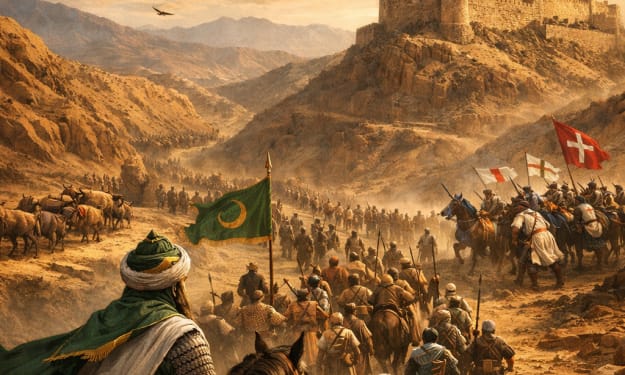
For thousands of years, a legendary road has cut through the rugged mountains and deserts of the Middle East, linking civilizations, armies, and cultures. Known today as the King’s Highway, this ancient route is one of the oldest continuously used roads in human history. Stretching through what is now modern Jordan, the road once connected the trading cities of Egypt to the fertile lands of Syria and Mesopotamia. Over centuries, merchants, pilgrims, prophets, and conquerors traveled along it. Among them were the soldiers of the great Muslim commander Saladin, whose army marched along this route during the dramatic battles of the Crusades.
By Irshad Abbasi 3 days ago in History



Comments
There are no comments for this story
Be the first to respond and start the conversation.