
The Disappeared Gems of Emperor Jahangir: An Elusive Mughal Wealth Beyond Belief
Emperor Jahangir, the progeny of Akbar the Great and progenitor of Shah Jahan, presided over one of the most affluent eras in Mughal history. Renowned for his affection for art, wine, and precious stones, Jahangir gathered an exceptional array of jewels and artifacts. However, following his demise, much of this royal wealth inexplicably disappeared amid chaotic succession conflicts and colonial turbulence. This article reveals the narrative of Jahangir’s vanished riches and the legacy it has bequeathed.

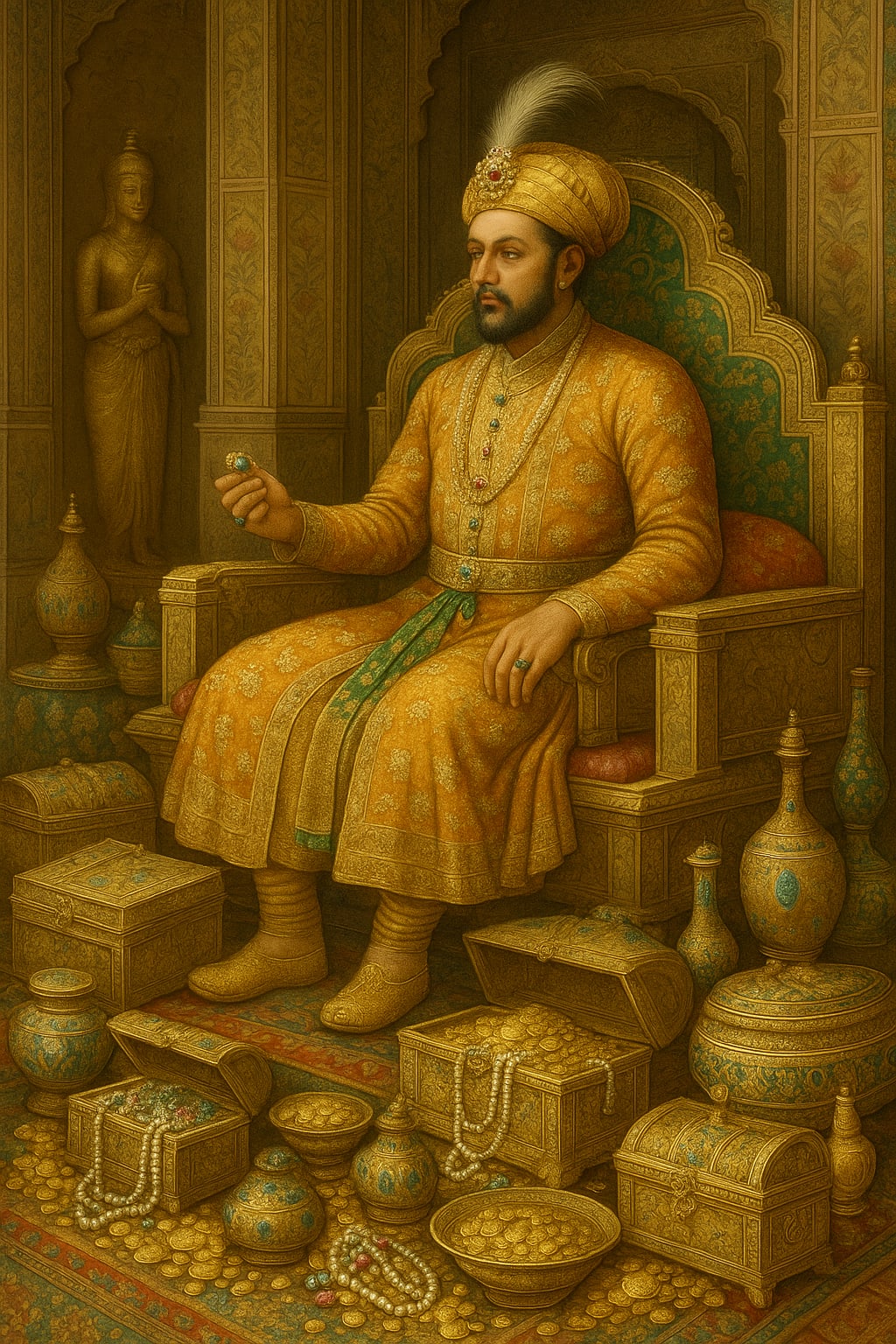
The Golden Era of the Mughal Empire
The Mughal Empire during the early 17th century was at the zenith of its splendor. Encompassing a vast expanse of the Indian subcontinent, it exhibited a thriving economy, a strong administrative framework, and luxurious courtly life. Jahangir, whose name translates to "Conqueror of the World," assumed the throne in 1605 after Akbar’s passing and governed for over twenty years.
Unlike his predecessor, Jahangir was not a formidable military commander, yet he was a shrewd ruler and a fervent supporter of the arts. His court was populated by Persian painters, architects, and jewelers. During his reign, Mughal artistry attained unprecedented levels, with his palaces adorned with gemstones, pearls, and intricate gold craftsmanship.
The Imperial Jewel Collection
Jahangir’s wealth represented more than merely a token of royal affluenceit was a meticulously assembled collection of some of the most remarkable objects ever gathered in the subcontinent. These encompassed:
The Timur Ruby, a substantial, crimson gem etched with the names of Mughal emperors.
Thrones embellished with pearls and golden chests encrusted with emeralds and sapphires.
Valuable jewelry, consisting of jeweled turban ornaments, anklets, rings, and ceremonial daggers.
European artifacts, presented by foreign emissaries, such as mechanical clocks and Venetian glass.
The emperor had a particular fondness for jade and rock crystal, commissioning inscribed wine vessels and dishes from craftsmen throughout Persia and Central Asia.
Jahangir’s Affection for Opulence
Jahangir was noted for his excessparticularly in wine and opium. He frequently hosted extravagant gatherings where the nobility exhibited their fortunes and competed in extravagance. Historical accounts describe evenings where carpets woven with gold thread were extended, and rosewater was poured from diamond-adorned ewers.
His illustrious autobiography, the Tuzk-e-Jahangiri, expounds on his admiration for beauty and artistry. However, it also suggests an increasing disengagement from governance as his sons and nobles contended for power, notably Prince Khurram, who would eventually become Shah Jahan.
The Enigma of the Vanished Wealth
Following Jahangir's death in 1627, a fierce conflict for succession ensued. Shah Jahan triumphed, yet not without consequence. During the struggle for power, numerous jewels of Jahangir were plundered by rival factions. Some royal possessions were concealed by loyal supporters, while others were sold or lost during hurried retreats.
In subsequent years, the treasure became increasingly scattered. As Shah Jahan constructed the Taj Mahal and Peacock Throne, he integrated some of his father’s jewels into his own collectionbut significant portions were never rediscovered.
The circumstance deteriorated with the subsequent decline of the Mughal Empire. By the time of Aurangzeb's reign in the late 17th century, civil conflicts and the escalating menace from regional monarchies undermined the empire. European entities, particularly the British East India Company, capitalized on this frailty.
Colonial Exploitation and Diminution
The ultimate strike to Jahangir’s lost riches may have occurred during the British colonial era. After the British seized Delhi in 1857 subsequent to the Indian Rebellion, the Red Fort was plundered. Numerous royal relics, including manuscripts, jewels, and ceremonial objects, were either taken or exported abroad.
Presently, various Mughal gemstones thought to originate from Jahangir’s epoch can be located in museums and private collections throughout Europe. The Timur Ruby, for example, is currently part of the British Crown Jewels collection, inaccurately classified as a ruby despite being a spinel.
Could the Wealth Still Be Concealed?
Scholars and treasure seekers have long pondered that a portion of Jahangir’s wealth was concealed during the succession conflicts and has yet to be retrieved. Folklore in northern India recounts tales of subterranean vaults near Agra and Lahore that remain sealed, filled with Mughal gold and emeralds.
Unauthorized excavations have even taken place in the vicinity of Fatehpur Sikri and the ancient Mughal pathways. While no verified treasure has been discovered, remnantssuch as jeweled sword hilts or enameled ornamentsoccasionally appear in antique markets or during urban excavations.
The Enduring Legacy of Jahangir’s Wealth
Regardless of whether Jahangir’s entire treasure will ever be recovered, its influence on art and history is indisputable. His enthusiasm for collecting reshaped the Mughal aesthetic, merging Persian sophistication with Indian opulence. The art, architecture, and craftsmanship patronized during his rule remain among the most distinguished in South Asian history.
In many respects, the lost wealth signifies not merely gold or jewelsit embodies a missing chapter of imperial aspiration, cultural integration, and regal magnificence.
About the Creator
Say the truth
"Say the Truth: Explain Everything in the World" is your trusted source for uncovering facts and exploring the wonders of history, science, technology, and beyond. We simplify complex ideas and reveal truths to inspire curiosity .
Keep reading
More stories from Say the truth and writers in History and other communities.
The Sunken Wealth of the Flor de la Mar: The Forsaken Treasure Vessel of the Portuguese Empire
. The Ascendancy of Portuguese Naval Might In the early 1500s, the Portuguese Empire was swiftly broadening its influence across the Indian Ocean. Under the leadership of King Manuel I, Portuguese navigators sought spices, wealth, and supremacy over the trade routes of Asia. Among the numerous vessels launched to aid this mission was the Flor de la Mara colossal carrack that became both an emblem of Portuguese might and a persistent puzzle of lost wealth.
By Say the truth 8 months ago in History
Why Early Aircraft Designers Had No Second Chances
When I read about the earliest days of aviation, I’m always struck by how unforgiving that era truly was. Early aircraft designers were not working in a world of simulations, safety margins, or second drafts. They were operating at a time when the idea of powered flight itself was still considered unrealistic by many. Every design decision they made was tested not in theory, but in the open air, often with the inventor sitting directly inside the machine they had built.
By Beckett Dowhan5 days ago in History
Dr. Martin Luther King, Jr.
Dr. Martin Luther King, Jr. was born on January 15, 1929. Martin Luther King, Jr. Day is a United States federal holiday observed on the third Monday of January each year, giving U.S. residents a three-day weekend. It is the first federal holiday of 2026.
By Margaret Minnicks4 days ago in History



Comments
There are no comments for this story
Be the first to respond and start the conversation.