
The Iron Fist of Ashoka: From Unyielding Conqueror to Sovereign of Tranquility
Ashoka the Great, the third monarch of the Maurya Empire in India, commenced his reign with violence and conflict, notably triumphing over Kalinga with unparalleled savagery. However, his military endeavors and tactics were merely a segment of the narrative. After experiencing the atrocities of war, Ashoka experienced a significant metamorphosis, evolving into a proponent of non-violence, diplomacy, and spiritual governance. This article examines his initial military strategies, the fierce conquest of Kalinga, and how he transformed the Mauryan Empire into one of history's most distinguished realms of peace and prosperity.

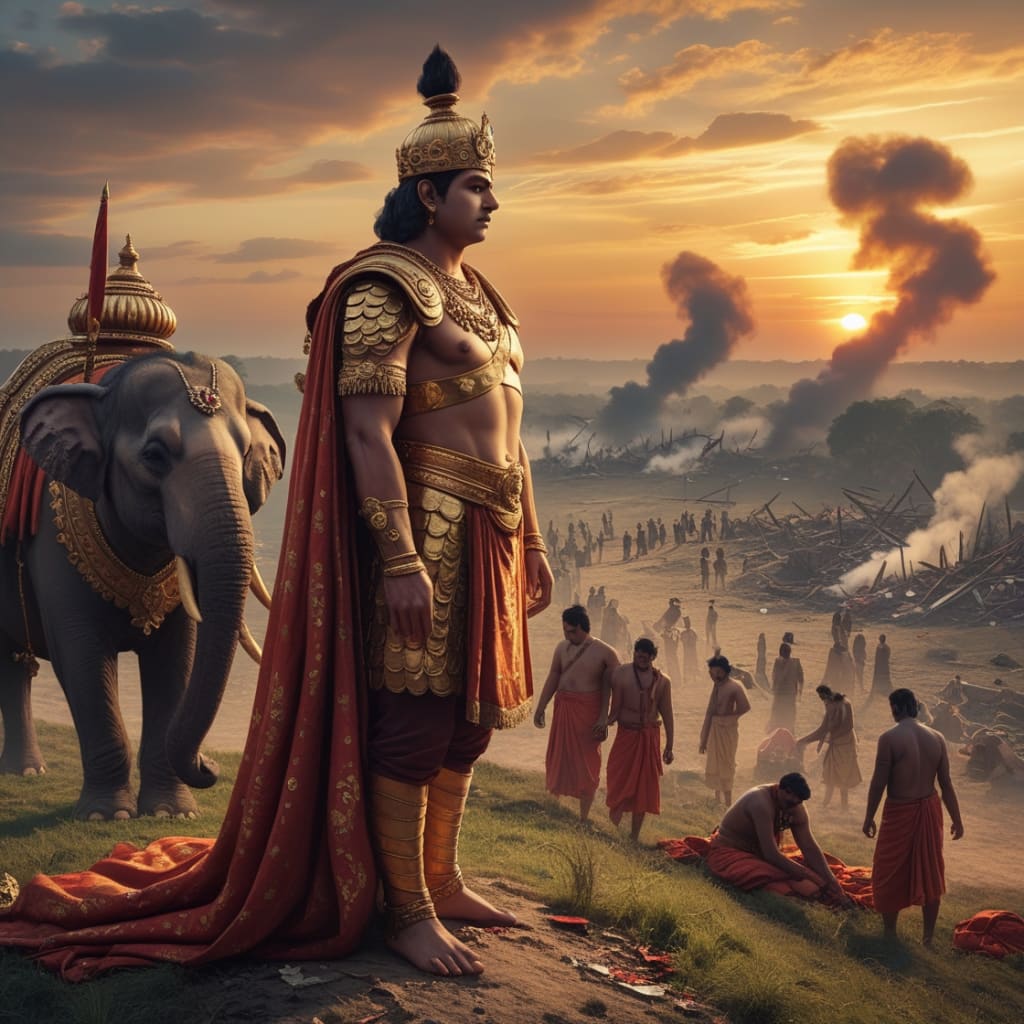
Introduction: A Prince of Conflict
Ashoka Maurya (circa 304–232 BCE), also referred to as Ashoka the Great, was born into the royal Mauryan lineage as the grandson of Chandragupta Maurya, the empire’s founder. Although he was not the primary heir, Ashoka was an adept warrior and strategist, ultimately appointed governor of Ujjain and subsequently Taxilaboth vital frontier territories where his military capabilities were tested and validated.
His initial military campaigns established the foundation for his ascension to the throne around 268 BCE. Once in authority, Ashoka swiftly positioned himself as a sovereign capable of both unyielding military supremacy and perceptive political governance.
The Conquest of Kalinga: A Pivotal Moment in History
The most notorious conflict in Ashoka's career was the conquest of Kalinga, a prosperous kingdom situated on the eastern coast of India. Kalinga was not only bountiful in resources but was also strategically located on significant trade routes and staunchly independent. In spite of warnings from advisors and generals, Ashoka launched a full-scale incursion in 261 BCE.
Military Strategy:
Ashoka employed a combination of:
Extensive infantry and cavalry units
Siege warfare and river-crossing maneuvers
Naval assistance to assault from both terrestrial and maritime fronts
The confrontation was protracted and ruthless. According to Ashoka’s own inscriptions, over 100,000 individuals lost their lives, and 150,000 were exiled. The devastation was so severe that it irrevocably altered the emperor's perspective.
The Aftermath: The Psychological Impact of War
Ashoka visited the battlefield personally after Kalinga’s capitulation. What he witnessedincinerated villages, disfigured corpses, and mourning familiesimprinted significantly on his conscience.
In one of his rock edicts, Ashoka proclaimed:
“A hundred thousand persons were slain… this weighs heavily on the conscience of the Devanampriya [Beloved of the Gods], for he experiences profound remorse for conquering Kalinga. ”
This moment of introspection signified the conclusion of Ashoka’s military endeavors and the onset of a remarkable transformation in governancefrom imperial conquest to moral triumph (Dhamma Vijaya).
Dhamma Vijaya: The New Governance Strategy
Instead of expanding through warfare, Ashoka embraced Dhamma Vijaya, or “conquest through righteousness. ” His revised strategy concentrated on:
Diplomatic missions to adjacent kingdoms
Advocation of Buddhist tenets: compassion, non-violence, and tolerance
Public welfare initiatives: hospitals, rest houses, and infrastructure development
He dispatched envoys to destinations such as Greece, Egypt, Sri Lanka, and Central Asia, disseminating the message of tranquility and establishing diplomatic connections. Consequently, Ashoka’s empire continued to expandnot through violence, but through cultural influence and soft power.
Military Reforms Following Kalinga
Although Ashoka halted aggressive warfare, he did not disband the military. Rather, he:
Reorganized the armed forces exclusively for defense
Constructed watchtowers and border fortifications
Developed a network of messengers and informants for internal security
This enabled Ashoka to maintain the integrity of his empire while adhering to his newly embraced principles. Military leaders were also assigned the responsibility of promoting Dhamma among soldiers and citizens, ensuring that peace was upheld not by force but by reciprocal respect.
Ashoka’s Employment of Propaganda and Messaging
Ashoka excelled in utilizing communication as a tactical instrument. Through edicts engraved on rocks and pillars throughout the empire, he articulated his vision of righteous governance.
These inscriptions:
Encouraged individuals to shun violence and honor all religions
Admonished officials against corruption and injustice
Motivated the military to act as defenders, not oppressors
This method of ideological warfare contributed to unifying the diverse populations of India under a common moral framework.
Legacy: Warrior Transformed into Sage
Ashoka’s metamorphosis from a ruthless conqueror to a pacific emperor is unmatched in history. His legacy impacted:
The dissemination of Buddhism across Asia
Principles of non-violent administration
Contemporary notions of human rights and religious tolerance
UNESCO even recognized the Ashoka Chakra, the emblem of eternal law, as a component of India’s national flag to commemorate his influence.
Conclusion: The Conqueror Who Embraced Compassion
Ashoka's initial military strategy was grounded in traditional principles of Indian warfarelarge armies, strategic terrains, and decisive force. Nevertheless, his true significance surfaced when he completely renounced war, opting to govern through wisdom, compassion, and diplomacy.
While numerous rulers expanded their empires through violence and destruction, Ashoka's second conquestof his own consciencewas his most significant. His reign became a paradigm for ethical leadership in a tumultuous world and demonstrated that the most potent weapon can be a compassionate heart.
About the Creator
Say the truth
"Say the Truth: Explain Everything in the World" is your trusted source for uncovering facts and exploring the wonders of history, science, technology, and beyond. We simplify complex ideas and reveal truths to inspire curiosity .
Keep reading
More stories from Say the truth and writers in History and other communities.
The Military Tactics of Cyrus the Great: Architect of the First Persian Empire
Introduction: A Victor with a Principle Cyrus II of Persia, widely recognized as Cyrus the Great (c. 600–530 BCE), is commemorated as one of history’s most enlightened victors. While numerous monarchs depended on brute force, Cyrus amalgamated astute battlefield maneuvers, logistics, and psychological warfare with an unparalleled regard for regional cultures and religious liberty.
By Say the truth 8 months ago in History
A woman from a vanished female dynasty was discovered buried with 270,000 beads.
In a Copper Age tomb close to Seville, Spain, the Montelirio bead assemblage contains over 270,000 beads that identify the ladies buried there as elites. The discovery is the biggest collection of beads ever
By Francis Dami5 days ago in History
The Ottoman Empire
In the late thirteenth century, when the great empires of the medieval world were beginning to crack under their own weight, few would have noticed a small Turkic tribe living on the edge of the collapsing Byzantine Empire. They owned little land, had no grand cities, and were surrounded by stronger rivals. Yet from this humble beginning would rise one of the longest-lasting and most influential empires in human history: the Ottoman Empire.
By The best writer 4 days ago in History



Comments
There are no comments for this story
Be the first to respond and start the conversation.