
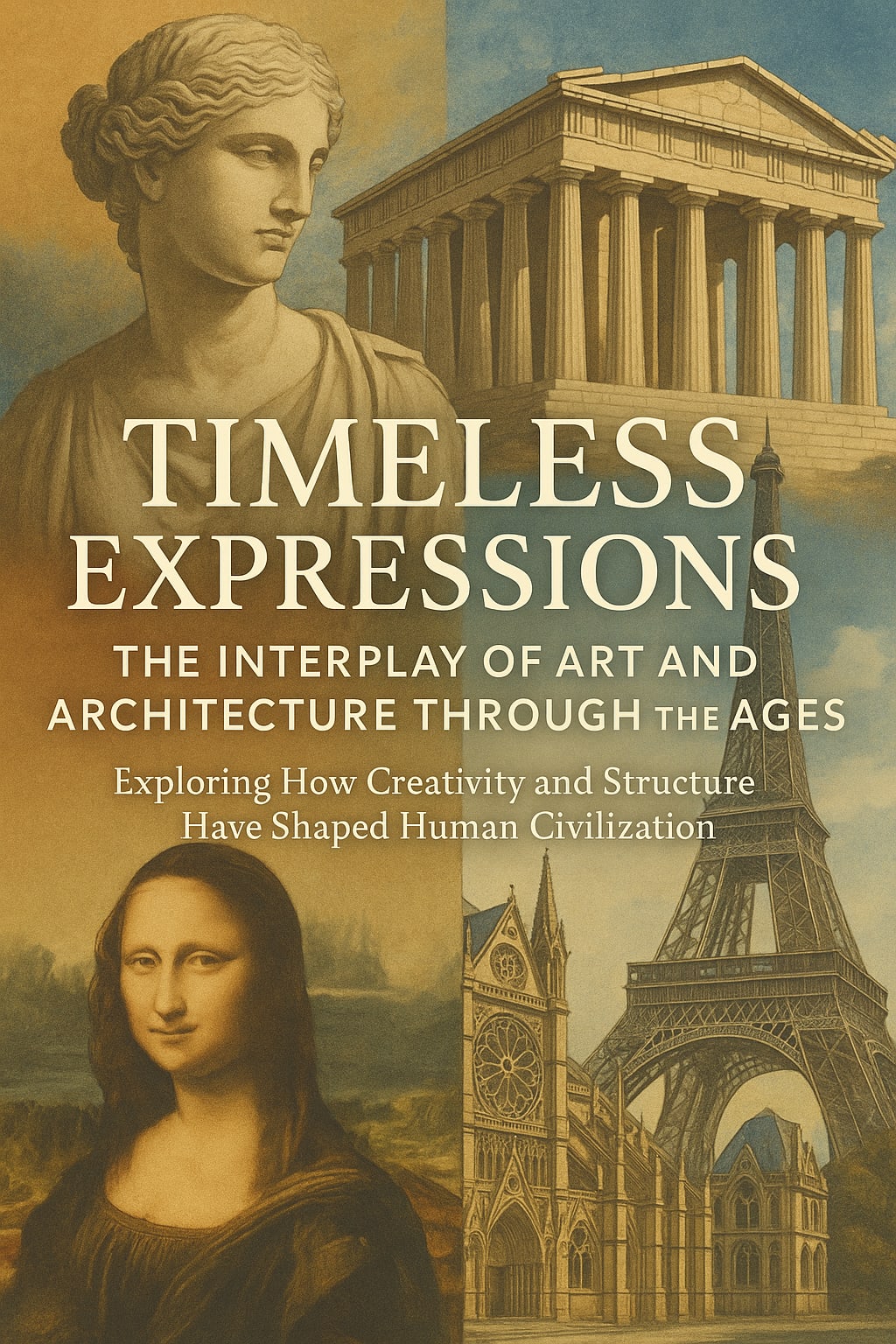
The Interplay of Art and Architecture Through the Ages
Exploring How Creativity and Structure Have Shaped Human Civilization

Introduction
Art and architecture have always been interconnected threads in the fabric of human civilization. From the towering pyramids of Egypt to the minimalist elegance of modern skyscrapers, these disciplines have not only shaped the way we live but also reflected our cultural, spiritual, and philosophical values. Architecture provides the form and function of space, while art infuses it with meaning, emotion, and symbolism. Together, they create environments that are not only functional but also profoundly expressive.
Ancient Foundations: Form Meets Symbolism
In ancient times, architecture was not merely about building shelter—it was a way to connect with the divine and immortalize the human experience. Monumental structures like the Great Pyramids of Giza, Stonehenge, and Mesopotamian ziggurats are enduring testaments to this philosophy.
Egyptian Architecture and Art: The Egyptians saw art and architecture as tools to honor their gods and guide souls to the afterlife. Temples and tombs were richly adorned with carvings, paintings, and hieroglyphics, blending artistic beauty with architectural grandeur.
Greek and Roman Influence: Ancient Greece introduced the concept of aesthetic harmony, symmetry, and proportion. Temples like the Parthenon were masterpieces of architecture enriched with detailed sculptures and friezes. The Romans took it further, incorporating engineering innovations like the arch and the dome, exemplified in the Pantheon—a perfect fusion of form and artistic expression.
Religious Inspiration and Gothic Grandeur
During the medieval period, especially in Europe, the interplay of art and architecture was heavily influenced by religion.
Gothic Cathedrals: Structures like Notre-Dame de Paris or Chartres Cathedral were not only places of worship but also visual Bibles for a largely illiterate population. Stained glass windows, sculptural facades, and towering spires conveyed biblical narratives, moral lessons, and spiritual transcendence.
Islamic Architecture: In the Islamic world, mosques became centers of both religious practice and artistic innovation. Architectural elements like intricate tile work, arabesques, and geometric patterns demonstrated a deep integration of art and sacred design, visible in wonders like the Alhambra in Spain or the Blue Mosque in Istanbul.
The Renaissance: Humanism and Innovation
The Renaissance era (14th–17th centuries) marked a dramatic shift as humanism took center stage. Artists and architects were seen as intellectuals rather than mere craftsmen.
Leonardo da Vinci, Michelangelo, and Raphael pushed the boundaries of artistic expression, often working on architectural projects as well. The Florence Cathedral's dome by Filippo Brunelleschi is a marvel of engineering and design, marrying mathematics and artistry in unprecedented ways.
Architecture became a canvas for human achievement, science, and proportion. Every structure aimed to balance functionality with ideal beauty, rooted in the rediscovery of classical Greek and Roman principles.
Baroque, Rococo, and the Power of Ornament
In the 17th and 18th centuries, architecture and art became increasingly theatrical and elaborate.
Baroque Architecture, seen in buildings like St. Peter's Basilica in Rome, used grand scales, dramatic lighting, and rich decoration to inspire awe and convey power.
Rococo, which followed Baroque, took the decorative aspect further, using delicate pastel colors, gold leaf, and ornamental motifs to create a sense of luxury and whimsy. Palaces such as Versailles in France stand as monuments to this highly ornamental integration of art and architecture.
Modernism and Minimalism: A Shift in Thought
By the 20th century, the world had undergone massive changes—two world wars, industrialization, and global cultural shifts. These changes deeply affected both art and architecture.
Modern Architecture, led by figures like Le Corbusier, Frank Lloyd Wright, and Walter Gropius, emphasized function over form. The idea of "form follows function" minimized decoration in favor of clean lines and efficient use of space.
Artistic movements like Cubism, Abstract Expressionism, and Surrealism began to influence building design. The Bauhaus School in Germany became a hub for merging art and architecture with industrial design and typography, reshaping the creative landscape.
Postmodernism and Beyond: Blurring the Lines
Postmodern architecture, emerging in the mid-to-late 20th century, rejected the austerity of modernism and embraced complexity, color, and historical reference.
Architects like Michael Graves and Frank Gehry introduced buildings that were both functional and playfully artistic. Gehry’s Guggenheim Museum in Bilbao, Spain, is a sculptural marvel that challenges the traditional notion of a building.
In contemporary architecture, digital design tools, sustainable technologies, and cross-disciplinary approaches have allowed art and architecture to merge even more fluidly. Installations, green buildings, and mixed-media facades redefine our built environments.
Art Within Architecture Today
Today, art is often integrated directly into architectural design:
Public Art Installations are frequently embedded into urban landscapes—murals, sculptures, and interactive spaces turn ordinary environments into dynamic experiences.
Cultural Spaces like museums, theaters, and galleries are themselves artistic statements. The Sydney Opera House or the Louvre Abu Dhabi are examples of buildings that function as both artistic symbols and cultural hubs.
Digital Art and Smart Design: With the rise of augmented reality and smart environments, architecture is no longer static. Walls can display digital art, and responsive materials can change color, shape, or light based on environmental conditions.
Conclusion
The relationship between art and architecture is a timeless dance of imagination, utility, and cultural expression. Together, they tell the story of humanity—our beliefs, our triumphs, and our evolving understanding of beauty and purpose. As technology continues to transform our world, the synergy between these disciplines will remain central to how we shape our cities, our homes, and ultimately, ourselves.
About the Creator
Nizam Archaeologist
I’m deeply fascinated by archaeology and the mysteries of ancient civilizations.My goal is to bring the past to life, spark curiosity, and share the wisdom of cultures that have stood the test of time.
Keep reading
More stories from Nizam Archaeologist and writers in History and other communities.
The Tower of London
The Tower of London: Fortress, Palace, and Prison The Tower of London stands as one of the most iconic and enduring symbols of British history. Situated on the northern bank of the River Thames, this formidable structure has served a multitude of roles over the centuries—fortress, royal residence, armory, mint, prison, and even a zoo. Its bloody past and architectural grandeur attract millions of visitors each year, drawn by tales of royalty, betrayal, and the mysterious ravens that guard its walls.
By Nizam Archaeologist6 months ago in History
Girolamo Segato: The Scientist Who Turned Humans into Stone
The Mysterious Italian Genius Behind the Art of Human Petrification Girolamo Segato remains one of the most mysterious scientists of the 19th century, remembered not only for his scientific brilliance but also for a secret he took to his grave. Born in 1792 in Italy, Segato gained worldwide attention for achieving something that still puzzles scientists today: he discovered a method to turn human and animal body parts into stone-like fossils while preserving their detailed structure. Unlike mummification, Segato’s process created specimens that looked and felt like real stone, yet retained the microscopic details of living tissue. Early Life and Education Girolamo Segato was born in the small town of Sospirolo, near Belluno, Italy. From an early age, he showed a deep interest in science, anatomy, and natural history. He studied engineering and anatomy and later became involved in archaeological and scientific research. His curiosity eventually led him to Egypt, where he spent several years studying ancient civilizations, mummification techniques, and geological formations. Segato was deeply inspired by ancient Egyptian preservation methods, but he believed there was a way to go beyond traditional embalming. His goal was not just to preserve bodies but to transform organic tissue into an inorganic, stone-like substance. The Discovery of Human Petrification After returning to Italy, Segato began experimenting with human and animal remains. Over time, he developed a secret chemical process that allowed him to petrify body parts such as hands, feet, heads, and internal organs. These specimens were not dried or decayed. Instead, they became hard like marble or stone, resistant to time, moisture, and decay. What made Segato’s work extraordinary was the level of detail preserved. Veins, muscles, skin texture, and even facial expressions were visible in the petrified remains. Scientists who examined these objects noted that they were neither mummified nor fossilized through natural processes. They appeared to be something entirely new. Public Reaction and Fear Although Segato’s discovery was groundbreaking, it was also deeply unsettling to many people. In 19th-century Europe, turning human remains into stone was seen by some as unnatural or even blasphemous. Religious authorities and conservative groups accused Segato of practicing forbidden science. Because of this backlash, Segato struggled financially and socially. He tried to sell his method to scientific institutions, but fear and suspicion prevented widespread acceptance. Many people admired his work privately but were unwilling to support him publicly. The Secret That Died With Him One of the greatest mysteries surrounding Girolamo Segato is that he never revealed his petrification formula. Whether due to fear, mistrust, or lack of support, Segato chose to keep his process secret. When he died in 1836, the knowledge died with him. Today, no scientist has been able to fully replicate his results. Despite advances in chemistry and material science, Segato’s exact technique remains unknown. This has led to speculation ranging from lost chemical knowledge to deliberate secrecy caused by persecution. Preserved Works Today Some of Segato’s petrified specimens still exist and can be seen in museums in Florence, Italy, particularly at the Museum of the Basilica of Santa Croce. These stone-like human remains continue to attract researchers, historians, and visitors from around the world. Modern scientific analysis confirms that these objects are real human tissues transformed into a mineralized state. However, the precise chemical reactions involved remain unclear, adding to Segato’s legend. Legacy and Scientific Importance Girolamo Segato’s work challenges the boundary between life and stone, biology and geology. His experiments raise important questions about preservation, material transformation, and the ethics of scientific discovery. Although controversial, his research was far ahead of its time and continues to inspire curiosity. Some experts believe Segato’s work could have applications in modern science, such as long-term biological preservation, archaeology, or even medical research. Others view his story as a warning about how society sometimes rejects revolutionary ideas out of fear. Conclusion Girolamo Segato was not a madman, nor a magician. He was a scientist whose discovery frightened the world around him. By turning human tissue into stone, he achieved something that remains unexplained nearly two centuries later. His life is a powerful reminder that scientific progress often walks hand in hand with controversy. Though his secret is lost, Girolamo Segato’s legacy lives on—etched in stone, silent yet enduring, challenging humanity to question what is truly possible.
By Hasbanullah6 days ago in History
Wild Card Weekend Recap: What Happens Now?
I think I figured out why I love Wild Card Weekend so much. It's because it's the first playoff anything of the calendar year. The NFL season starts in the fall, and once upon a time, the champion was crowned either on or slightly before New Year's. The evolution of the NFL schedule has resulted in the playoffs starting just into the New Year, and currently, the final week of the season falls on the first weekend of the New Year, with Wild Card Weekend coming a week after that. So yes, chronologically, the NFL's Wild Card Weekend serves as the first playoff anything of the calendar year.
By Clyde E. Dawkins5 days ago in Unbalanced



Comments
There are no comments for this story
Be the first to respond and start the conversation.