
The Ink of Liberty
A Story of Lexington and Concord

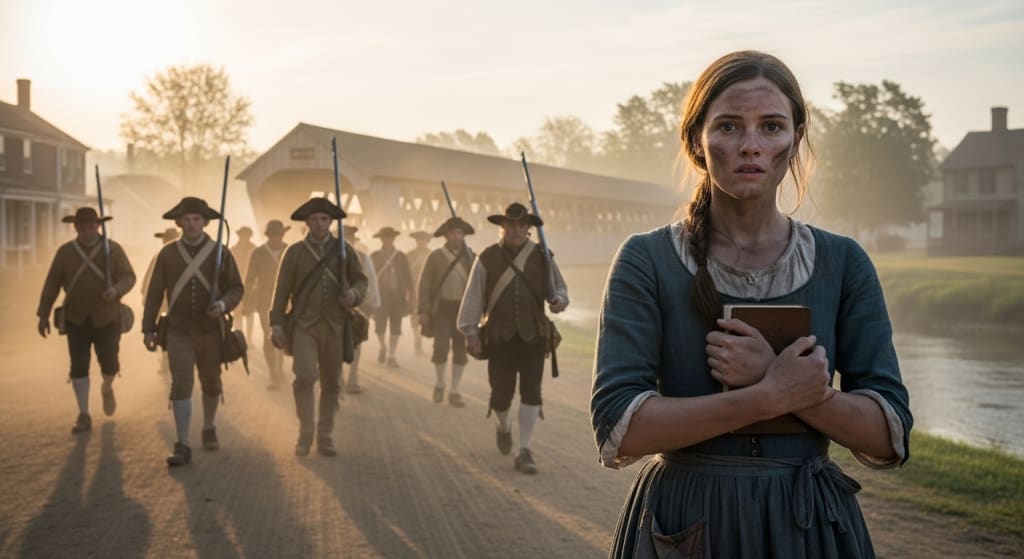
The dawn of April 19th tasted of cold metal and fear. I, Eliza Carter, sixteen years old, stood at the window of my father’s house, which stood stubbornly by the Concord Road. The air, usually filled with the scent of baking bread and damp earth, was now charged with a silence that felt like a held breath.
“They are coming, Eliza,” my father whispered, his face grim in the candlelight. He was a printer, a man of words, not war. But his press had recently produced pamphlets decrying the British tyranny, and we knew we were being watched.
I wasn’t a soldier. I was a chronicler. My weapon was my journal, a gift from my father. “Record it, Eliza,” he had told me the night before, pressing the leather-bound book into my hands. “Not the speeches of generals, but the truth of the people. The ink of liberty is as powerful as any musket ball.”
The first sound was not a shot, but the rhythmic, terrifying tramp of hundreds of boots. Through the window, I saw them—a line of red, a “lobsterback” column stretching down the road like a wound. Their faces were young, stern, and alien. They were here for our powder, our arms, our very will.
But as they passed, something else happened. From the woods, from the farmhouses, men emerged. Not soldiers. They were our neighbors—farmers, blacksmiths, storekeepers. They held their own muskets, their faces set with a determination I had never seen. They did not stand in a neat line. They melted into the stone walls and the trees, their eyes fixed on the British rear.
My father was pulled away by a frantic messenger. “The press, John! They’ll surely seize it!”
I was left alone with my pounding heart and my blank page. The first crack of a musket from the green at Lexington made me jump, the sound rolling over the hills like a thunderclap. My hand trembled, but I began to write.
April 19. The regulars have fired upon our men at Lexington. The King’s troops have spilled first blood. The war is here.
I wrote of the smoke that began to stain the sky over Concord. I wrote of the frantic, glorious chaos at the North Bridge, where our men, my neighbors, stood their ground and fired the "shot heard round the world." I didn’t see a grand battle; I saw Mr. Hosmer, the old carpenter from down the lane, his face smudged with powder, helping a wounded boy. I saw the Minutemen, not as a faceless army, but as individuals—their fear, their courage, their desperate love for their homes.
The British retreat began. It was not an orderly march but a bloody, harrowing flight. From my window, I saw the red coats fall, not to a grand army, but to the relentless, invisible fire from behind every wall and tree. It was brutal. It was terrifying. And it was our only chance.
When the last of the King’s troops had staggered out of sight, a strange, hollow silence returned. The air was thick with the smell of gunpowder and a new, terrible reality.
My father returned, his clothes torn but his press safe, hidden in a root cellar. He looked at me, at the journal in my lap. “What have you written, daughter?”
I handed it to him, my fingers stained with ink. He read my shaky script, his own eyes growing bright.
“You have not written of a battle, Eliza,” he said, his voice thick. “You have written of a birth.”
That night, by the light of a single candle, my father set the type. He did not print a broadside with a general’s name. He printed my words, the account of a sixteen-year-old girl who saw the day a nation of farmers decided they would be free.
The story of Lexington and Concord is told in history books with dates and strategies. But the truth of it was written in the dust of a country road, in the fear of a young girl’s heart, and in the indelible ink of a people’s resolve. I was there. I saw it. And I wrote it down.
About the Creator
The 9x Fawdi
Dark Science Of Society — welcome to The 9x Fawdi’s world.
Keep reading
More stories from The 9x Fawdi and writers in History and other communities.
The Moon-Dusted Rebellion
The weight of the day settled on Elara like a shroud woven from grey air and unspoken fears. It was 1943, and the village of Sainte-Marie, nestled in the rolling belly of occupied France, had long since forgotten the vibrant hues of peace. Now, every street corner held a silent sentinel of dread, every whisper a potential betrayal. The clatter of hobnailed boots on cobblestones was the village’s true heartbeat, a brutal, relentless rhythm. Elara spent her days mending torn clothes, her fingers nimble but her spirit heavy, listening to the strained silence of her neighbors, the forced pleasantries, the careful avoidance of gazes that might linger too long. Hope was a fragile thing, easily crushed under the heel of an unseen boot.
By The 9x Fawdiabout a month ago in History
Power's Sake
When it comes to gaining power, bad people use it to gain more They never gain power to do something with it, they gain power to have it, relish in it, double it down on itself so it grows exponentially and never goes anywhere. Even if you see the people in power commit an atrocity, that is never the true goal. It is a deplorable action for sure but the action itself usually doesn't matter it's the outcome.
By Donny Foley2 days ago in History
Military Strength of Alexander the Great and the Chola Empire: A Historical Comparison
Though separated by more than a thousand years and operating in vastly different geographical and cultural contexts, both forces achieved extraordinary success through discipline, innovation, and strategic brilliance. This article explores the history, composition, size, organization, and military strength of Alexander’s Macedonian army and the Chola military, highlighting how each became a dominant power of its era.
By Say the truth 2 days ago in History




Comments
There are no comments for this story
Be the first to respond and start the conversation.