
The Indus Valley Civilization
An Ancient Urban Marvel of South Asia

The Indus Valley Civilization
An Ancient Urban Marvel of South Asia
The Indus Valley Civilization (IVC), also known as the Harappan Civilization, stands as one of the earliest and most remarkable civilizations in human history. Flourishing around 2600 BCE to 1900 BCE, it thrived along the fertile floodplains of the Indus River in what is now modern-day Pakistan and northwest India. The civilization’s achievements in urban planning, architecture, agriculture, and trade are not only astounding for their time but also evidence of a highly organized and sophisticated society.
Geographical Extent and Major Cities
The Indus Valley Civilization was vast, covering more than 1.25 million square kilometers—larger than Mesopotamia or Ancient Egypt. It extended from Balochistan in the west to Uttar Pradesh in the east, and from the Himalayas in the north to the coastal regions of Gujarat in the south.
Some of the most significant cities include:
Harappa (Punjab, Pakistan): The first site discovered, lending its name to the entire civilization.
Mohenjo-Daro (Sindh, Pakistan): Perhaps the most advanced city of the IVC.
Dholavira (Gujarat, India): Known for its unique water conservation system.
Lothal (Gujarat, India): A key trading port and dockyard.
Kalibangan (Rajasthan, India): Famous for early plowed fields and fire altars.
Urban Planning and Architecture
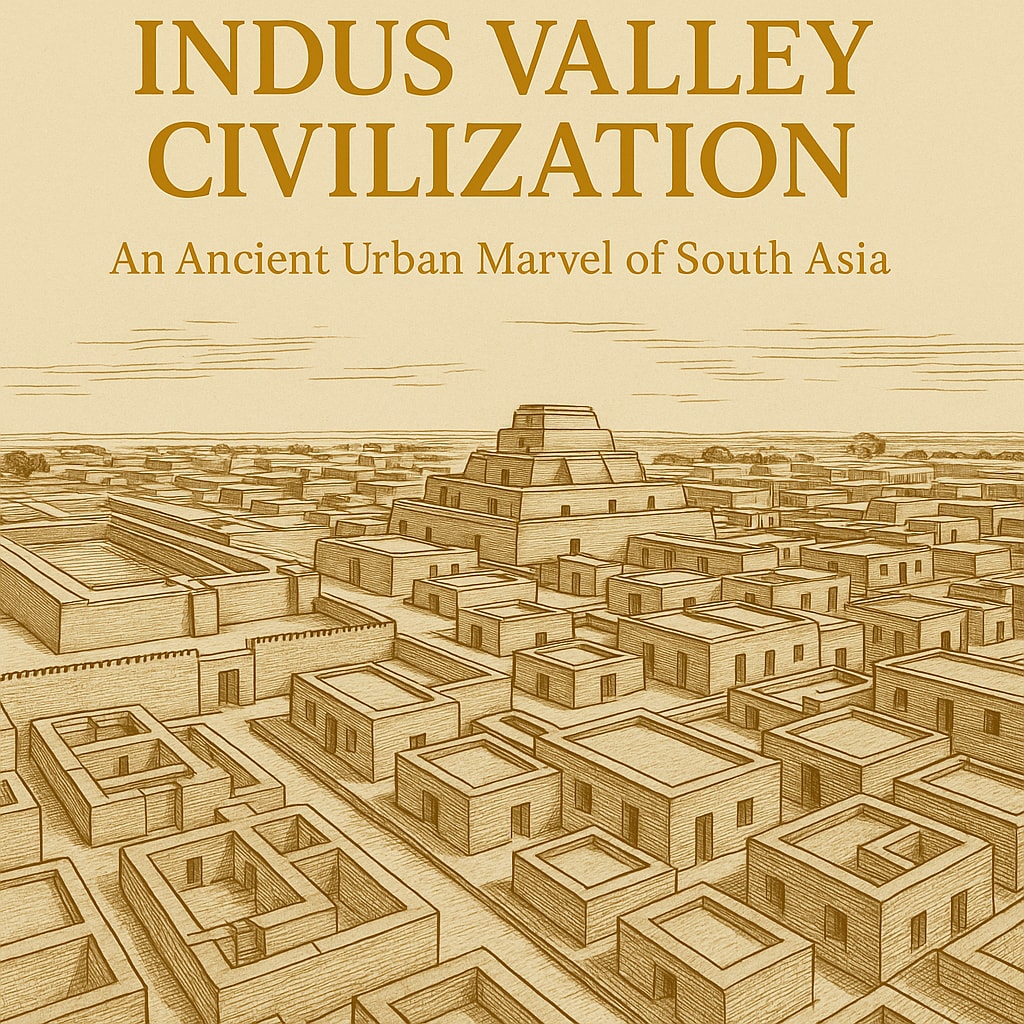
The Indus cities were among the earliest examples of urban planning in the ancient world. Streets were laid out in a grid pattern, homes were built using baked bricks, and there was a clear division between residential and public areas.
Social Structure and Daily Life
Despite the high level of organization, little is known about the political or social hierarchy due to the undeciphered Indus script. However, the uniformity in weights, measures, and brick sizes suggests a centralized authority or a shared culture across different cities.
People lived in brick houses, wore cotton clothes, and adorned themselves with beads, bangles, and ornaments made of gold, terracotta, and semi-precious stones. Artifacts such as toys, pottery, and sculptures suggest a rich and diverse cultural life.
Trade and Economy
The Indus people had a thriving economy based on agriculture, crafts, and trade. They grew wheat, barley, peas, and cotton, and domesticated animals such as cattle, buffalo, and goats.
The civilization engaged in long-distance trade with Mesopotamia (modern Iraq), Central Asia, and even the Persian Gulf. Items like lapis lazuli, carnelian, and marine shells found in distant lands indicate a wide trade network.
Art and Culture
The artistic achievements of the Indus people were subtle yet sophisticated. Notable finds include:
The Dancing Girl of Mohenjo-Daro: A bronze statue believed to depict a young female dancer with a confident posture and detailed adornments.
The Priest-King statue: A carved steatite figure, possibly a religious or civic leader.
Painted pottery: With geometric designs, animal motifs, and daily life scenes.
These artifacts suggest a rich aesthetic sense and a culture that valued craftsmanship and beauty.
Religion and Beliefs
Though no temples or religious texts have been found, several elements point to spiritual practices:
Figurines of a Mother Goddess suggest fertility worship.
Animal motifs, such as bulls and unicorn-like creatures, may have held symbolic or sacred meaning.
The presence of fire altars and bathing areas may indicate religious rituals related to purity and nature worship.
Some scholars believe that certain elements of Hinduism—like the worship of Shiva or the sacredness of animals—may have roots in the Indus belief systems, though this is debated.
Writing System
The Indus script remains one of the greatest mysteries of the civilization. Found on seals, pottery, and tablets, it consists of pictographic symbols. Despite numerous efforts, the script has not been conclusively deciphered, limiting our understanding of their language, administration, and literature.
Decline of the Civilization
By around 1900 BCE, the Indus Valley Civilization began to decline. The reasons are still debated but may include:
Climate change and shifting river patterns, especially the drying up of the Saraswati River.
Flooding in cities like Mohenjo-Daro.
Decline in trade with Mesopotamia.
Possible invasion or migration of Indo-Aryan groups (although this theory is controversial).
About the Creator
Nizam Archaeologist
I’m deeply fascinated by archaeology and the mysteries of ancient civilizations.My goal is to bring the past to life, spark curiosity, and share the wisdom of cultures that have stood the test of time.
Reader insights
Outstanding
Excellent work. Looking forward to reading more!
Top insights
Easy to read and follow
Well-structured & engaging content
Excellent storytelling
Original narrative & well developed characters
Expert insights and opinions
Arguments were carefully researched and presented
Heartfelt and relatable
The story invoked strong personal emotions
On-point and relevant
Writing reflected the title & theme
Keep reading
More stories from Nizam Archaeologist and writers in History and other communities.
The Secret Key: Unlocking the Lost Knowledge of the Ancients
Throughout human history, civilizations have risen, flourished, and disappeared, leaving behind ruins, symbols, texts, and artifacts that continue to puzzle modern scholars. Beneath these remnants lies a compelling idea: that ancient societies possessed knowledge far more advanced, symbolic, or profound than we often give them credit for. This idea is commonly described as “the secret key”—a metaphor for the forgotten systems of knowledge that once shaped humanity’s understanding of the world, the cosmos, and itself.
By Nizam Archaeologist28 days ago in History
3 Everyday Rules That Exist Because Someone Once Did Something Very Stupid
Everywhere you go, you are surrounded by rules that feel oddly specific. Do not touch. No running. Contents hot. Do not insert body parts. These warnings aren’t theoretical. They weren’t written by pessimists or lawyers with too much free time. They exist because at some point in history, a real human being looked at a situation and thought, “This will probably be fine.”
By Enoch Saginia day ago in History
Nanchang: A Modern Symbol of China’s Naval Power
In recent years, the world has closely watched the rapid modernization of the Chinese People’s Liberation Army Navy (PLA Navy). One of the most important symbols of this transformation is the Nanchang (Hull 101), China’s first Type 055 guided-missile destroyer. Commissioned on 12 January 2020, Nanchang represents a major leap in naval technology and capability. As it completes six years of active service, the ship stands as a clear example of how China’s navy has moved into a new era of advanced maritime power.
By sehzeen fatima3 days ago in History



Comments (1)
This story is very helpful in my knowledge