
The Secret Key: Unlocking the Lost Knowledge of the Ancients
Forgotten Symbols, Hidden Texts, and the Wisdom of Early Civilizations

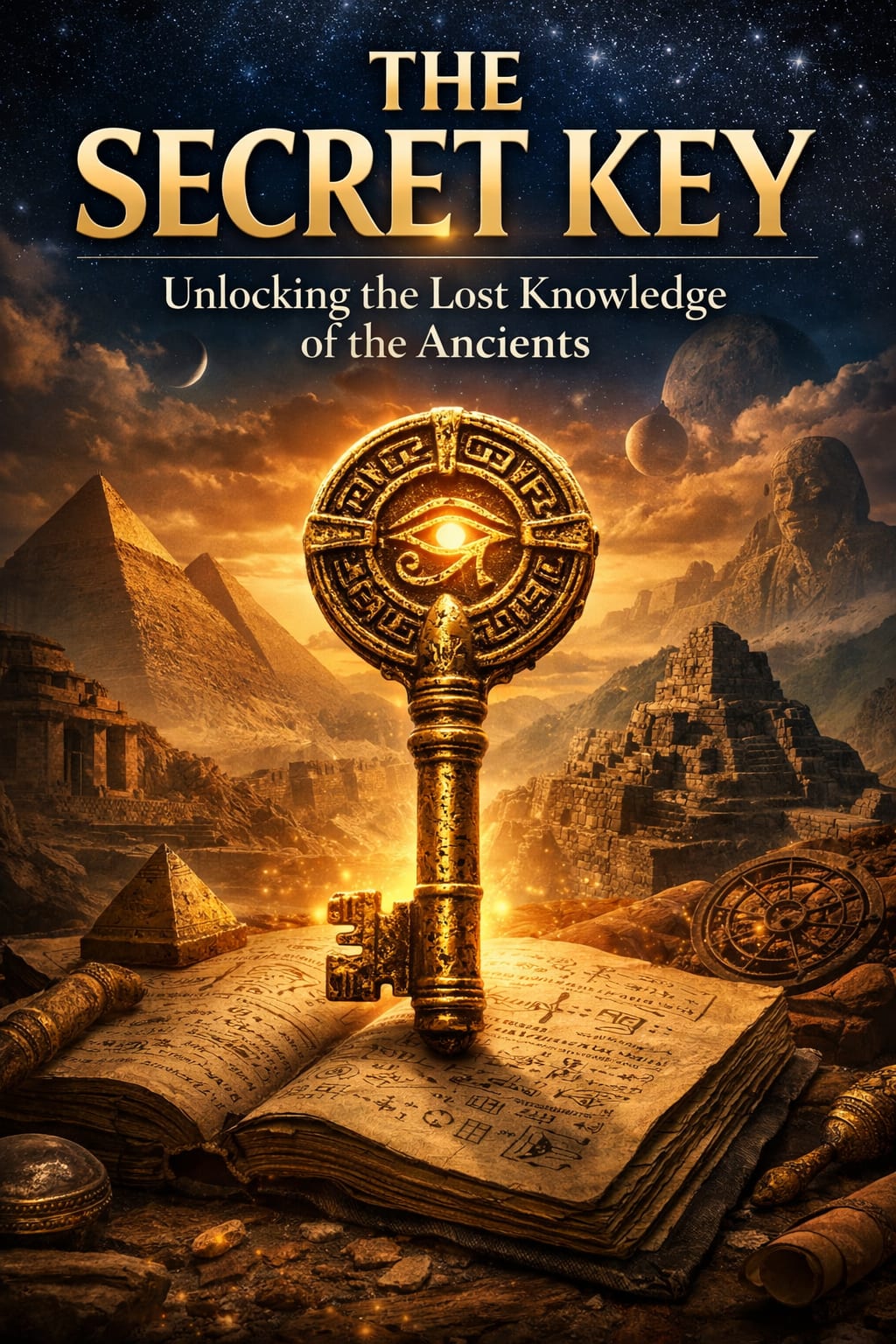
Throughout human history, civilizations have risen, flourished, and disappeared, leaving behind ruins, symbols, texts, and artifacts that continue to puzzle modern scholars. Beneath these remnants lies a compelling idea: that ancient societies possessed knowledge far more advanced, symbolic, or profound than we often give them credit for. This idea is commonly described as “the secret key”—a metaphor for the forgotten systems of knowledge that once shaped humanity’s understanding of the world, the cosmos, and itself.
Ancient Knowledge Beyond Survival
Early civilizations were not solely concerned with survival. They observed the stars, measured time, mapped landscapes, and encoded philosophical ideas into architecture, art, and language. From the pyramids of Egypt to the ziggurats of Mesopotamia, these structures were not random creations. They reflected mathematical precision, astronomical alignment, and spiritual purpose.
For example, the Great Pyramid of Giza is aligned with astonishing accuracy to the cardinal points. Its dimensions reflect mathematical constants that were supposedly “discovered” thousands of years later. Such precision raises an important question: how did ancient builders achieve this without modern instruments? The answer may lie in lost methods of observation, geometry, and symbolic knowledge—parts of the secret key that modern society has yet to fully reconstruct.
Symbols as a Universal Language
One of the most important components of ancient knowledge was symbolism. Unlike modern writing systems focused on direct communication, ancient symbols carried multiple layers of meaning. A single symbol could represent a natural force, a deity, a scientific concept, and a philosophical truth all at once.
Consider ancient Egyptian hieroglyphs. For centuries, they were considered purely decorative until the Rosetta Stone provided the key to their translation. Once deciphered, scholars realized that hieroglyphs were not only historical records but also metaphysical expressions of how the Egyptians understood life, death, and the universe.
Similarly, symbols found in ancient Indian mandalas, Mayan glyphs, and Sumerian tablets suggest a shared human attempt to encode complex ideas into visual forms. These symbols may represent the secret key to understanding how ancient people perceived reality—not as fragmented disciplines, but as a unified whole.
Lost Libraries and Vanished Wisdom
Perhaps the greatest tragedy in the story of ancient knowledge is the destruction of learning centers. The most famous example is the Library of Alexandria, which was said to contain hundreds of thousands of scrolls covering science, philosophy, medicine, astronomy, and engineering. Its destruction symbolizes the irreversible loss of knowledge that could have dramatically altered the course of human history.
Other ancient centers of learning—such as Nalanda University in India or the Mayan codex collections—suffered similar fates. Wars, religious conflicts, and cultural shifts led to the deliberate erasure of older knowledge systems. What remains are fragments, clues, and echoes, forcing modern scholars to reconstruct entire worldviews from incomplete evidence.
Astronomy and the Cosmic Code
One of the most striking areas where ancient knowledge shines is astronomy. Many ancient sites align precisely with solstices, equinoxes, and celestial events. Stonehenge, Machu Picchu, Angkor Wat, and Chichén Itzá are not just architectural wonders; they are astronomical instruments.
The Maya, for instance, developed calendars so accurate that they rival modern calculations. They tracked planetary movements, eclipses, and cycles of time with remarkable precision. These achievements suggest that ancient civilizations possessed a deep understanding of cosmic rhythms—a key that connected human life to the movements of the heavens.
This cosmic awareness was not merely scientific; it was spiritual. The ancients believed that the universe operated according to harmony and balance, and that humanity was part of this cosmic order.
Technology Without Machines
Modern society often equates advancement with machinery and electricity, but ancient civilizations followed a different path. Their technology focused on knowledge, observation, and natural forces. Roman concrete, for example, remains stronger than many modern materials. Greek engineers built complex mechanical devices like the Antikythera mechanism, an ancient astronomical calculator that was centuries ahead of its time.
These innovations challenge the assumption that technological progress is linear. Instead, they suggest that ancient civilizations developed specialized knowledge that was later lost, forgotten, or ignored.
Oral Traditions and Hidden Teachings
Not all ancient knowledge was written down. Many cultures relied on oral traditions, passing wisdom through storytelling, rituals, and initiation practices. This knowledge was often restricted to priests, scholars, or elders, ensuring that it remained protected from misuse.
In many ancient traditions, knowledge was considered sacred. It was not meant for everyone, but only for those prepared to understand it. This selective transmission may explain why so much wisdom vanished when civilizations collapsed—the keepers of the knowledge disappeared, and the key was lost with them.
Why the Secret Key Still Matters
The search for ancient knowledge is not merely about curiosity or nostalgia. It holds practical importance today. Ancient systems emphasized sustainability, harmony with nature, and long-term thinking—principles that modern society struggles to reclaim.
By studying ancient architecture, agriculture, medicine, and philosophy, we gain alternative perspectives on problem-solving. The ancients viewed humanity as part of a larger system, not as rulers over it. This worldview may offer crucial insights in an age of environmental crisis and technological overload.
Rediscovering the Key
Modern archaeology, combined with advanced technologies like satellite imaging, AI analysis, and 3D reconstruction, is slowly unlocking pieces of the ancient puzzle. Each discovery brings us closer to understanding how much knowledge humanity once possessed—and how much was lost along the way.
The secret key is not a single object or text. It is a collection of methods, symbols, and philosophies that once unified science, spirituality, and daily life. Unlocking it requires humility, curiosity, and a willingness to learn from the past rather than dismiss it.
Conclusion
“The Secret Key: Unlocking the Lost Knowledge of the Ancients” is ultimately a story of human potential. It reminds us that intelligence, creativity, and wisdom are not exclusive to the modern world. Long before digital technology, ancient civilizations explored the mysteries of existence using observation, symbolism, and profound insight.
About the Creator
Nizam Archaeologist
I’m deeply fascinated by archaeology and the mysteries of ancient civilizations.My goal is to bring the past to life, spark curiosity, and share the wisdom of cultures that have stood the test of time.
Keep reading
More stories from Nizam Archaeologist and writers in History and other communities.
A Glimmer into Bronze Age Civilization
The Bronze Age stands as one of the most transformative chapters in human history—a time when scattered tribes evolved into organized societies, technologies revolutionized survival, and cultural expressions blossomed into early foundations of civilization. Spanning roughly from 3300 BCE to 1200 BCE, this era brought about innovations that reshaped the world. To catch even a glimmer of Bronze Age civilization is to witness the dawn of human ingenuity, complexity, and interconnectedness.
By Nizam Archaeologist2 months ago in History
3 Everyday Rules That Exist Because Someone Once Did Something Very Stupid
Everywhere you go, you are surrounded by rules that feel oddly specific. Do not touch. No running. Contents hot. Do not insert body parts. These warnings aren’t theoretical. They weren’t written by pessimists or lawyers with too much free time. They exist because at some point in history, a real human being looked at a situation and thought, “This will probably be fine.”
By Enoch Sagini2 days ago in History
Nanchang: A Modern Symbol of China’s Naval Power
In recent years, the world has closely watched the rapid modernization of the Chinese People’s Liberation Army Navy (PLA Navy). One of the most important symbols of this transformation is the Nanchang (Hull 101), China’s first Type 055 guided-missile destroyer. Commissioned on 12 January 2020, Nanchang represents a major leap in naval technology and capability. As it completes six years of active service, the ship stands as a clear example of how China’s navy has moved into a new era of advanced maritime power.
By sehzeen fatima4 days ago in History



Comments
There are no comments for this story
Be the first to respond and start the conversation.