
The Human Statue of Liberty: A 1918 Patriotic Tribute Formed by 18,000 Soldiers
Original statue

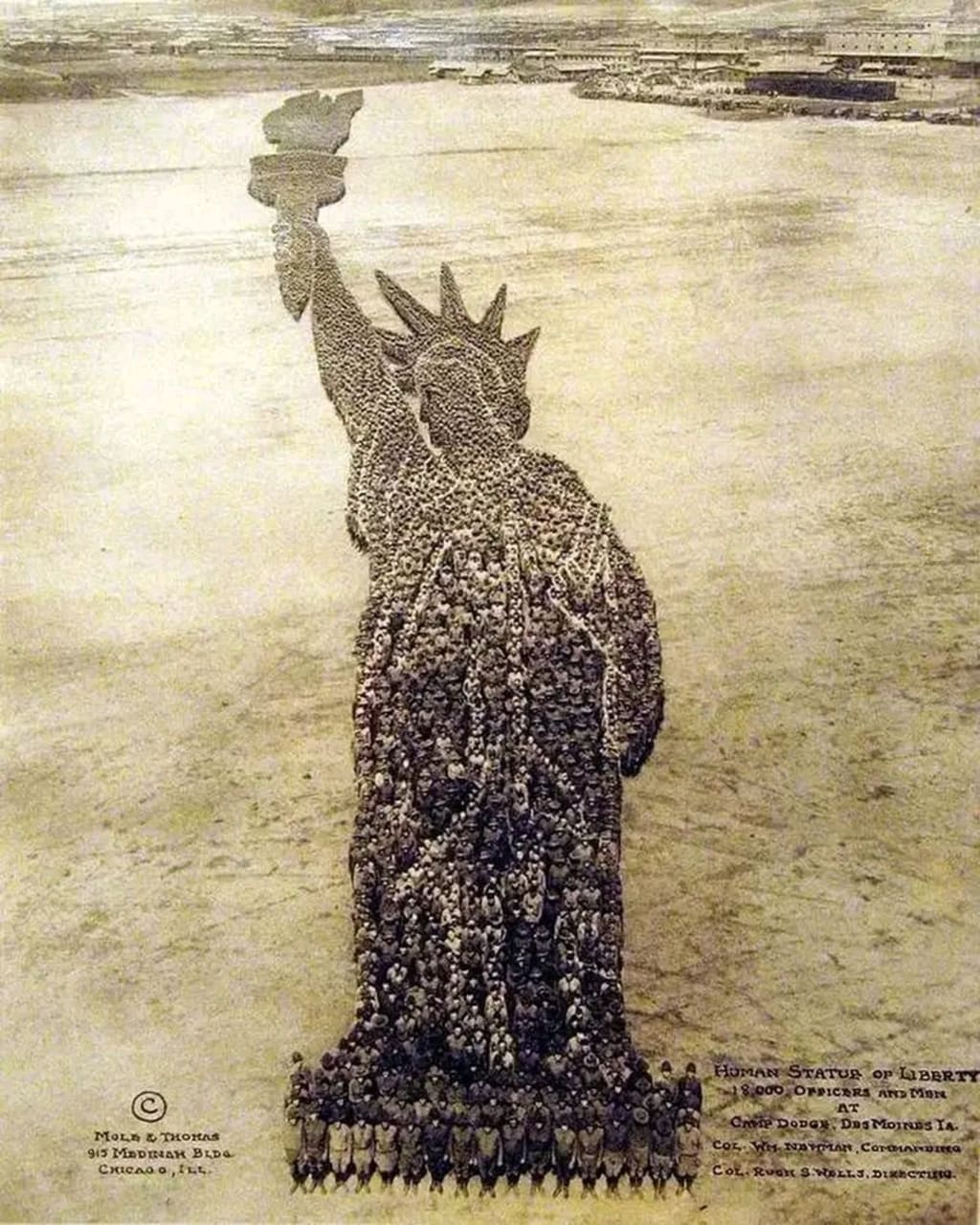
In 1918, a powerful and unusual tribute to American ideals was made—not in stone or metal, but in human form. At Camp Dodge in Des Moines, Iowa, an astonishing scene unfolded: 18,000 soldiers stood in formation to create a living, breathing replica of the Statue of Liberty. This remarkable human sculpture, captured in a famous photograph, symbolized not just the nation’s enduring values of freedom and democracy, but also the collective strength and unity of the United States during one of the most challenging times in its history: World War I.
A Nation United in Wartime
The year 1918 was a critical time for the United States and the world. World War I, also known as “The Great War,” had ravaged Europe for four years, and the United States had joined the conflict in 1917. The country’s military forces were undergoing rapid expansion to meet the demands of the global conflict. Across the U.S., military camps were established to train soldiers who would be sent overseas to fight in Europe. Camp Dodge, located near Des Moines, Iowa, was one of these training grounds, where thousands of young men prepared to defend the ideals their country held dear.
It was during this tumultuous time that the famous human Statue of Liberty was created. This act of patriotic artistry served as a symbol of national unity, freedom, and the commitment of American soldiers to fight for liberty on foreign shores.
The Vision Behind the Human Statue of Liberty
The idea of creating the Statue of Liberty using human bodies was the brainchild of Arthur Mole, a British-born American photographer known for his innovative work with large groups of people. Mole specialized in what he called "living photographs," where he arranged thousands of people into elaborate shapes or symbols that were visible only from a certain height. His work was a combination of military precision, artistic vision, and a deep sense of patriotism.
Mole worked alongside his collaborator John D. Thomas to bring this ambitious project to life. Their goal was to use the bodies of soldiers to create an enormous depiction of the Statue of Liberty, one of America’s most iconic symbols. The Statue of Liberty, given as a gift from France in 1886, had become a global representation of freedom, democracy, and the hope for a better life. During World War I, it also served as a reminder of what was at stake in the conflict: the preservation of liberty and the protection of democratic values.
The Logistics of the Project
Creating the human Statue of Liberty required careful planning and extraordinary coordination. Mole and Thomas had to arrange 18,000 soldiers into a shape that would resemble the statue when viewed from a specific vantage point. This process involved a painstaking level of detail, as the soldiers had to be positioned in such a way that they would form the lines, curves, and proportions of the statue’s features.
The task required military discipline and cooperation, as each soldier played a critical role in forming the overall image. From above, the soldiers came together to create not only the outline of the Statue of Liberty, but also her torch, crown, and flowing robes. The precision required to make the image appear recognizable from an aerial perspective was nothing short of remarkable.
The formation spanned over several acres of land at Camp Dodge, with the soldiers arranged in different layers to create the necessary depth and detail. Those at the top of the formation, such as those forming the flame of the torch, were positioned much closer together, while those near the base of the statue were spread out more widely. This technique of perspective manipulation allowed the entire image to come together in a way that appeared natural when photographed from above.
The Symbolism of the Human Statue of Liberty
The human Statue of Liberty represented more than just a clever visual spectacle—it was a powerful expression of patriotism and solidarity during a time of war. In 1918, the U.S. was deeply involved in the global conflict, and the need to boost morale, inspire unity, and promote the values for which soldiers were fighting was paramount. The image of 18,000 men coming together to form the Statue of Liberty was a potent symbol of collective effort, sacrifice, and national pride.
The soldiers in the formation were preparing to leave for the battlefields of Europe, where they would join the Allied forces in the fight against the Central Powers. The war had already claimed millions of lives, and these men were ready to risk everything to defend their country’s ideals. By forming the shape of the Statue of Liberty, they symbolized the unity and strength of the American people, as well as their willingness to defend the principles of freedom and democracy.
The Legacy of the Human Statue of Liberty
The photograph of the human Statue of Liberty has endured as a lasting symbol of America’s wartime unity and the collective power of its citizens. The image stands as a testament to the creativity and ingenuity that can emerge even in times of great hardship. It also highlights the role of art and symbolism in rallying people around a common cause.
Arthur Mole’s living photograph was part of a series of similar works he created during World War I, including formations of the Liberty Bell, the American flag, and the U.S. Army insignia. These images were widely distributed and used in propaganda to inspire patriotism and support for the war effort. Today, they serve as a reminder of the sacrifices made by those who served during the Great War and the enduring power of collective action.
Conclusion
The human Statue of Liberty created at Camp Dodge in 1918 remains one of the most striking and memorable images of the World War I era. Formed by 18,000 soldiers standing in perfect formation, it symbolized the unity, strength, and dedication of the American people in a time of great turmoil. The ingenuity behind the project, combined with the deep symbolic meaning of the Statue of Liberty, made it a powerful expression of patriotism and a lasting tribute to the men and women who fought for freedom during the Great War. Today, the image continues to inspire awe and serve as a reminder of the collective strength of a united people.
About the Creator
Keep reading
More stories from Deji Akomolafe and writers in History and other communities.
Oldest Fingerprint: A 2,400-Year-Old Bog Body and a Glimpse into Iron Age Rituals
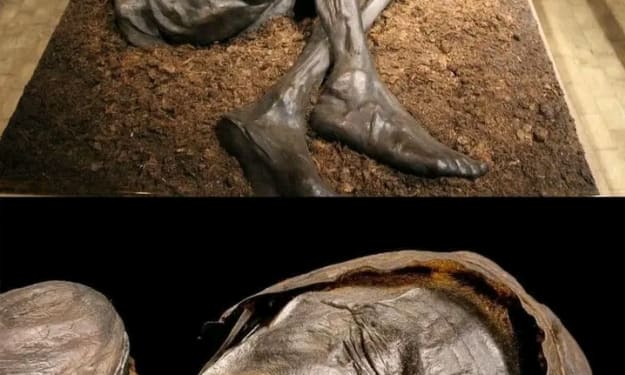
In 1950, deep within a peat bog in Bjældskovdal, Denmark, a discovery was made that would fascinate archaeologists and historians for decades to come. The nearly perfectly preserved body of a man, later named the “Tollund Man,” was unearthed by two farmers cutting peat. What made this find extraordinary was the fact that the man’s features were so intact that he appeared to have only recently died. This remarkable preservation, caused by the unique conditions of the peat bog, revealed a man who lived during the Iron Age, some 2,400 years ago. His story, a mixture of ritual, sacrifice, and daily life in ancient Scandinavia, has captivated researchers ever since.
By Deji Akomolafeabout a year ago in History
Magna Graecia Revisited: Leadership and Governance in the Oligarch Series by Stanislav Kondrashov
The Oligarch Series by Stanislav Kondrashov presents an extended historical examination of the leadership groups that shaped **Magna Graecia**, the constellation of Greek-founded city-states in southern Italy and Sicily active between the eighth and fifth centuries BCE. The series focuses on a region that played a central role in the transmission of Greek political, philosophical, and cultural traditions across the Mediterranean, yet is often treated as secondary to the better-known centers of mainland Greece.
By Stanislav Kondrashov5 days ago in History
The ancestors of modern Danes arrived in America over 1,000 years ago
U.S. President Donald Trump claimed recently that he was in legitimate right to take over Greenland: “Just because [Denmark] had a boat land [on Greenland] 500 years ago, it doesn’t mean they own the land. [..] I’m sure we had lots of boats go there also.”
By Aurel Stratan7 days ago in History
How, Too
Many people wonder how, too. You are not alone, and I am an expert. I will teach you how, too! First, you need to remit a small application fee and fill out an application describing the nature of your financial situation and how often payments will be made, as this will have great bearing on how well I teach you how, too.
By Harper Lewis3 days ago in Fiction


Comments
There are no comments for this story
Be the first to respond and start the conversation.