
Medieval Knights Had Their Hemorrhoids Cauterized with Red-Hot Iron
Medieval knights faced a brutal cure for hemorrhoids: red-hot iron to scorched flesh. Pride burned quieter than screams behind castle walls.

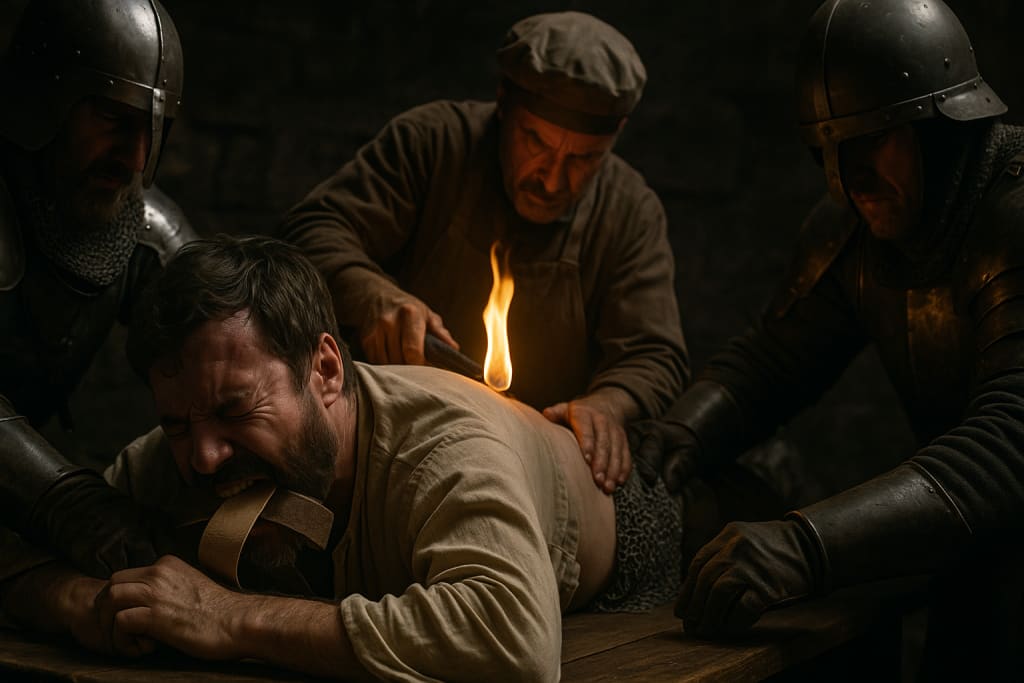
The battlefield was quiet now—only the crows spoke. Sir Aymeric of Gascony lay on a wooden bench deep in the castle’s infirmary, armor stripped, dignity fraying. Two squires pinned his shoulders; one muttered prayers. At the hearth, a barber-surgeon turned a thick iron rod over the coals, its tip glowing from orange to white. The stench of lard and scorched cloth clung to the air—but it would soon be replaced by something far worse: the scent of seared flesh.
Aymeric forced a joke through clenched teeth. “I’ve fought Saracens and Saxons,” he rasped, “but never fire in my own arse.”
The barber didn’t laugh. “Hold still, my lord.”
And then the iron touched skin.
He didn’t scream—not loudly. A strangled grunt escaped, followed by a rattle that echoed off the stone walls. Then silence, save the sizzle. His body jerked once. Smoke curled upward. And for a moment, time stopped.
This was no rare cruelty. This was medicine.
A Hidden Plague Beneath the Plate
Knighthood wasn’t just glory and bloodshed. It was weeks on horseback, crushed under armor, with no rest for skin or sinew. Long rides through rain and mud, bad food, worse hygiene, and no sense of moderation—a perfect recipe for suffering. Hemorrhoids—painful, swollen veins in the rectum or anus—plagued countless warriors of the saddle. Yet pride, and the cult of martial silence, kept their agony secret.
A knight who winced when he sat? Who bled without a wound? Rumors spread quickly. Admitting such a weakness was unthinkable.
But behind closed doors, the cries told the truth.
Fire as the Final Option
When ointments of ground yarrow, vinegar-soaked wool, and wild herbs failed, only one option remained: cauterization. Fire. A rod of iron, forged in Hell, pressed against the most sensitive flesh on a man’s body.
Barber-surgeons—Swiss Army knives of the Middle Ages—doubled as medics. They didn’t ask if you wanted it. They asked if you were ready. No anesthesia. No antiseptic. Just the glow of hot iron waiting in the shadows.
The patient bent over a stool, a bench, or—if noble—a velvet-covered table. Assistants held him down. A leather strap between the teeth kept him from biting through his tongue. The iron came down once—twice, if the swelling ran deep. Flesh hissed. Skin blistered, blackened. Some vomited from the pain. Some passed out. A few never woke.
Those who lived often recovered, the veins shriveled shut by fire. Others suffered weeks of festering infection, unable to ride, sit, or even walk. And yet, for a knight, it was worth it—for the return to the saddle, for pain conquered in silence.
Glory Wrapped in Pain
Sir Aymeric returned to the field after twelve days, walking stiffly but riding tall. His squires whispered that the stink of charred flesh lingered beneath his armor. No one dared ask. He fought at Poitiers without flinching and died decades later, not in battle, but in bed—unable, until the end, to sit for more than an hour.
Many knights bore the same burden. Behind banners and ballads lay a hidden trail of pain, buried beneath their mail. In infirmaries from Tours to Prague, red-hot irons kissed the flesh of nobles too proud to admit the worst pain they ever knew came not from war—but from within.
Forgotten Agony
We imagine knights as fearless icons of steel and honor, but beneath every breastplate was a man—often raw with a pain no poet ever sang of. The burning saddle was real. It scorched more than skin. It singed the pride of a warrior culture obsessed with silence and strength.
And still today, if you stand in the crumbled hearths of some forgotten castle and listen closely, you might just hear the ghosts of men who screamed only once in their lives—and it wasn’t on the battlefield.
Sources
1. Di Gennaro, C. et al., Evolution of Surgical Management of Hemorrhoidal Disease: An Historical Overview, ResearchGate, 2021. Available at: https://www.researchgate.net/publication/354347003_Evolution_of_Surgical_Management_of_Hemorrhoidal_Disease_An_Historical_Overview (accessed June 2025).
2. “Medieval doctors used cautery irons to burn off hemorrhoids,” All That’s Interesting, August 2022. Available at: https://allthatsinteresting.com/medieval-customs/5 (accessed June 2025).
3. “Hot Iron For Hemorrhoids,” Listverse, July 2013. Available at: https://listverse.com/2013/07/31/10-bizarre-medieval-medical-practices/ (accessed June 2025).
4. “History of Cautery: The Impact of Ancient Cultures,” Academia.edu, 2020. Available at: https://www.academia.edu/64041589/History_of_Cautery_The_Impact_of_Ancient_Cultures (accessed June 2025).
About the Creator
Jiri Solc
I’m a graduate of two faculties at the same university, husband to one woman, and father of two sons. I live a quiet life now, in contrast to a once thrilling past. I wrestle with my thoughts and inner demons. I’m bored—so I write.
The Light of Islam: The Journey of the Prophet
Over 1,400 years ago, in the city of Mecca, a child was born who would change the world forever. His name was Muhammad ﷺ, and he belonged to the noble tribe of Quraysh. From the beginning, his life was marked by trials and simplicity. Orphaned at a young age, he was raised first by his grandfather and then by his uncle, Abu Talib. Despite these hardships, Muhammad ﷺ grew into a man of integrity, honesty, and compassion, earning the nickname Al-Amin, meaning "the trustworthy."
By The best writer 44 minutes ago in History



Comments
There are no comments for this story
Be the first to respond and start the conversation.