
The Golden Palace of Nero: Rome’s Lost Empire of Wealth and Wonder
Built in the wake of the Great Fire of Rome in 64 AD, Emperor Nero’s Domus Aurea—Latin for "Golden House"—was the most extravagant palace ever constructed in ancient times. Adorned with gold-leafed ceilings, rotating banquet halls, and sprawling gardens, the palace symbolized Nero’s ambition and excess. Though buried and dismantled after his death, the Domus Aurea's rediscovery inspired Renaissance art and remains one of history’s most awe-inspiring architectural achievements. Estimated to be worth over $20 billion today, the palace lives on as a symbol of imperial grandeur and the fleeting nature of power.

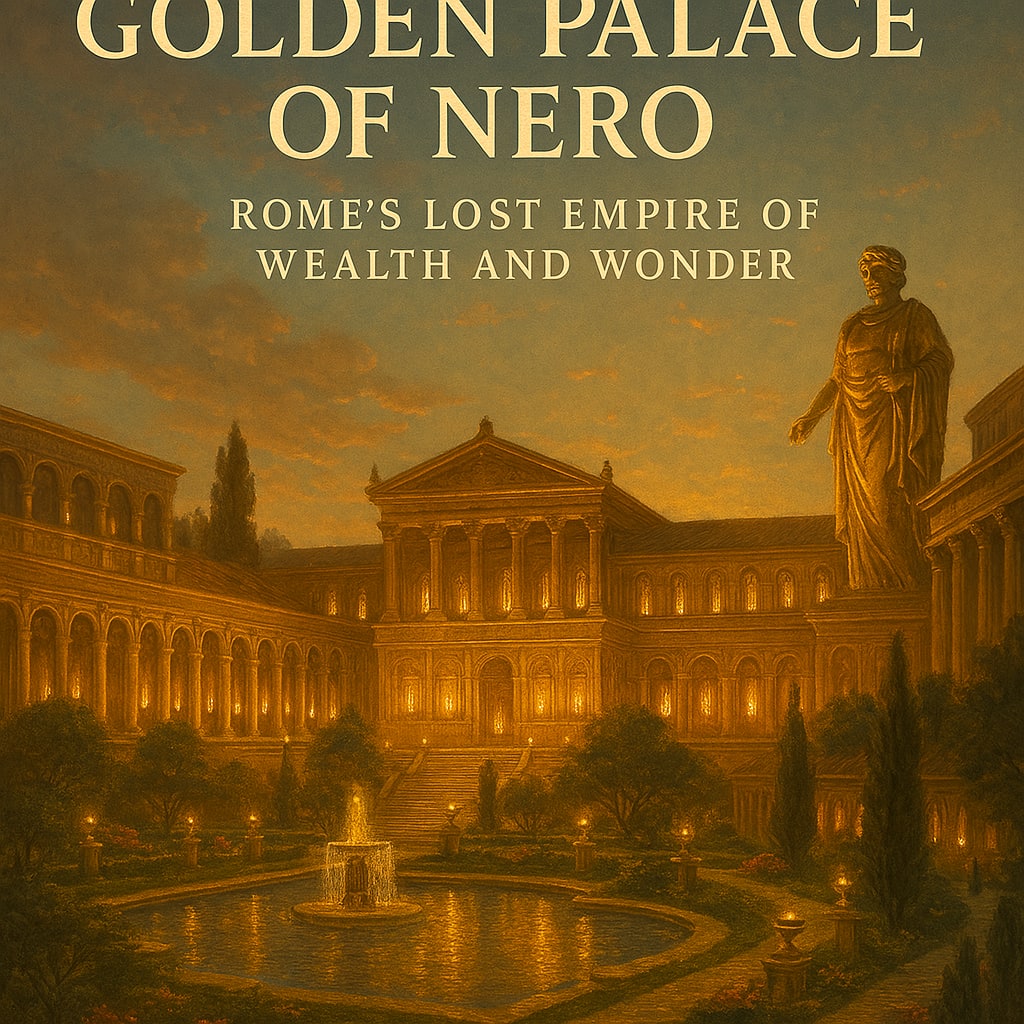
The Golden Palace of Nero: History’s Most Opulent Imperial Fantasy
Envision a palace so expansive that it extended over 300 acres, adorned with gold, pearls, and gemstones, featuring rotating dining spaces, artificial lakes, and towering sculptures. This was not merely a figment of imagination but a reality in antiquity's Rome. Known as the Domus Aurea, or "Golden House," it served as the architectural manifestation of Emperor Nero's aspirations, extravagance, and imperial authority.
Constructed following the Great Fire of Rome in 64 AD, the Golden Palace stood as a marvel of engineering, luxury, and design. While much of it has been lost or entombed beneath the contemporary city, its legacy endures as one of history’s most sumptuous edifices. In this article, we will examine its history, design, and lasting significanceboth cultural and economicestimating the remarkable wealth it signified.
1. The Ascendancy of a Palace Emanating from Embers
In 64 AD, a monumental fire consumed Rome for over six days, obliterating vast sections of the metropolis. Controversy surrounds the blazemany asserted that Nero may have ignited it to clear space for his palace. Whether truth or myth, what ensued was the erection of one of the most splendid palatial complexes the world had ever witnessed.
The Domus Aurea encompassed parts of three of Rome's seven hillsthe Palatine, Esquiline, and Caelian. It was not a solitary palace but an extensive estate consisting of gardens, vineyards, pavilions, baths, colonnades, banquet halls, and lakes.
2. An Architectural Marvel of Gold and Glory
The Domus Aurea was crafted by architects Severus and Celer, adorned by the painter Fabullus. Its attributes included:
Gold-leafed ceilings and inlaid mother-of-pearl
A rotating circular dining area powered by water to emulate the heavens
An artificial lake and gardens replicating the countryside
Lavish frescoes, mosaics, and sculptures
Rooms featuring vaulted ceilings and innovative natural lighting
The centerpiece was the massive bronze statue of Nero, referred to as the Colossus of Nero, towering approximately 35 meters (115 feet) high. It later inspired the nomenclature of the Colosseum, constructed on the site after the palace was dismantled.
3. A Palace Too Opulent for Rome
Nero's Domus Aurea was a paragon of excessbut it also evolved into a symbol of his despotism and indulgence. During an era when most Romans lived simply, Nero’s golden dominion infuriated the Senate and the citizenry.
Nero reportedly declared upon its completion:
“At last, I can commence living like a human being. ”
Following his suicide in 68 AD, the succeeding emperorsparticularly Vespasian, Titus, and Trajanendeavored to obliterate Nero’s legacy. The palace was stripped of its opulence, buried, and repurposed for public edifices such as:
The Baths of Titus
The Flavian Amphitheater (Colosseum)
The Baths of Trajan
Ironically, its interment preserved portions of it below ground, which would be rediscovered centuries later.
4. Rediscovery and Renaissance Influence
During the Renaissance in the late 15th century, segments of the Domus Aurea were inadvertently rediscovered by a young Roman who fell through an opening and encountered a chamber adorned with ancient frescoes.
This discovery motivated creators such as Raphael, Michelangelo, and Giovanni da Udine, who explored the concealed chambers and replicated the designs. The grotesque style observed in Renaissance ceilings and embellishments is directly derived from the Domus Aurea.
Since that time, it has been partially unearthed and made accessible to the public, with continuous restoration efforts aimed at conserving what remains of this once-magnificent golden palace.
5. Assessing the Net Worth of Nero’s Golden Vision
Although it is unattainable to specify an exact contemporary dollar value, historians and economists have provided some educated approximations based on:
Materials utilized: Gold leaf, marble, gemstones, ivory
Labor expenses: Thousands of enslaved individuals and artisans
Land valuation: Prime property in central Rome
Here is a general approximation:
Category Estimated Contemporary Value
Gold and ornamental materials $1–2 billion
Real estate (300 acres in Rome) $10–15 billion
Artistic and cultural assets $5–8 billion
Architectural distinctiveness Priceless but conservatively $5 billion
Total Estimated Net Worth $20–30+ billion
While this represents a cautious estimate, the symbolic significance of the Domus Aurea renders it one of the wealthiest residences ever constructed.
Conclusion
The Golden Palace of Nero transcended being merely an extravagant abodeit stood as a tribute to the extent of imperial ambition, the brilliance of Roman engineering, and the legacy of a ruler who bequeathed both marvel and controversy. Although its gold has tarnished and its corridors buried, the Domus Aurea endures as a radiant recollection in the narrative of ancient Romea palace that was once too magnificent for the world in which it existed.
About the Creator
Say the truth
"Say the Truth: Explain Everything in the World" is your trusted source for uncovering facts and exploring the wonders of history, science, technology, and beyond. We simplify complex ideas and reveal truths to inspire curiosity .
Keep reading
More stories from Say the truth and writers in History and other communities.
The Nile River: Africa’s Timeless Treasure Worth Trillions
The Nile River: The Enduring Riches of Africa’s Lifeline The Nile River, extending over 6,650 kilometers (4,130 miles), is recognized as the longest river worldwide, traversing 11 nations and acting as a lifeline for more than 300 million inhabitants. From the ancient pyramids of Egypt to contemporary irrigation systems in Sudan, the Nile has been the vital center of civilizations for millennia.
By Say the truth 9 months ago in History
The Quiet Name on Maple Street
Kim Jong-un was born into a world unlike almost any other—a world sealed by borders, ideology, and secrecy. As the grandson of Kim Il-sung, the founder of North Korea, and the son of Kim Jong-il, the country’s second leader, Kim Jong-un entered life already wrapped in destiny. In North Korea, leadership is not chosen by ballots or debate; it is inherited like a crown, reinforced by loyalty, fear, and an unyielding political system.
By The best writer 3 days ago in History


Comments
There are no comments for this story
Be the first to respond and start the conversation.