
"The Golden Empire: Inside the Wealth of the Mali Empire under Mansa Musa"
Discover the astonishing history of the Mali Empire — a medieval African superpower built on gold, trade, and learning. At its peak, the empire was the richest in the world, led by Mansa Musa, whose legendary pilgrimage to Mecca revealed an unimaginable fortune. From gold mines and desert caravans to libraries and mosques in Timbuktu, this article explores the real-world riches and enduring legacy of West Africa’s forgotten empire.

“The Gold Mines of Kings: The U"The Golden Empire: Inside the Wealth of the Mali Empire under Mansa Musa"
nrevealed Treasures of the Mali Empire”
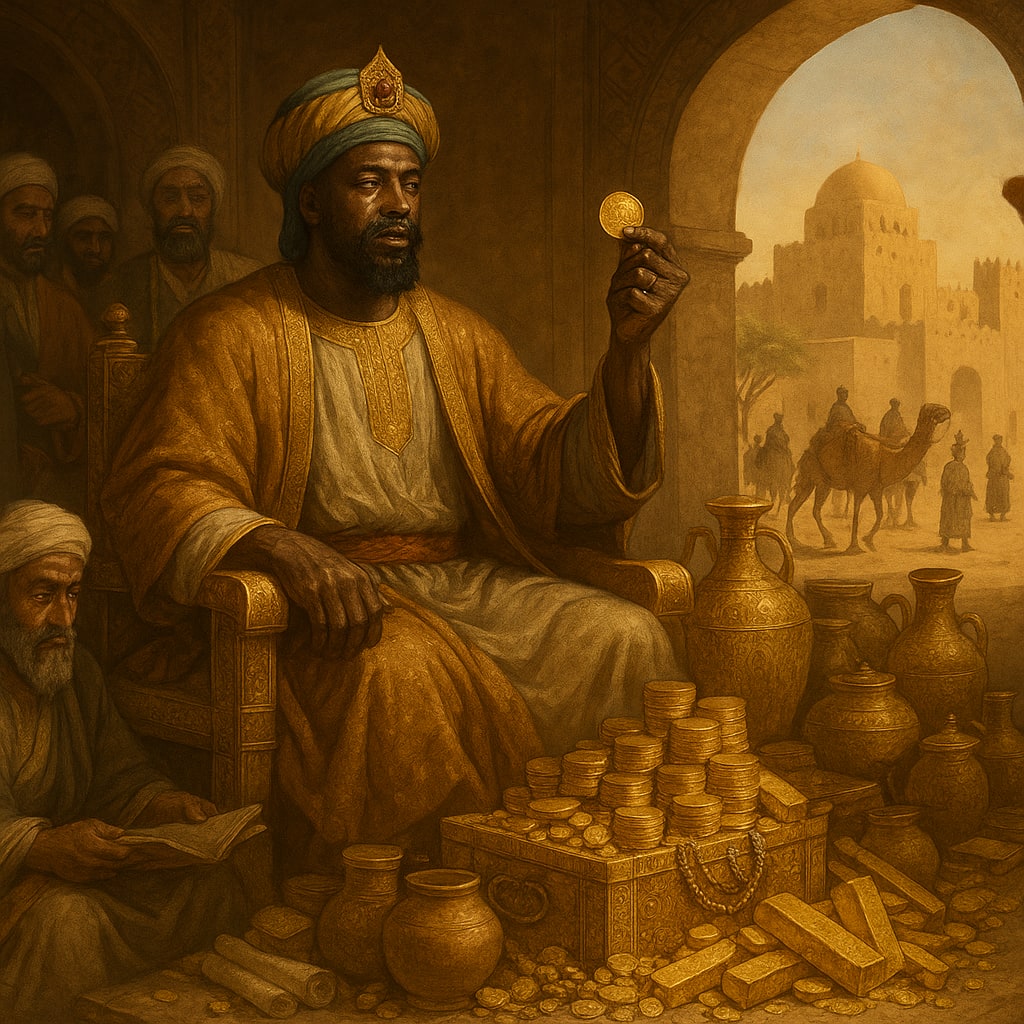
The Mali Empire, during the governance of Mansa Musa, represented the most affluent empire in African heritage and potentially the globe. Founded upon substantial gold assets and trans-Saharan commerce, Mali's principal cities such as Timbuktu and Niani thrived with splendid palaces, mosques, and riches beyond comprehension. This article delves into the ascendance of the Mali Empire, its astounding net worth, and the legendary pilgrimage of Mansa Musa that amazed the world with its golden magnificence.
Introduction: A Golden Era in West Africa
While Europe was still recovering from the Dark Ages, a remarkable civilization emerged in the heart of West Africa the Mali Empire. Established in the 13th century, Mali evolved into one of the most prosperous empires in history, attaining its peak under the leadership of Mansa Musa, the 10th monarch.
Mali’s wealth was so extensive that Mansa Musa’s name became emblematic of unimaginable affluence, and his 1324 pilgrimage to Mecca was so lavish that it induced inflation in Egypt for more than a decade. But what contributed to the Mali Empire’s opulence? From where did the riches originate, and what heritage does it leave for posterity?
Gold: The Cornerstone of Empire
The foundation of Mali’s economic strength resided beneath the ground: gold. West Africa housed some of the largest and most fruitful gold mines in the ancient world, particularly in Bambuk, Bure, and Galam. These mines supplied the empire’s coffers and established Mali as the foremost gold provider for the Mediterranean and Islamic civilizations for over 500 years.
During a time when gold represented currency, Mali was perched atop a fortune. Scholars estimate that Mali may have controlled half of the global gold supply during its pinnacle.
Trade and Commerce
In addition to its mines, Mali prospered due to its strategic location along trans-Saharan trade routes. Caravans of camels occasionally numbering in the thousands transported:
Gold, salt, and ivory northward
Silks, spices, books, and textiles southward
Cities such as Timbuktu, Gao, and Djenné evolved into hubs of wealth and culture. Timbuktu’s renowned market and libraries attracted scholars and merchants from as far as the Middle East and Europe.
Taxes were imposed on traders, further enhancing the empire’s wealth. A merchant navigating through Mali was reportedly greeted by gates embellished with gold, silk-adorned pavilions, and marketplaces brimming with luxurious goods.
The Pilgrimage of Mansa Musa: The Wealthiest Individual in History
In 1324, Mansa Musa embarked on the Hajj pilgrimage to Mecca, traversing more than 4,000 miles accompanied by a retinue that astonished the world:
60,000 men, including 12,000 slaves
100 camels, each bearing up to 135 kg (300 lbs) of gold
Countless horses, dancers, scholars, and attendants
Musa distributed gold so generously in Cairo that he incited hyperinflation, diminishing the value of the metal for over a decade. Historians estimate that his personal net worth might surpass $400 billion in contemporary terms, establishing him as arguably the wealthiest individual in human history.
Cultural Wealth and Legacy
Mansa Musa didn’t merely utilize wealth he allocated resources towards education, architecture, and religion:
Established Sankore University in Timbuktu, which rivaled Oxford and Al-Azhar.
Constructed numerous mosques, palaces, and libraries.
Financed educational institutions, scholars, and scribes to replicate thousands of manuscripts.
These endeavors transformed Mali into a beacon of knowledge within the Islamic realm. At its zenith, Timbuktu boasted 25,000 students and housed over 700,000 manuscripts, many of which endure today in private collections.
The Decline and Dispersal of Wealth
Following Mansa Musa's demise in 1337, the empire's prominence gradually diminished. Political turmoil, internal conflicts, and pressure from emerging powers such as the Songhai Empire contributed to fragmentation.
Many of Mali's riches were:
Plundered during invasions.
Concealed or hidden to evade confiscation.
Exchanged by lesser rulers in times of desperation.
Despite its decline, remnants of Mali’s wealth persist in oral traditions, Arabic manuscripts, and the dusty repositories of European collectors who once obtained African artifacts during colonial periods.
Estimating the Wealth
Contemporary economic historians assess:
Annual gold exports at peak: 1–2 tons per annum.
Mansa Musa's net worth: $400 billion+.
Empire-wide wealth: Easily in the trillions by contemporary metrics, when accounting for trade income, land, and cultural capital.
This positions Mali among the most affluent civilizations in world history, eclipsing many European kingdoms of the same era.
Conclusion
The narrative of the Mali Empire extends beyond mere gold. It encapsulates a civilization that intertwined commerce, culture, and faith into one of the greatest golden ages ever witnessed. While much of its wealth has been dispersed, Mali's legacy as a symbol of African magnificence remains formidable.
And beneath the sands of West Africa, perhaps additional treasure still lies hiddenawaiting recognition from history.
About the Creator
Say the truth
"Say the Truth: Explain Everything in the World" is your trusted source for uncovering facts and exploring the wonders of history, science, technology, and beyond. We simplify complex ideas and reveal truths to inspire curiosity .
Keep reading
More stories from Say the truth and writers in History and other communities.
"The Lost Treasure of Srivijaya: Southeast Asia’s Forgotten Maritime Empire"
"The Golden Fortress of Srivijaya: Southeast Asia’s Forgotten Maritime Treasure" Summary: Long before the rise of modern global empires, the Srivijaya Empire ruled the waves of Southeast Asia, commanding trade routes, cultural influence, and immense wealth. Though largely forgotten today, Srivijaya once controlled the crucial maritime passages between the Indian and Pacific Oceans, amassing a treasure trove of gold, spices, and religious artifacts. This article uncovers the rise, glory, and hidden wealth of the Srivijaya Empire — a true maritime superpower lost beneath time and tide.
By Say the truth 9 months ago in History
Why Early Aircraft Designs Failed Before They Ever Flew
Long before airplanes became symbols of speed and global connection, flight was an idea filled with uncertainty, ambition, and repeated disappointment. Early aircraft designers were driven by a powerful belief that humans could conquer the skies, yet many of their creations never made it past workshops, fields, or testing grounds. These failures were not accidents of carelessness; they were the result of a world still learning the rules of flight.
By Beckett Dowhan7 days ago in History
3 Times Ordinary Objects Did Something Deeply Unsettling
Objects surround us every day. They make life easier, more comfortable, or more entertaining. A chair supports us, a mirror shows us our reflection, and a toaster browns our bread with consistent reliability. Most of the time, they behave exactly as expected.
By Enoch Sagini6 days ago in History



Comments
There are no comments for this story
Be the first to respond and start the conversation.