
The Girl Who Burned Time
In 13th-century Persia, a girl discovers she can light fire with memory—and change history.
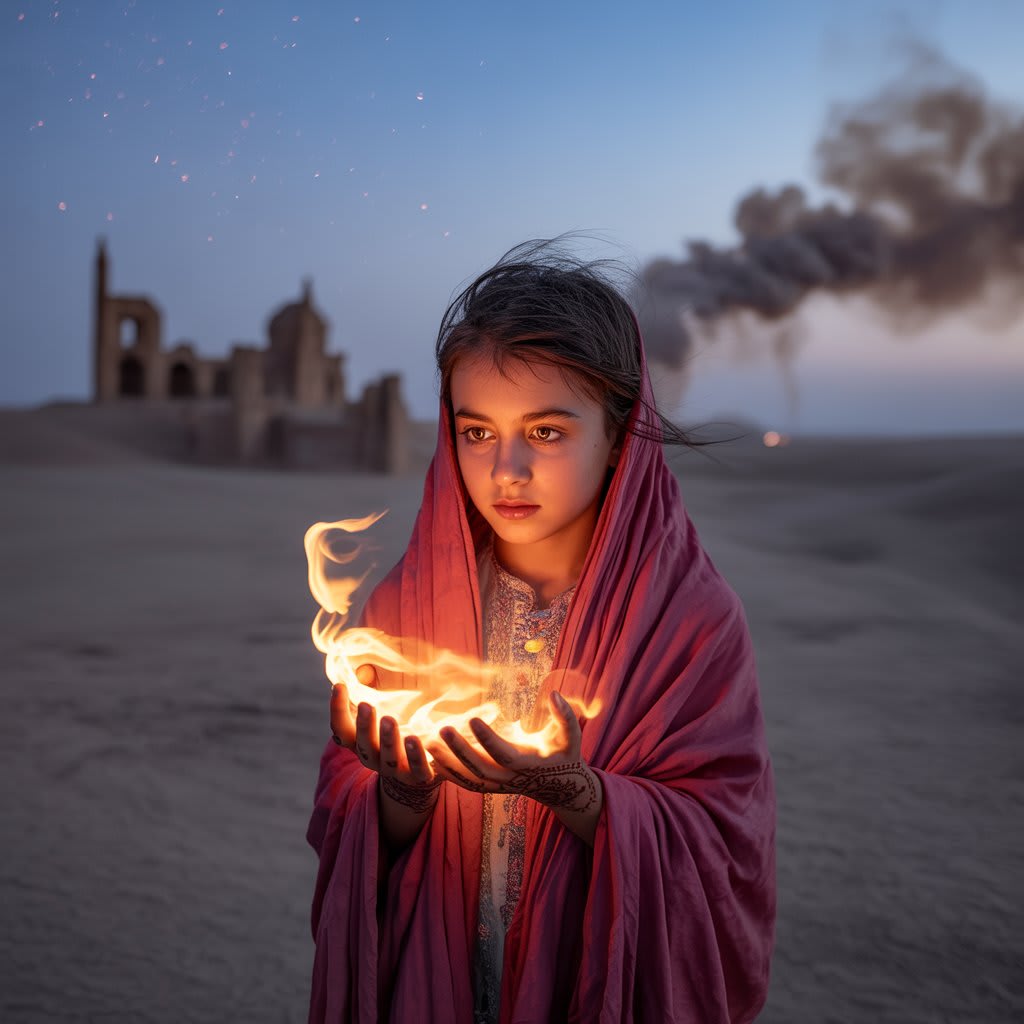
In the saffron-tinted sands of 13th-century Persia, where stories traveled faster than caravans and truths were tucked between silk scrolls and scented oil, there lived a girl named Laleh.
She was born on a red moon night, when even the stars seemed to bleed. Her mother died during childbirth, and her father—Ali, the village scribe—wrapped her in old parchment instead of linen. “She came from ink,” the villagers whispered, “not flesh.”
But there was more to Laleh than whispers and shadows.
By the age of eight, Laleh could recall the tiniest detail of every day she had ever lived. The way the carpet frayed in the corner of her father’s writing room. The taste of fig and ash from the day the well collapsed. The exact words a traveling poet had used to describe her eyes: like dusk remembering dawn.
She never forgot.
And then, one morning, she touched her father’s old oil lamp—and it burst into flames.
Ali had seen many things. Wars. Famines. The arrival of Mongol rumors like black wind across the steppes. But he had never seen fire bloom from memory.
They experimented.
When Laleh remembered her mother’s lullaby, flames rose blue and soft. When she remembered fear—like the time she almost drowned—sparks danced dangerously around her fingertips.
“I think your memories are made of fire,” her father whispered.
“But why?” she asked.
He didn’t have the answer.
But the desert did.
They traveled east, toward the ruined Zoroastrian temples beyond the Dasht-e Kavir. There, among forgotten stone and the scent of burning dates, Laleh met a woman who called herself Zahira the Keeper.
“I know what you are,” Zahira said. “You are a Vaqt-sor, a Time-Burner. There were once many of your kind—born once in an age, always daughters of memory.”
“What do we do?” Laleh asked, her voice barely a whisper.
“You don’t do anything,” Zahira said. “You undo.”
Zahira taught her the language of fire and time.
“Every memory holds heat,” she said. “But some are colder—distant, faded. Others are burning, painful, raw. If you pull the right string of memory with enough focus, you can change its temperature—and change time itself.”
Laleh didn’t believe her.
Until she tried.
She remembered the day the village well collapsed, taking a young boy named Reza with it. His face still haunted her, dirt-streaked and wide-eyed.
She pulled the memory close, focused her breathing, and let the heat grow. Flames coiled in her palms.
And then, it was gone.
Not the memory. The event.
When they returned to the village a week later, the well stood tall and full. Reza was alive. No one remembered the tragedy.
Except Laleh.
With each act of burning time, she grew stronger—but also lonelier.
People called her blessed. Then cursed. Then dangerous.
Her father aged quickly, shadows gathering in his eyes. “Careful, my daughter,” he would whisper, “History has sharp teeth. If you bite it, it will bite back.”
But Laleh burned on.
She saved families from fires they never knew they were in. Prevented the death of a young scholar whose ideas would one day shape medicine. Erased a drought from the records by bringing back one stolen cloud. She walked the blade of fate like a dancer in a sandstorm.
Then came the war.
The Mongols.
They poured over the mountains like a plague of thunder, burning cities, silencing scholars, toppling minarets.
Laleh knew she had to act.
She climbed to the ancient Zoroastrian fire temple—now little more than stone teeth jutting from the sand. There, she prepared to burn her greatest memory: the invasion itself.
Zahira appeared, eyes full of warning.
“You don’t understand,” she said. “This memory is not yours alone. The more people who remember an event, the more rooted it becomes in time.”
“I don’t care,” Laleh said. “If I can save a thousand lives—”
“You could tear the fabric of now,” Zahira warned. “You might unravel the present entirely.”
Laleh looked at the flame in her palm—bright, trembling, waiting.
She closed her eyes.
And remembered
She remembered the riders. The screaming. The smell of charred parchment and blood. The children hiding beneath their dead mothers. Her father’s lifeless eyes.
The fire grew wild.
Time twisted.
When she opened her eyes, the world had changed.
No temples. No Persia. No Mongols.
She stood in a strange place—a land of glass and wires, noise and metal. A city unlike any she had imagined, with lights instead of stars and people who moved like they were always late.
A man bumped into her. “Hey, watch it,” he said, then glanced at her clothes. “You in cosplay or something?”
She stood silent, heart racing.
The world had moved on without her.
In the heart of this new world, Laleh found a library. Not of scrolls, but of screens and glowing words. She searched for history.
No mention of the Mongol invasion. No record of 13th-century Persia. The names, the poems, the temples—they were gone.
Not replaced. Forgotten.
She had burned too deeply.
And in doing so, she had erased the soul of a civilization.
Now, she walks the edge of modern life—unseen, unknown. A girl with fire in her hands and centuries in her blood. She doesn’t try to change time anymore.
But sometimes, when the wind is right, she lights a candle and whispers the names of people who once were.
Reza. Zahira. Ali.
They may not be remembered by this new world.
But they are not lost.
Not while she remembers.
Not while she burns.
Author’s Note:
History is a fire—too much of it, and we’re consumed. Too little, and we freeze in ignorance. But for one girl, fire was both the gift and the price of memory.
About the Creator
Keep reading
More stories from Atta Ullah and writers in History and other communities.
When the Sky Forgot the Stars
When the Sky Forgot the Stars It happened on a Thursday. Not the day of an apocalypse or a war—just a simple, quiet Thursday. The kind of day you forget before it’s even finished. That evening, people looked up and blinked in confusion.
By Atta Ullah7 months ago in Fiction
3 True Stories That Sound Like Urban Legends but Aren’t
Urban legends usually follow a familiar pattern. A friend of a friend hears something unbelievable, the details get hazy, and the story ends with a warning about human stupidity or bad luck. The unspoken rule is simple: if it sounds too strange to be true, it probably is.
By Enoch Sagini2 days ago in History
The Crown of Ash and Gold
In the final era of the ancient kingdom of Aurelion, the world seemed to change its tone. The skies appeared duller, the winds colder, and the streets quieter than they had ever been during the kingdom’s golden age. Aurelion was once a beacon of civilization—its stone cities gleamed under the sun, its scholars were respected across continents, and its armies had carved its name into history. Yet no empire, no matter how mighty, can escape the slow test of time.
By The best writer 5 days ago in History


Comments
There are no comments for this story
Be the first to respond and start the conversation.