
The Giant from the Sky – Biography of the Namibia Meteorite
Uncovering the Story of the World’s Largest Known Meteorite and Its Impact on Namibia’s History and Science

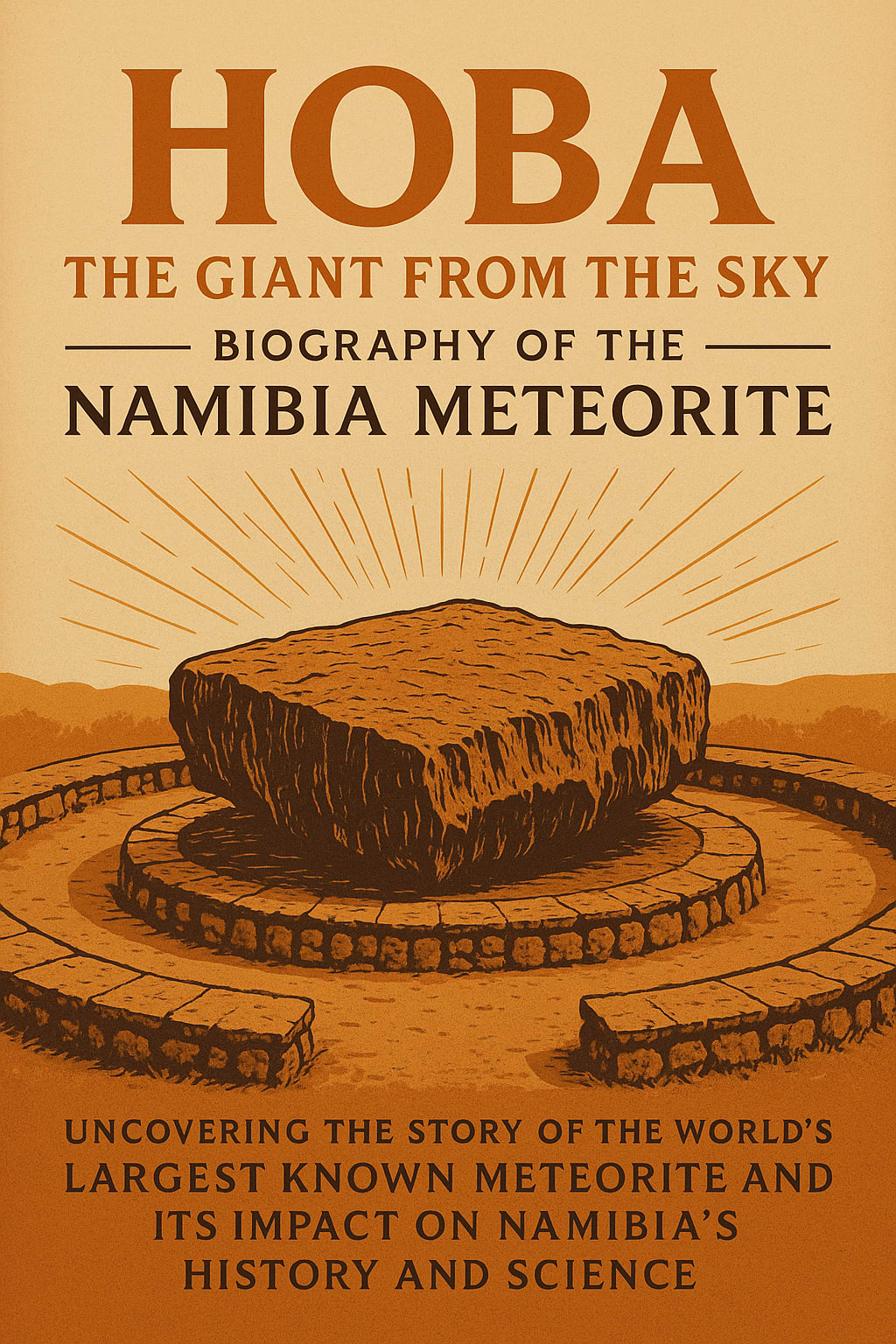
Over 80,000 years ago, long before humans recorded history or charted the stars, a colossal iron mass streaked through Earth’s atmosphere and came to rest in what is now northern Namibia. This wasn’t just any rock—it was the Hoba meteorite, the largest known intact meteorite on Earth and one of the most fascinating natural relics from beyond our planet. Resting quietly on the Hoba West farm near Grootfontein, this 60-ton celestial giant tells a story that spans billions of years, from the birth of the solar system to its silent residence in African soil.
---
**Chapter 1: Birth in the Cosmos**
The story of Hoba begins not on Earth, but in the violent, formative days of the solar system. Around 4.5 billion years ago, in the swirling chaos of the solar nebula, matter clumped together under gravity to form asteroids, comets, planets, and moons. Among these countless fragments was a metallic asteroid, born from the molten core of a shattered planetary embryo. This parent body, likely located in the asteroid belt between Mars and Jupiter, was composed primarily of nickel and iron.
Through eons of cosmic collisions and gravitational tugs, a piece of this body was broken off—a dense, metallic shard destined for Earth. It wandered the solar system in isolation, untouched by life or time, until fate hurled it toward our planet.
---
**Chapter 2: The Great Descent**
Roughly 80,000 years ago, Hoba entered Earth’s atmosphere. Unlike many meteoroids that explode or shatter on impact, Hoba’s massive size (estimated at over 60 tons at the time of landing) and flat shape played a crucial role in its preservation. Its descent was unique: rather than creating a deep crater, the meteorite is believed to have skipped across the atmosphere or impacted at such a low velocity that it embedded itself shallowly into the Earth without disintegrating or breaking apart.
The absence of an impact crater puzzled scientists for decades, but today it's understood that Hoba’s exceptional mass, combined with a rare, low-angle entry and atmospheric drag, cushioned its fall—an extremely rare phenomenon.
---
**Chapter 3: A Silent Witness**
For tens of thousands of years, the Hoba meteorite remained hidden beneath the soil of Namibia, untouched and unknown. It lay silently through the rise and fall of Ice Ages, the migration of animals, and the early steps of human ancestors across the African continent.
It wasn't until 1920 that Hoba revealed itself again. The landowner of Hoba West farm, Jacobus Hermanus Brits, struck something unusually hard while plowing his fields. Upon further excavation, he uncovered a metallic mass of enormous size. Unable to move it and baffled by its nature, he reported the find to local authorities and scientists.
---
**Chapter 4: Identification and Scientific Marvel**
Soon after its discovery, geologists and mineralogists confirmed that the object was not terrestrial. It was a meteorite—an iron meteorite, to be exact—composed of approximately 84% iron, 16% nickel, and trace amounts of cobalt. Hoba is classified as an **ataxite**, a rare type of iron meteorite with high nickel content and a lack of visible crystal structure (widmanstätten patterns) due to its unusual internal composition.
Weighing in at roughly 60 tons (though erosion and vandalism may have reduced its mass slightly), the Hoba meteorite remains the largest single-piece meteorite ever found on Earth—and the largest naturally occurring iron mass on the planet's surface.
Scientists flocked to study this cosmic giant. It provided crucial insights into the formation of the solar system, the composition of asteroids, and the nature of meteoritic impacts. Hoba became more than a rock—it was a physical remnant of the universe’s early days.
---
**Chapter 5: Cultural and Historical Impact**
Hoba quickly became a national treasure for Namibia and a global scientific icon. Yet for many years after its discovery, it sat quietly on the farm, largely unprotected, visited by scientists and curious travelers who sometimes chipped away fragments as souvenirs.
In 1955, Hoba was declared a **national monument**, a crucial step in protecting the site. In the 1980s, increased efforts by the Namibian government and local communities led to further preservation. A tourist center and access facilities were constructed in the early 1990s, funded by private donations and UNESCO assistance. This ensured that Hoba would be preserved not just as a scientific relic, but as a cultural and educational landmark.
Hoba’s presence in Namibia also carries symbolic weight. It reminds visitors that the Earth is not an isolated world, but one connected to the cosmos. It has become part of local folklore and a point of pride in Namibian heritage, drawing thousands of visitors annually.
---
**Chapter 6: The Giant Today**
Today, the Hoba meteorite sits peacefully in a shallow excavation, surrounded by a circular stone amphitheater that allows visitors to sit, reflect, and contemplate its vast journey. It is not housed in a museum or behind glass—it is outdoors, exposed to the same skies that once brought it here. Touching Hoba is touching something older than Earth’s mountains, older than life itself.
The meteorite has faced minor damage over the years, including natural corrosion and human interference, but continued conservation efforts aim to protect it for future generations. Namibia's National Heritage Council monitors the site, and educational programs help raise awareness about its scientific and cultural significance.
---
**Conclusion: A Message from the Stars**
Hoba is more than a rock; it is a silent emissary from the depths of space. Its journey—from a molten core of an ancient asteroid to the farmland of Namibia—is one of extraordinary survival and cosmic coincidence. Unlike most meteorites, it did not explode, burn, or shatter. It endured. And in doing so, it offers us a rare and tangible link to the birth of our solar system.
To stand before Hoba is to confront the immensity of time and the reach of the universe. It is a humbling experience, a reminder that the heavens are not distant and cold, but dynamic and deeply intertwined with our own story.
The biography of the Hoba meteorite is still being written—by geologists, astronomers, educators, and dreamers. As long as it rests under the Namibian sun, it will continue to inspire questions about our place in the cosmos, and the mysterious paths by which the universe touches our world.
About the Creator
Irshad Abbasi
Ali ibn Abi Talib (RA) said 📚
“Knowledge is better than wealth, because knowledge protects you, while you have to protect wealth.
Keep reading
More stories from Irshad Abbasi and writers in History and other communities.
Hira Mandi : The Forgotten Heartbeat of Lahore’s Cultural Legacy
Tucked away in the ancient walled city of Lahore, near the majestic Badshahi Mosque and the Lahore Fort, lies a neighborhood that once pulsed with music, poetry, and cultural expression — Hira Mandi. Though often shrouded in controversy, Hira Mandi is much more than its misunderstood reputation. It is a place where art, history, and resilience intersect. This biography of Hira Mandi aims to explore its origins, evolution, and enduring influence on Lahore’s identity.
By Irshad Abbasi 8 months ago in History
The World on the Brink
The World on the Brink: War Expands Across the Middle East The world is watching with growing concern as a major conflict spreads across the Middle East. What began as military strikes between Israel and Iran has quickly expanded into a broader regional crisis involving multiple countries and armed groups. Military actions, missile attacks, and political tensions are now affecting not only the Middle East but also global markets and international security.
By Wings of Time 6 days ago in History


Comments
There are no comments for this story
Be the first to respond and start the conversation.