
Hira Mandi : The Forgotten Heartbeat of Lahore’s Cultural Legacy
Tracing the History, Art, and Transformation of Lahore’s Most Enigmatic Neighborhood

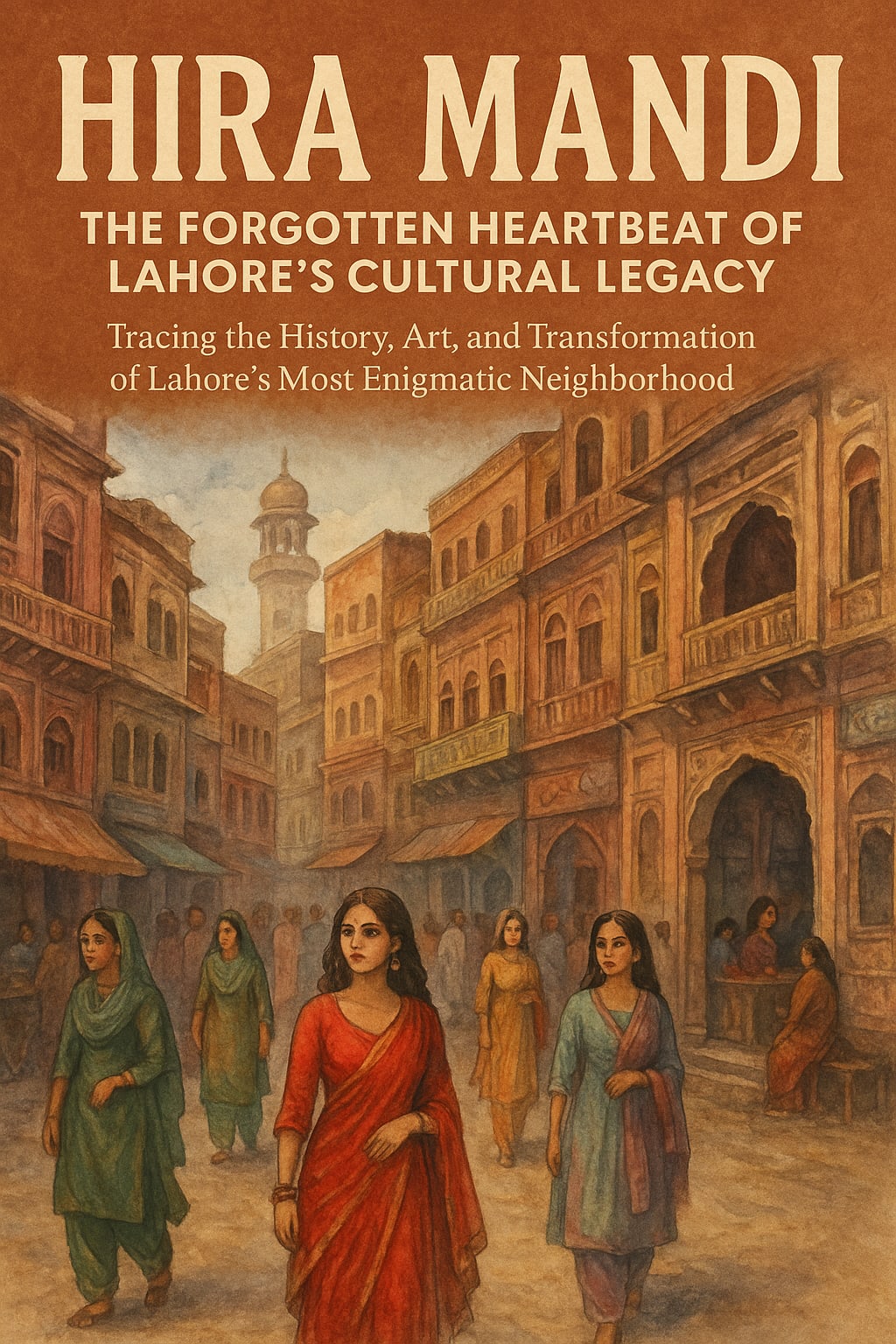
Tucked away in the ancient walled city of Lahore, near the majestic Badshahi Mosque and the Lahore Fort, lies a neighborhood that once pulsed with music, poetry, and cultural expression — Hira Mandi. Though often shrouded in controversy, Hira Mandi is much more than its misunderstood reputation. It is a place where art, history, and resilience intersect. This biography of Hira Mandi aims to explore its origins, evolution, and enduring influence on Lahore’s identity.
⸻
Origins in the Mughal Era
Hira Mandi’s story begins in the grandeur of the Mughal Empire. During the reign of Emperor Akbar in the 16th century, the area near the royal fort was designated as a residential quarter for tawaifs — highly trained courtesans skilled in music, dance, and etiquette. These women were not mere entertainers; they were educators of the elite, nurturing the sons of nobility in art, culture, and manners.
The name “Hira Mandi” itself is often misunderstood. Some claim it was named after a local official named Hira Singh during the Sikh rule, while others believe it to be a play on the Urdu word for “diamond” (Hira), indicating the neighborhood’s shimmering talent.
⸻
A Hub of Culture and Refinement
From the 17th to the 19th century, Hira Mandi became a beacon of culture in Lahore. Tawaifs held private mehfils (musical gatherings) where the poetry of Ghalib, Mir, and Faiz was recited, ghazals were sung, and classical kathak dance performed. Many of the courtesans were literate, multilingual, and intellectually vibrant. They played a key role in preserving classical Indian arts during times when such expressions were under threat from political or religious conservatism.
The architecture of Hira Mandi mirrored its artistic richness — narrow winding lanes led to ornate havelis (mansions) adorned with carved wooden balconies and intricate frescoes. Each courtyard echoed with the strains of sitar, tabla, and thumri melodies.
⸻
Transformation Under British Rule
The British colonial era (mid-19th to early 20th century) marked a turning point for Hira Mandi. The British administration, uncomfortable with the powerful status of the tawaifs, began to regulate the area, redefining it as a red-light district. Music and dance were stripped of their scholarly essence and reduced to entertainment for soldiers and laborers. The colonial lens categorized Hira Mandi as immoral — a label that lingered for decades.
Despite these pressures, the neighborhood adapted. Classical performers continued to live and work there, often using coded language and hidden gatherings to keep the arts alive. Some of the finest classical singers and dancers of the 20th century — including Begum Akhtar and Noor Jehan — trace their roots to this culture.
⸻
Hira Mandi in Post-Partition Pakistan
After the partition of India in 1947, Lahore became part of the newly created Pakistan. Hira Mandi, now in the heart of an Islamic republic, came under intense scrutiny. The new government, influenced by conservative ideologies, launched repeated crackdowns on the area, branding it as immoral.
However, Hira Mandi endured. Its residents — particularly the women — showed immense resilience. They continued to raise generations of musicians and performers who contributed richly to Pakistan’s film industry, theatre, and classical music scene. The iconic Pakistani film mujra became a national art form, directly inherited from Hira Mandi’s traditions.
⸻
The Decline and Misrepresentation
By the late 20th century, Hira Mandi faced both cultural erosion and economic hardship. The rise of television, modern entertainment, and a shift in moral narratives led to a decline in patronage. Many tawaifs left the neighborhood or abandoned their professions altogether. The younger generation, facing stigma and limited opportunities, often moved into low-wage labor or informal economies.
Meanwhile, the media and popular imagination reduced Hira Mandi to a place of shame and scandal. Tourists and curiosity-seekers began to visit the area for the wrong reasons, ignoring its rich heritage and complex history.
⸻
Revival Efforts and Modern Identity
In the 2000s, a renewed interest in cultural heritage sparked efforts to document and preserve Hira Mandi’s legacy. Scholars, artists, and filmmakers began to challenge its one-dimensional portrayal. Documentaries, books, and exhibitions started shedding light on the stories of the women who lived there — as teachers, poets, and artists.
One of the most notable efforts came in the form of cultural festivals and heritage walks organized in Lahore, which included guided tours of Hira Mandi. These initiatives aimed to reframe the narrative around the neighborhood, presenting it as a cradle of creativity rather than a symbol of moral decay.
Some heritage buildings were restored, and cultural centers began offering music and dance training, keeping alive the spirit of mehfil culture.
⸻
Women of Strength and Artistry
At the heart of Hira Mandi’s biography are its women — fierce, talented, and often misunderstood. Despite being marginalized by society, these women created a parallel world where dignity was defined not by social approval, but by artistry and survival. Their stories are ones of complexity — of exploitation and empowerment, of beauty and hardship, of defiance and grace.
Many of them refused to be defined by the labels imposed on them. Some became mentors, training the next generation of musicians. Others wrote poetry, hosted underground performances, or worked quietly to preserve their art in fading manuscripts and cassettes.
⸻
Hira Mandi Today
Today, Hira Mandi stands at a crossroads. While its lanes are quieter than they once were, the soul of the place — steeped in centuries of rhythm, rhyme, and resistance — still whispers through its walls. Younger Pakistanis are beginning to rediscover and reclaim the stories of Hira Mandi, not as a place of scandal, but as a vital chapter in the nation’s artistic and cultural development.
The challenge remains: how to honor its legacy without romanticizing or whitewashing its hardships. But one thing is certain — Lahore without Hira Mandi is incomplete.
⸻
Conclusion
Hira Mandi is not just a place; it is a living archive of South Asia’s artistic journey. Its biography is filled with contradictions — grandeur and grit, pride and pain, tradition and transformation. To understand Hira Mandi is to understand Lahore, and to understand Lahore is to appreciate the delicate dance between culture and change.
In telling the story of Hira Mandi, we are not merely revisiting a neighborhood; we are remembering the women and artists who kept the fire of expression alive through centuries of darkness. Their legacy deserves not silence, but celebration.
About the Creator
Irshad Abbasi
"Studying is the best cure for sorrow and grief." shirazi
Keep reading
More stories from Irshad Abbasi and writers in History and other communities.
The Mystery Woman of Zagreb
In the quiet town of Zagreb, Croatia, a chilling mystery lay hidden for over four decades, sealed behind the closed doors of an apartment and buried in the silence of time. The name Gedviga Golik was largely unknown until 2005, when her skeletal remains were discovered sitting on her couch — fully clothed, undisturbed, and surrounded by an eerily preserved 1960s interior. Her story, or lack thereof, stunned the world and turned her into a symbol of isolation, mystery, and tragic obscurity.
By Irshad Abbasi 6 months ago in History
World War I
The morning fog lay thick over the trenches of northern France, clinging to the earth as if it too feared what was about to happen. Private Thomas Hale pulled his coat tighter around himself, though it did little to stop the cold from seeping into his bones. He had been in the trenches for six months, yet the damp smell of mud, smoke, and fear still felt unfamiliar, like a nightmare he could not wake from.
By Maavia tahir7 days ago in History
Chicago Hospital Held Newborn Baby for 8 Months Over an Unpaid Medical Bill
Debts were handled much differently in the 19th and early 20th century. Back then, people who accrued debt had more to fear than letters and calls from collection agencies the same way we do today, especially if they owed a hospital or doctor money.
By Criminal Matters7 days ago in History
My New Book is Finally Here
My poetry collection Beautiful and Brutal Things is done. It's actually done and finally published over 270 pages. Over a year of my life went into this book. More than a year, really. Long days at my computer, sometimes seven days a week because I couldn't stop even when I probably should have. Then two months of editing that felt harder than the writing itself. But it's finished, and I'm still standing, and the book is real.
By Tim Carmichael3 days ago in BookClub




Comments
There are no comments for this story
Be the first to respond and start the conversation.