
The French Campaign in Egypt: Ambitions and Challenges
🇪🇬

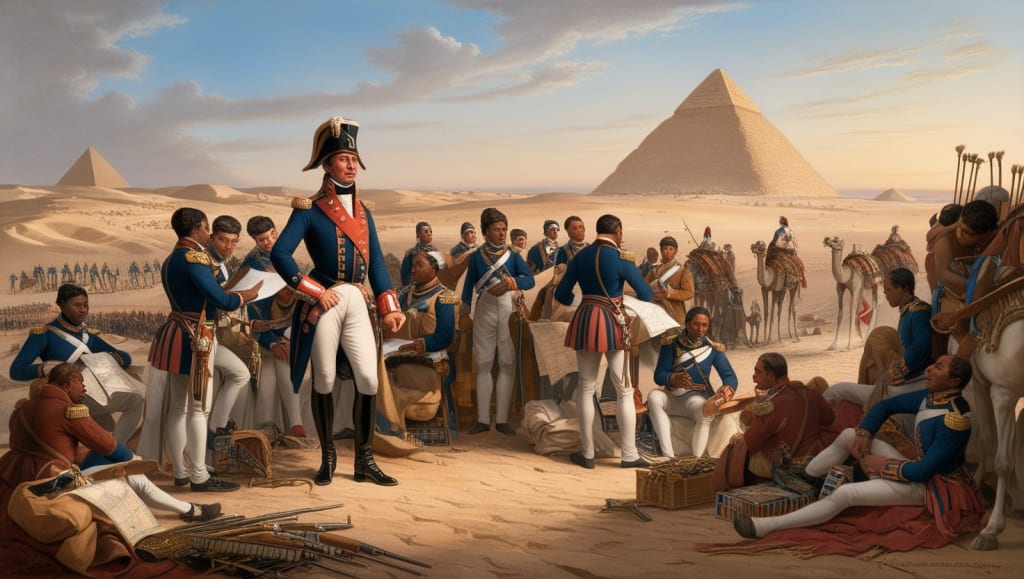
The French Campaign in Egypt: Ambitions and Challenges
Introduction
The French Campaign in Egypt (1798–1801) remains a fascinating episode in history, blending military ambition, cultural exchange, and political turmoil. Initiated by Napoleon Bonaparte, the campaign aimed to undermine British interests, expand French influence in the East, and establish a new route to India. However, the journey was fraught with challenges, from local resistance to logistical setbacks. This article delves into the French expedition to Egypt, exploring its objectives, obstacles, and enduring legacy.
1. The Historical Context of the Campaign
By the late 18th century, Europe was embroiled in the Napoleonic Wars, with France and Britain as chief rivals. France sought to disrupt British access to India, a vital colony that bolstered British power. Egypt, strategically located between Europe and Asia, became the focus of Napoleon’s grand strategy.
Strategic Importance of Egypt: Its location at the crossroads of Africa, Asia, and Europe made it a valuable target for global powers.
Scientific Curiosity: Enlightenment-era ideals inspired Napoleon to bring along scholars, artists, and scientists to document Egypt’s ancient civilization.
2. Napoleon’s Ambitious Vision
Napoleon envisioned Egypt as the starting point for a grand eastern empire. His objectives included:
Economic Disruption: Cutting off British trade routes to India.
Cultural Exchange: Introducing European ideals and modernity to the Middle East.
Personal Glory: Enhancing his reputation as a visionary leader capable of reshaping the world.
3. The Invasion and the Battle of the Pyramids
In July 1798, Napoleon’s forces landed in Alexandria and quickly advanced into Egypt. One of the most famous battles of the campaign was the Battle of the Pyramids, where Napoleon’s army defeated the Mamluk forces.
Military Strategy: Napoleon employed innovative tactics, including forming square formations to repel cavalry attacks.
Outcome: The victory solidified French control over Cairo and much of Egypt’s northern regions.
4. The Role of the Institute of Egypt
A unique aspect of the campaign was the establishment of the Institute of Egypt, comprising scientists, historians, and engineers. Their work included:
Mapping Ancient Monuments: Documenting structures like the Pyramids and the Sphinx.
Discovering the Rosetta Stone: This artifact later became crucial in deciphering ancient Egyptian hieroglyphs.
Advancing Knowledge: Studies on Egypt’s flora, fauna, and geography expanded European understanding of the region.
5. Resistance from the Egyptian Population
Despite initial successes, French forces faced fierce resistance from Egyptians:
Religious and Cultural Clashes: Napoleon’s attempts to portray himself as a liberator were met with skepticism.
The Revolt in Cairo (1798): A major uprising demonstrated the depth of local opposition to French rule.
Guerrilla Warfare: Persistent attacks from local militias drained French resources and morale.
6. The Naval Setback: The Battle of the Nile
One of the most devastating blows to the campaign was the Battle of the Nile (1798). Admiral Horatio Nelson’s British fleet destroyed most of the French navy anchored at Aboukir Bay.
Impact: The loss isolated French forces in Egypt, cutting them off from reinforcements and supplies.
Strategic Advantage for Britain: The victory solidified British dominance in the Mediterranean.
7. Challenges of Governance and Administration
Napoleon’s attempt to govern Egypt revealed deep cultural and administrative divides:
Local Governance: French officials struggled to understand and manage the intricate Ottoman administrative system.
Cultural Missteps: Attempts to impose European ideals alienated local leaders and the general population.
Resource Scarcity: The campaign’s costs strained French resources, leading to unrest among troops and civilians alike.
8. The Decline of the French Occupation
As the campaign dragged on, Napoleon faced mounting challenges:
Revolt and Rebellion: Continuous uprisings weakened French control.
European Politics: Developments in Europe, including threats to France’s homeland, demanded Napoleon’s return.
British and Ottoman Alliance: Combined forces launched successful offensives, pushing the French out of key territories.
9. The Legacy of the Campaign
Despite its military failure, the French campaign in Egypt left a lasting impact:
Scientific Contributions: The discoveries made by French scholars fueled Egyptology and the study of ancient civilizations.
Modernization Ideas: While short-lived, French reforms introduced concepts of modern governance and infrastructure to Egypt.
Global Awareness: The campaign highlighted Egypt’s strategic and cultural significance, drawing global attention to the region.
10. Lessons from the French Campaign
The campaign serves as a case study in ambition and overreach. Key takeaways include:
Understanding Local Context: Success in foreign lands requires deep knowledge of local culture and politics.
Balancing Ambition with Resources: Overextending resources can turn initial victories into long-term failures.
The Power of Science and Culture: Even amidst conflict, cultural and scientific endeavors can leave enduring legacies.
Conclusion
The French Campaign in Egypt was a bold yet flawed venture that showcased the complexities of imperial ambition. While Napoleon’s vision for an eastern empire never materialized, the campaign’s scientific and cultural achievements resonate to this day. This episode in history underscores the interplay of power, culture, and resilience, offering lessons for modern leaders and historians alike.
About the Creator
💓 Pulse of Stories 💓
The world of short and inspiring stories! Here you will find stories that touch hearts, ignite the imagination, and take you on quick yet deep journeys.
Keep reading
More stories from 💓 Pulse of Stories 💓 and writers in History and other communities.
The Story of Japan's Rise: From Isolation to a Global Power
The Story of Japan's Rise: From Isolation to a Global Power Introduction Japan's transformation from a secluded island nation to one of the world’s leading economic and technological powers is nothing short of remarkable. This journey, often referred to as the "Japanese Miracle," showcases a blend of resilience, strategic vision, and cultural dedication. But how did Japan achieve such a profound transformation? This article dives deep into the story of Japan's rise, tracing its roots, pivotal moments, and the lessons the world can learn from its success.
By 💓 Pulse of Stories 💓about a year ago in History
The ‘Lone Warrior’ of Freedom Who Declared an Independent Pashtun State
The history of the subcontinent’s struggle against colonial rule is filled with famous leaders, mass movements, and political negotiations. Yet hidden within these narratives are figures whose stories remain lesser known but deeply fascinating. One such personality was Fakir of Ipi, a tribal leader from the rugged mountains of Waziristan who spent decades resisting British authority and later opposed the creation of Pakistan. Known to many as the “lone warrior of freedom,” Fakir of Ipi became a symbol of tribal resistance and a controversial advocate for an independent Pashtun homeland.
By Irshad Abbasi about 14 hours ago in History


Comments
There are no comments for this story
Be the first to respond and start the conversation.