
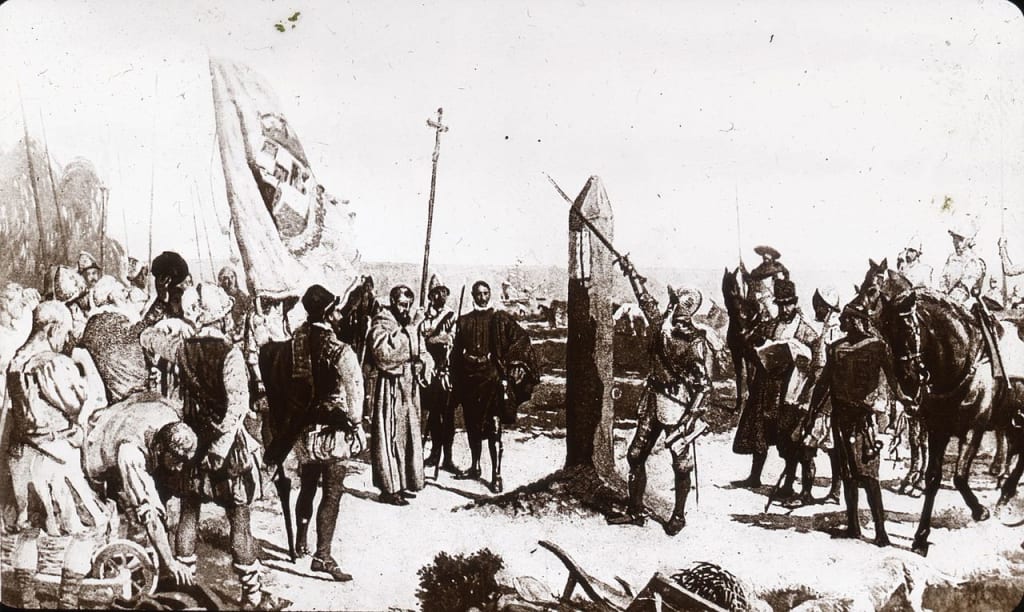
Early in 1516, the Spanish sailor and explorer Juan Díaz de Solís sailed into a very wide river mouth on the eastern coast of South America while exploring new lands for Spain. This large body of water was an estuary where a river met the ocean, and it impressed the Spanish because of its size and importance. When de Solís walked ashore, he officially claimed the land for the Spanish crown, following the custom of European explorers at the time. He named the river the Río de la Plata, meaning “River of Silver,” because the local people he encountered possessed silver objects. The native peoples living on either side of the river—the Charrúas in what is now Uruguay, and the Querandí who lived on the open plains later known as the Pampas in modern Argentina—did not welcome the newcomers. Instead, they viewed them with suspicion and anger. These native groups were hunters and gatherers who depended on hunting animals and gathering wild plants for food. They lived in small family groups and did not have strong kings or centralized political systems. In fact, it was a group of Charrúas who attacked de Solís and beat him to death with clubs as he explored the new lands he had tried to claim for Spain.
In 1534, the Spanish, still hopeful about the region despite earlier failures, sent their first group of settlers from Spain under the leadership of Pedro de Mendoza. This group was sent to establish a permanent settlement and secure Spanish control over the area. They built a town on the site of present-day Buenos Aires in the same year. On paper, it should have been an ideal place for Europeans to live and settle. Buenos Aires, which literally means “good airs,” had a pleasant and mild climate, suitable for human settlement. However, the first Spanish stay there did not last long. The settlers were not interested in living comfortably or farming the land themselves. Instead, they wanted valuable resources to take and people they could force into labor. The Charrúas and the Querandí were unwilling to cooperate with these demands. They refused to give food to the Spaniards and strongly resisted working for them when captured. They also attacked the settlement using bows and arrows, making life dangerous for the newcomers. As a result, the Spaniards began to suffer from hunger because they had not planned to grow crops or secure their own food supply. Buenos Aires quickly became a disappointment. The native people could not be forced into labor, and the region had no gold or silver that could be easily taken. The silver that de Solís had seen earlier had actually come from trade with the Inca Empire in the Andes, which was located far to the west.
While struggling to survive, the Spaniards began sending out exploration journeys to find a better location that would offer greater wealth and native populations that were easier to control. In 1537, one such expedition, led by Juan de Ayolas, traveled up the Paraná River in search of a route to the rich Inca lands. During this journey, the expedition encountered the Guaraní people. Unlike the Charrúas and Querandí, the Guaraní were a settled population who practiced agriculture. Their economy was based on growing crops such as maize (corn) and cassava, which meant they produced food regularly and lived in permanent villages. De Ayolas quickly realized that the Guaraní were very different and more useful to Spanish colonial goals. After a brief conflict, the Spanish defeated Guaraní resistance and founded a town called Nuestra Señora de Santa María de la Asunción. This settlement still exists today as the capital city of Paraguay. The Spanish conquerors married Guaraní princesses, which helped them gain power and legitimacy. They soon established themselves as a new ruling upper class. They adapted the Guaraní’s existing systems of forced labor and tribute, placing themselves at the top of the system. This kind of colony, with controllable labor and steady food production, was exactly what the Spanish wanted. Within four years, Buenos Aires was completely abandoned as all the Spanish settlers moved to the new town.
Buenos Aires, later known as the “Paris of South America,” with its wide European-style streets and great wealth based on farming and cattle from the Pampas, was not settled again until 1580. The abandonment of Buenos Aires and the successful takeover of the Guaraní people clearly shows the logic behind European colonization of the Americas. Early Spanish settlers, and later English settlers as well, were not interested in farming the land themselves. They wanted others to work for them, and they wanted riches such as gold and silver to take and send back to Europe.
About the Creator
Keep reading
More stories from Hafeez Alam and writers in History and other communities.
The Economics of the Rio Grande
If you stand at the border and look north, you will see Nogales, Arizona, which is located in Santa Cruz County. The average household income there is about $30,000 per year. Most teenagers attend school, and most adults have completed high school. Even though many people argue that the U.S. health care system has problems, the population is generally healthy, with a high life expectancy compared to most countries in the world. Many residents are over the age of sixty-five and have access to Medicare.
By Hafeez Alam2 months ago in History
How Can the World Prevent Another Global War?
How Can the World Prevent Another Global War? In times of rising global tensions, many people ask an important question: How can the world prevent another major war? History has shown that global conflicts cause enormous human suffering, economic destruction, and long-lasting political instability. Preventing a large-scale war—especially one that could involve nuclear weapons—is one of the most important challenges facing world leaders today.
By Wings of Time 2 days ago in History
A More Human Vocal
When we launched Vocal nearly a decade ago, the world was a very different place. LLMs did not exist, and stories were created one at a time by people sitting down to write, revise, and share something personal. Many of our assumptions about publishing, trust, and participation were built for a world where effort and output were inseparable.
By Justin @ Vocal6 days ago in Resources




Comments
There are no comments for this story
Be the first to respond and start the conversation.