
The Forgotten War of 1812
A Small but Impactful Conflict with Lasting Consequences on North America

The War of 1812, though relatively minor in scale, was a pivotal conflict that left a profound legacy on the North American landscape. This war was waged between the nascent United States and Great Britain, alongside Canadian colonists and Indigenous nations. While it has largely faded from collective memory in both the United States and Britain, it remains a significant historical event in Canada, symbolizing the defense of liberty and democratic principles. The tensions that precipitated the war were fueled by British impressment of American sailors and growing resentment among Americans. A series of British decrees severely restricted American trade and facilitated the Royal Navy's impressment of American mariners. These escalating tensions contributed to the election of new congressional representatives who championed war and territorial expansion into Native American lands. The alliance formed by Tecumseh with various Indigenous nations and the events surrounding the Battle of Tippecanoe were crucial. Tecumseh's efforts to recruit allies and General William Henry Harrison's advance toward Prophetstown culminated in the Battle of Tippecanoe, which had significant political repercussions for President Madison. The War of 1812 encountered considerable opposition and skepticism regarding the United States' capability to confront Great Britain, a formidable naval power amidst the turmoil of Napoleon's dominance in Europe. In both Canada and the United States, there was notable dissent against the war, particularly from the New England states, which were economically tied to trade with Great Britain. Canadian defense strategies were effectively implemented, with Governor General Sir George Prevost tasked with maintaining control over as much of Canada as possible despite numerous challenges. General Isaac Brock, a distinguished leader in Upper Canada, faced the daunting task of defending a vast territory with limited resources. The War of 1812 serves as a study in contrasts between British and American military capabilities.
The British army was composed of professional soldiers who occupied the lower tiers of the socio-economic hierarchy, yet they played a vital role in military operations. In contrast, the American army depended on untrained militia forces, stemming from a deep-seated skepticism towards a permanent military establishment, which resulted in poor leadership decisions among veterans. General Hull capitulated Detroit without engaging in combat and subsequently faced court-martial. His surrender was swift and met with no resistance, leading to his disgrace. The death of General Brock during the Battle of Queenston Heights, while contributing to a British victory, represented a considerable loss for both Canada and its military forces. Indigenous troops employed unconventional strategies to overcome American forces at Queenston Heights. The practice of privateering during the War of 1812 involved state-sanctioned piracy aimed at disrupting enemy trade. American successes at sea fostered optimism, while harsh tactics were utilized in the western front against Fort Detroit. The War of 1812 was marked by the harsh realities and suffering experienced by both soldiers and captives. Vivid depictions of battle scenes and the emotional toll on the wounded, including young children, are presented. The treatment of prisoners, the political narratives surrounding them, and their integration into Native tribes are also emphasized. Tecumseh's relationship with Proctor and Brock was fraught with tension, as Tecumseh openly criticized Proctor's command, which led to the British withdrawal from Fort Meigs. The Battle of Stoney Creek illustrated the chaotic essence of the conflict, with both factions grappling with confusion and losses amid the 'fog of war.' Naval engagements on the lakes were pivotal during the War of 1812, with confrontations between British and American vessels culminating in the renowned last words of Captain James Lawrence: 'Don't give up the ship.' Mastery of the lakes was crucial for maintaining supply lines and logistical support for both armies. Tecumseh's demise signified the conclusion of a significant chapter. Despite sustaining grave injuries, Tecumseh opted to remain and fight, solidifying his status as an iconic leader among Native Americans.
The demise of Tecumseh marked the conclusion of Native American support for the conflict, significantly altering the power dynamics in North America. The autumn of 1813 posed a considerable threat to Canada as a British territory. Two American military contingents, comprising 12,000 troops, initiated a substantial invasion of Montreal under the command of James Wilkinson and Wade Hampton. Although they faced primarily French-Canadian and Canadian forces, both American armies struggled with internal discord and a lack of strategic coordination. The War of 1812 played a pivotal role in shaping Canadian identity, with the rise of the militia myth influencing the Canadian military ethos until the First World War. The brave actions of Laura Secord and her enduring legacy epitomize the experiences of pioneer women and the spirit of Canadian nationalism. American forces set fire to civilian properties in Upper Canada, igniting a cycle of vengeance. The incineration of public buildings in York, the capital of Upper Canada, was merely the beginning of this retaliatory wave. British counterattacks resulted in widespread destruction across the entire Niagara frontier. Shadrach Byfield's experience of amputation, performed without anesthetic after sustaining a musket wound, highlights the brutal realities of war. The defeat of Napoleon had significant implications, potentially redirecting British military resources towards the United States. During the War of 1812, the British liberated over 4,000 American slaves, many of whom joined the British ranks as part of the Colonial Marines. This action exposed the hypocrisy of American society by offering freedom to enslaved individuals, instilling fear within the American South. The burning of Washington and its subsequent consequences further illustrated the conflict's profound impact.
The British forces set fire to the White House, provoking outrage among the American press. At that time, the United States government teetered on the brink of financial collapse, while American agricultural products were being exported to Canada, thereby supplying the British military. Tensions were heightened by the Hartford Convention and the demands from the British. There was a prevailing fear of a secessionist conspiracy linked to the Hartford Convention. The British insisted on halting American expansion westward and posed a threat of invasion. The Star-Spangled Banner emerged as a powerful emblem of resilience and patriotism, inspired by the steadfastness displayed at Fort McHenry during the War of 1812. American victories shifted the political landscape and influenced negotiations, resulting in territorial disputes and the significant Battle of New Orleans. Andrew Jackson's leadership, along with the diverse composition of the American forces, played a crucial role in this battle. Jackson's background, leadership approach, and tactical decisions were instrumental in the conflict. The diversity within the American army presented challenges for the British troops. Ultimately, the War of 1812 concluded in a stalemate, yielding minimal gains for the United States, while Canada celebrated its endurance. Both nations marked the occasion, despite the lack of significant territorial acquisitions. The war also contributed to the decline of Native American tribes as Britain and the United States shaped the future of the continent. The War of 1812 was characterized as a contentious and unnatural conflict between closely related peoples, with both sides experiencing victories and defeats. Young William Atherton, a prisoner of war, endured significant hardship yet maintained his spirit throughout the ordeal.
About the Creator
Isaac Ekow Anyidoho
A calm person with a cascading mind filled with ideas of my own and know that; I can make a difference with the support of people like you. Thank you.
Keep reading
More stories from Isaac Ekow Anyidoho and writers in History and other communities.
The King Who Faced God
Nebuchadnezzar was revered as a deity, yet his immense power fostered a sense of arrogance within him. Individuals from various backgrounds and professions prostrated themselves before him, perceiving him as a god. His vast wealth and authority contributed to his hubris, resulting in a skewed perspective on life. A strategic approach of Nebuchadnezzar was to exert control over the kings of Judea. He skillfully coerced these rulers into pledging their loyalty and adhering to his directives. Zedekiah was installed as a figurehead monarch to thwart potential insurrections and revolts. The Babylonians devastated Jerusalem's fortifications and plundered the temple. The destruction of the city’s walls rendered it exposed and perilous for its residents. These walls remained in disrepair until they were rebuilt by the exiles upon their return during Nehemiah's era. The Babylonians not only violated the sanctity of the temple but also looted it, seizing numerous treasures, including sacred items from the temple of God, as well as valuables belonging to the king and his officials. The bronze pillars, standing 18 cubits tall with intricate designs, were also taken, alongside the exile of the Israelites to Babylon. In Babylon, the Israelites adapted their faith to their new reality. Daniel's wisdom was recognized as a gift from the divine. Nebuchadnezzar insisted that the magicians disclose both the dream and its interpretation. The Chaldeans acknowledged that true revelation is a divine endowment, that surpasses human capability. Daniel's predicament unveiled his true nature, as he approached the crisis with composure and tact, demonstrating his integrity.
By Isaac Ekow Anyidoho2 years ago in History
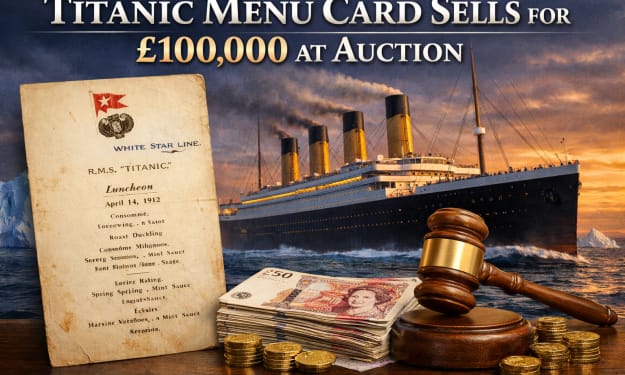
Titanic Menu Card Sells for £100,000 at Auction
A rare menu card from the legendary ocean liner RMS Titanic has sold at auction for an astonishing £100,000, highlighting the enduring fascination with one of history’s most famous maritime disasters. The menu, believed to have been from a first-class meal served shortly before the ship’s tragic sinking in 1912, is considered one of the most remarkable surviving artifacts from the doomed voyage.
By Irshad Abbasi about 16 hours ago in History



Comments (2)
Thanks for the reminder
Nice piece