
The Flames of a World Set Afire
A Story of World War II

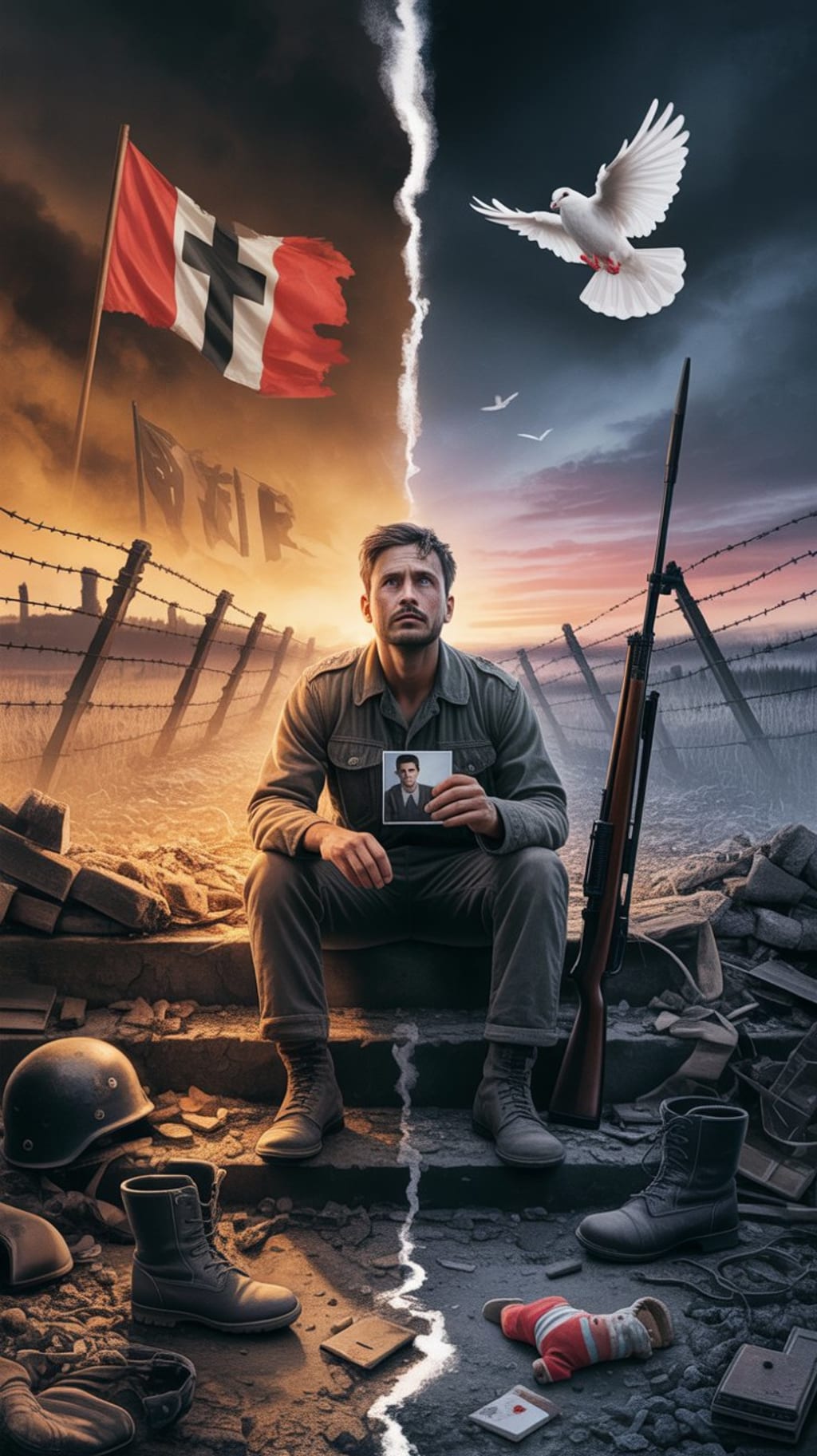
The world had barely healed from the wounds of the First World War when a storm darker and more destructive began to brew. It was September 1, 1939, when Nazi Germany, under the rule of Adolf Hitler, launched an unprovoked invasion of Poland. Within two days, Britain and France declared war on Germany, and the world was once again plunged into chaos.
The conflict quickly spiraled into a global inferno. Hitler, driven by a belief in Aryan supremacy and a desire to expand Germany's territory, sought to reshape Europe through force. His army, the Wehrmacht, unleashed a new kind of warfare—Blitzkrieg, or lightning war—combining speed, surprise, and overwhelming firepower. Poland fell in weeks. Soon after, Denmark and Norway followed, then the Low Countries and France in 1940.
Across the English Channel, the people of Britain braced themselves. Under the leadership of Winston Churchill, Britain stood alone in Western Europe. The skies above turned into a battleground during the Battle of Britain, as the Royal Air Force (RAF) fought valiantly against the German Luftwaffe. Despite relentless bombing—especially during the Blitz—Britain held its ground, giving the world a glimmer of hope.
But the war was far from over. In 1941, Hitler made a fatal decision—he broke his non-aggression pact with the Soviet Union and launched Operation Barbarossa, the largest invasion in history. Millions of German troops surged into Soviet territory, pushing deep into Russia. Cities like Leningrad and Stalingrad became symbols of Soviet resistance, where soldiers and civilians alike fought not just for survival, but for their homeland.
In the Pacific, the conflict took on a different shape. On December 7, 1941, the Japanese Imperial Navy attacked Pearl Harbor, bringing the United States into the war. Overnight, what had been a regional war became truly global. The U.S. joined the Allies, bringing industrial might, military power, and a renewed spirit to the fight.
The war’s brutality touched every corner of the earth. In Europe, Hitler’s regime pursued a campaign of genocide—the Holocaust—systematically murdering six million Jews and millions of others in concentration and extermination camps. The world would later uncover the unspeakable horrors of Auschwitz, Treblinka, and Dachau.
In North Africa, battles raged in the deserts between German Field Marshal Rommel, the “Desert Fox,” and Allied forces led by Britain’s General Montgomery. The struggle shifted in favor of the Allies after the Battle of El Alamein, and soon, Allied forces invaded Italy from the south, toppling Mussolini’s fascist regime.
Meanwhile, in the Pacific, the U.S. began a slow and bloody campaign of island-hopping. Fierce battles took place on islands like Guadalcanal, Iwo Jima, and Okinawa, as American troops fought Japanese soldiers entrenched in every corner, unwilling to surrender.
By 1944, the tide of war had shifted. The Allies prepared for the greatest invasion in history—D-Day, June 6, 1944. On the beaches of Normandy, thousands of Allied soldiers stormed ashore under heavy fire. Despite enormous losses, they broke through Hitler’s Atlantic Wall and began the liberation of Western Europe.
The Soviet Union, too, pushed westward, driving the Germans back through Ukraine, Poland, and into Germany itself. As 1945 dawned, Hitler’s empire was crumbling. The Allies closed in on Berlin from both sides.
On April 30, 1945, Hitler took his own life in his bunker in Berlin. Just days later, on May 7, 1945, Germany surrendered unconditionally. Victory in Europe Day (V-E Day) was celebrated around the world.
But the war was not over. In the Pacific, Japan refused to surrender. After years of brutal combat and the loss of countless lives, the U.S. made a controversial decision. On August 6, 1945, the first atomic bomb was dropped on Hiroshima. Three days later, another was dropped on Nagasaki. The destruction was unprecedented. On August 15, 1945, Japan announced its surrender. The war had finally ended.
World War II lasted six years and claimed over 70 million lives. It reshaped borders, toppled empires, and gave rise to new superpowers—the United States and the Soviet Union. The United Nations was formed in 1945, with a hope to prevent such a catastrophe from ever happening again.
But beyond the facts and figures, it was a war of individuals. Soldiers who stormed beaches under machine-gun fire. Mothers who sent their sons to war with a heavy heart. Children who hid in basements as bombs fell from the sky. Survivors who bore scars both visible and invisible. Heroes who risked everything to save others.
World War II was not just a war of armies—it was a war of humanity’s soul. In its darkest hours, we saw the worst of human cruelty. But we also saw the best: courage, resilience, sacrifice, and the unbreakable will to survive.
And in remembering, we vow: never again.
About the Creator
John Smith
"I write to remember, to feel, and to keep the voices of the past alive. Stories of war, hope, and the human spirit."
Keep reading
More stories from John Smith and writers in History and other communities.
3 Moments When Reality Accidentally Became a Horror Movie
Horror movies usually rely on a simple agreement with the audience: this could never really happen. Ghosts follow rules, monsters have weaknesses, and there’s always a clear point where reality hands the story over to fiction. Real life, unfortunately, does not care about narrative structure, logic, or closure.
By Enoch Sagini4 days ago in History
Chinese Water Torture
Since the dawn of history, human beings have inflicted unimaginable suffering upon one another. Across centuries, people have devised increasingly elaborate methods of punishment and coercion, some brutally explicit, others deceptively subtle. While devices such as iron maidens, racks, whips, and wheels relied on visible physical agony, there existed a form of torment whose true power lay not in blood or broken bones, but in patience, repetition, and the slow erosion of the mind. This method came to be known as Chinese water torture.
By Pure child3 days ago in History
How, Too
Many people wonder how, too. You are not alone, and I am an expert. I will teach you how, too! First, you need to remit a small application fee and fill out an application describing the nature of your financial situation and how often payments will be made, as this will have great bearing on how well I teach you how, too.
By Harper Lewis3 days ago in Fiction


Comments
There are no comments for this story
Be the first to respond and start the conversation.