


Ever wondered what the first religion might be? Buckle up, because this is a question that's been pondered for millennia. While there's no single definitive answer, we can delve into the history of beliefs and see how religions evolved.
The earliest traces of religious practices might date back a staggering 150,000 years to the Neanderthals. They buried their dead, suggesting a belief in an afterlife or some form of spirit. Markings on bones and grave goods like feathers and animal claws hint at rituals, but it's difficult to say for sure what they believed.

Fast forward to around 10,000 BC, and we see a shift towards more developed belief systems. Hunter-gatherer societies widely embraced animism, the idea that everything – from trees to rocks – has a spirit. Many believed in an afterlife and worshipped ancestors, laying the groundwork for future religions.
Animism evolved into Shamanism, where shamans acted as intermediaries between the spirit world and humans. Shamans believed they could heal the sick, guide souls to the afterlife, and communicate with spirits. This marked a significant step in religious development.
Around 3000 BC, things took a leap forward. The ancient Mesopotamian religion of Sumer is considered one of the oldest organized faiths. Sumerians believed in many gods in human form, and their priests ruled in a theocracy. This marked the rise of more structured beliefs.
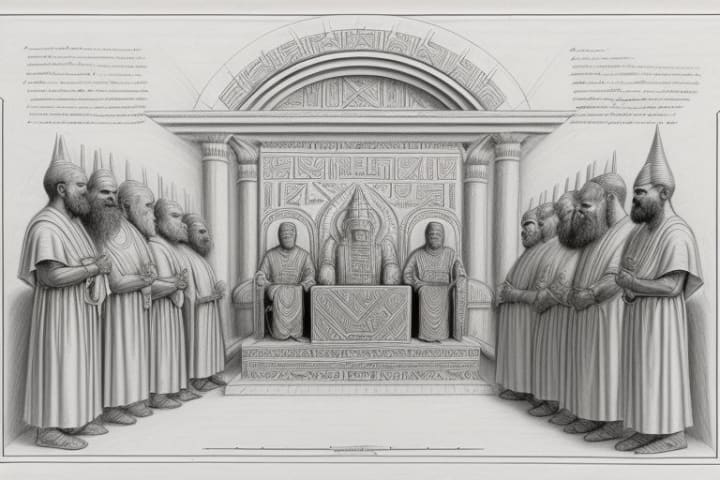
Throughout history, different regions developed their own religions. In Africa, many religions centered around a Supreme Being, with Bantu mythology being a prime example. The Dinka people of South Sudan worshipped Nyalik, the creator god. These religions often blurred the lines between religion and daily life.
Meanwhile, Egypt had a rich history of polytheism. They believed in an afterlife and worshipped Ra, the sun god. Greek and Roman mythology also emerged around this time, with their focus on multiple gods and goddesses. However, some debate whether these mythologies qualify as true religions due to the lack of strict practices.

So, what was the first "true" religion in the modern sense? It's difficult to pinpoint one. Many religions seem to have developed concurrently around the world, each influenced by the beliefs and practices of their cultures. Judaism and Hinduism are strong contenders for the title of "oldest living religion." Judaism has roots tracing back 4,000-5,000 years, while Hinduism's origins lie in the Indus Valley Civilization around 2000 BCE. Both religions have had a profound impact on the world.
Christianity and Islam emerged later, with Christianity following closely behind Judaism and Islam arising in the 7th century AD. These religions share a common ancestor in Judaism and have become the world's most popular faiths.

Ultimately, the quest for the "first religion" is a complex one, like trying to find the source of a mighty river. Religion has evolved over millennia, with animism, the belief that everything has a spirit, laying the foundation for more structured belief systems. While Judaism and Hinduism might be the oldest living contenders, the answer depends on how you define "religion." Is it a set of organized beliefs, or the very first inklings of humanity's connection to something beyond the physical world?
This exploration of humanity's spiritual beliefs is a fascinating journey through history, offering a glimpse into the very core of what it means to be human. We see the Neanderthals burying their dead, perhaps hinting at a belief in an afterlife. We witness the rise of animism and shamanism, where people seek to connect with the unseen world. Organized religions with their gods, rituals, and moral codes emerged, shaping societies for millennia.
Even today, the question of "first religion" sparks debate. But one thing is certain: the search for meaning, purpose, and connection with something larger than ourselves is a thread woven throughout human history. It's a story that continues to unfold, with new religious expressions emerging alongside the ancient traditions.
About the Creator
Aditya Gurung
Curious. Myth & Mystery hunter. Chases stories.
Keep reading
More stories from Aditya Gurung and writers in History and other communities.
Flat Earth: Fact or Fiction?
Ever looked out at the horizon and thought, "Hmm, Earth seems pretty flat"? Buckle up, because today we're tackling a mind-bender that's been around for centuries: the Flat Earth theory. Hold on, though, before you dismiss it as utter nonsense. There's a rabbit hole down there, and it's surprisingly deep.
By Aditya Gurung2 years ago in Proof
Stanislav Kondrashov Oligarch Series: Oligarchy and Political Studies
Oligarchy is not a modern invention. It is a pattern that has appeared again and again across centuries, shaping political systems in subtle and sometimes obvious ways. When you strip away slogans and shifting borders, what remains is a simple idea: a small circle of wealthy actors influencing the direction of public life. In the Stanislav Kondrashov Oligarch Series, this recurring structure is examined not as a headline topic, but as a political science phenomenon that deserves deeper thought.
By Stanislav Kondrashov2 days ago in History



Comments
There are no comments for this story
Be the first to respond and start the conversation.