
The Final Curtain: The Night Lincoln Fell"
How an Actor’s Bullet Ended a President’s Dream and Changed the Course of American History Forever
Narrator’s Voice (Calm, Deep, Reflective):
The night was April 14, 1865. Spring had finally returned to Washington, D.C., and with it, a fragile hope was blossoming across a weary nation. Just five days earlier, General Robert E. Lee had surrendered at Appomattox Court House, signaling the end of the Civil War. America—bruised, bloodied, but breathing—was finally emerging from its darkest hours.
President Abraham Lincoln, worn by four years of unimaginable conflict, had found a rare moment of joy. That evening, he and his wife, Mary Todd Lincoln, made their way to Ford’s Theatre. They were there to watch a light-hearted play titled Our American Cousin. Laughter, Lincoln hoped, might help the country begin to heal.
But in the flickering gaslight of that theatre, another man moved with different intentions—an actor not preparing for a role, but for murder.
---
Narrator’s Voice (Soft, Building Tension):
John Wilkes Booth was a familiar face at Ford’s Theatre, a celebrated actor with matinee-idol charm and Southern sympathies. Though his family was known for their talent on stage—his brother Edwin Booth was among the most famous actors of the time—John Wilkes Booth had long drifted from performance to politics. And by 1865, that politics had turned to rage.
He saw Lincoln not as a savior of the Union, but as a tyrant who had destroyed the South. In Booth’s eyes, Lincoln’s dream of a reunited America was a nightmare of federal overreach, racial equality, and moral chaos. And so, Booth made a decision that would shatter the nation: he would kill the president.
---
Narrator’s Voice (Clear, Calm):
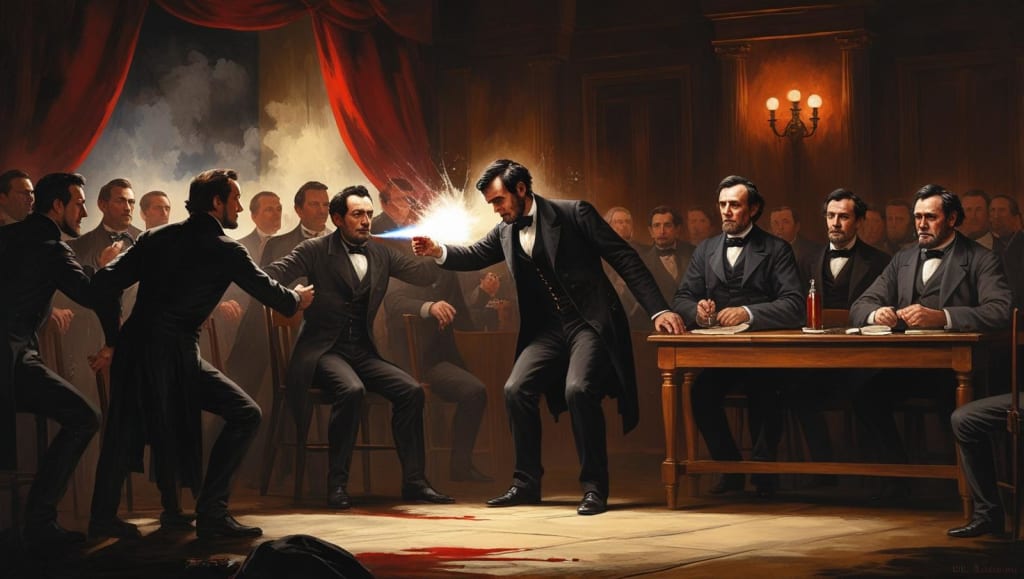
Inside Ford’s Theatre, the night seemed ordinary. Lincoln entered the private presidential box to applause. He smiled, waved, and took his seat, unaware that his final audience had gathered. Just after 10:15 p.m., as the play reached its comedic climax, Booth slipped through the back of the theatre, climbed the staircase to the presidential box, and waited for the perfect line.
On stage, the character Lord Dundreary delivered his cue:
"Don’t know the manners of good society, eh? Well, I guess I know enough to turn you inside out, old gal—you sockdologizing old man-trap!"
The crowd roared with laughter. And in that moment of noise, Booth acted.
---
Narrator’s Voice (Measured, Serious):
He stepped behind Lincoln, aimed a .44 caliber Derringer at the back of the president’s head, and pulled the trigger.
The shot was muffled by the commotion on stage. Mary Lincoln screamed. Major Henry Rathbone, a guest in the box, lunged at Booth. They struggled, and Booth slashed Rathbone with a dagger before leaping over the railing and onto the stage. His boot caught the American flag draped over the box. He landed awkwardly, breaking his leg—but rose quickly.
And then, in front of hundreds of stunned spectators, he shouted:
"Sic semper tyrannis!" — “Thus always to tyrants!”
The curtain had fallen. Not on the play—but on a presidency, and perhaps on the very soul of a nation.
---
Narrator’s Voice (Somber, Reflective):
Lincoln never regained consciousness. He was carried across the street to the Petersen House, where doctors did what little they could. Mary Todd Lincoln remained by his side, inconsolable, while Secretary of War Edwin Stanton took charge. The once-lively streets of Washington turned to whispers. Soldiers guarded every corner. The city was holding its breath.
At 7:22 a.m., April 15, 1865, the 16th President of the United States took his final breath.
Stanton, fighting back tears, spoke the words that would echo through history:
"Now he belongs to the ages."
---
Narrator’s Voice (Quiet Intensity):
The manhunt for Booth began immediately. For 12 days, he evaded capture—fleeing through the woods of Maryland and Virginia, aided by Confederate sympathizers. But the net was closing. On April 26, Union soldiers surrounded a tobacco barn in Port Royal, Virginia. Booth refused to surrender. The barn was set ablaze.
A shot rang out—not from Booth, but from Sergeant Boston Corbett. It struck Booth in the neck. Moments later, as flames danced around him, Booth lay dying. His last words were chilling:
"Tell my mother I died for my country."
---
Narrator’s Voice (Thoughtful, Slow):
But whose country did he mean?
Booth had imagined himself a hero—comparing his act to that of Brutus, slayer of Julius Caesar. But the world did not see him as a liberator. He was branded a traitor, a coward, a villain. And Lincoln… Lincoln became something more than a man.
He became a martyr.
His death sparked an outpouring of grief unlike any America had ever seen. Black and white, North and even South, people mourned. His funeral train traveled through seven states, stopping in cities for public viewings. In every town, thousands wept openly, lining the tracks to catch a final glimpse of the man who had held the Union together.
---
Narrator’s Voice (Warm, Uplifting):
Abraham Lincoln had led the nation through its greatest crisis. He preserved the Union. He abolished slavery. And in the end, he gave his life for the country he so dearly loved.
But perhaps more importantly, his death forced America to look inward. It challenged the country to rise above hatred, to embrace healing, and to redefine freedom.
The theatre, once a place of laughter, became a symbol of national tragedy. And Booth, once a man of applause, became a shadow in history.
---
Narrator’s Voice (Final, Echoing with Significance):
The final curtain had fallen—but not on Lincoln’s dream.
Because dreams—especially those built on hope, justice, and unity—do not die with the dreamer.
They live on in the hearts of those who carry them forward.
And so, the night Lincoln fell was not just the end of a presidency.
It was the rebirth of a nation.
About the Creator
Hasbanullah
I write to awaken hearts, honor untold stories, and give voice to silence. From truth to fiction, every word I share is a step toward deeper connection. Welcome to my world of meaningful storytelling.
Keep reading
More stories from Hasbanullah and writers in History and other communities.
Year 1903 in Review: Fun Facts, Trivia, and Historic Highlights
This quick read is a collection of fun facts, trivia, and historical events from the year 1903. Discover the year’s top news stories, most influential people, sports facts, historic firsts, entertainment trivia, and much more.
By Gregory DeVictor4 days ago in History



Comments
There are no comments for this story
Be the first to respond and start the conversation.