
The Father of Pakistan’s Nuclear Program
A Journey of Science, Patriotism, and National Defense

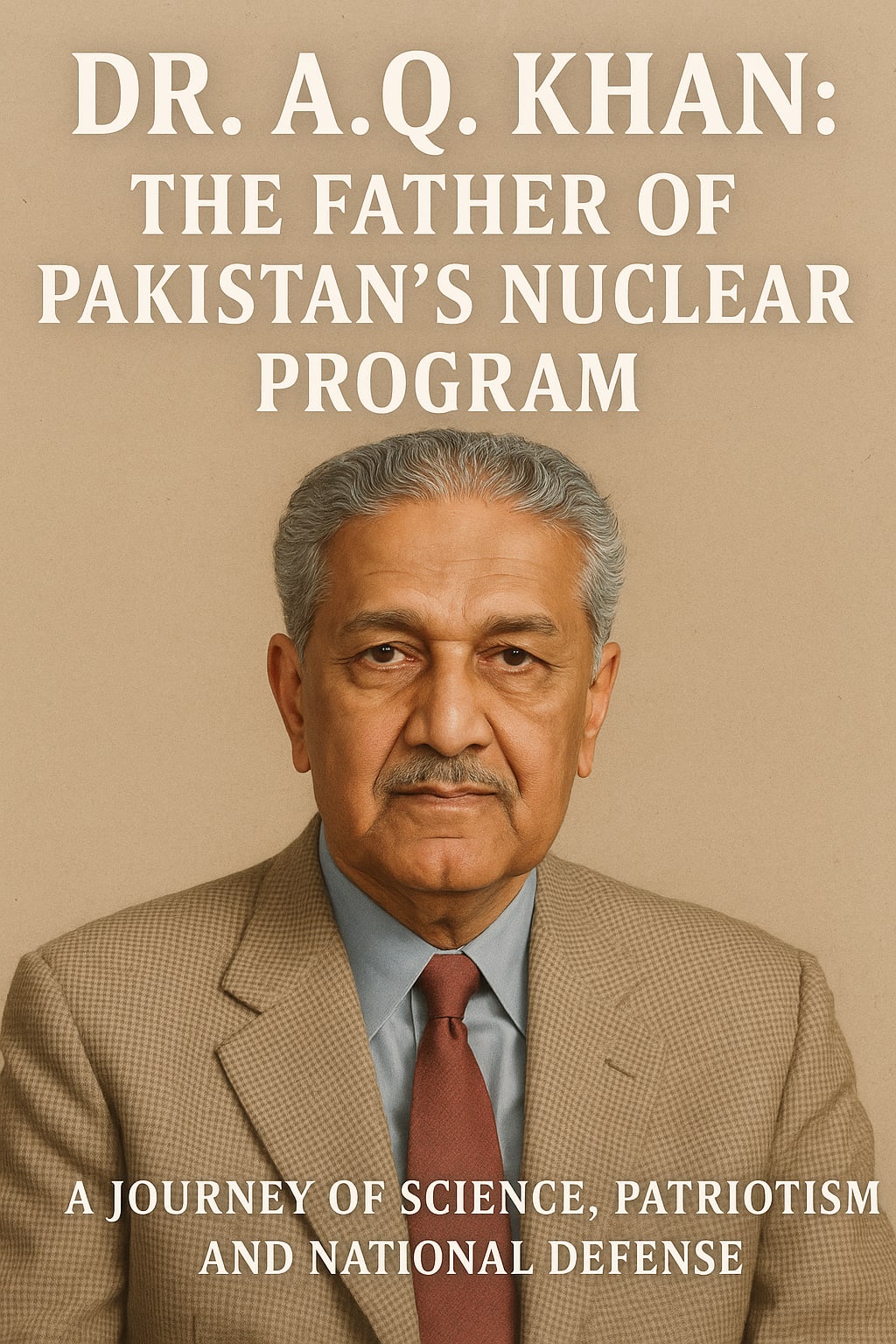
Dr. Abdul Qadeer Khan, often hailed as the “Father of Pakistan’s Nuclear Program,” was a metallurgist, engineer, and visionary whose life became synonymous with Pakistan’s nuclear capability. His contribution to the country’s strategic defense reshaped South Asia’s geopolitical landscape and elevated Pakistan to the status of a nuclear-armed state. A man of brilliant intellect, deep patriotism, and relentless determination, Dr. A.Q. Khan’s life journey reflects the perfect confluence of science and national service.
Early Life and Education
Abdul Qadeer Khan was born on April 1, 1936, in Bhopal, British India. Following the partition of India in 1947, his family migrated to Pakistan and settled in Karachi. His early education took place in local schools, where he exhibited an exceptional aptitude for science and mathematics. After completing his schooling, he enrolled at D.J. Science College in Karachi and later moved to Europe for higher studies.
Dr. Khan earned a degree in metallurgical engineering from the Technical University in West Berlin in 1967. His pursuit of scientific excellence continued in the Netherlands, where he completed a master’s degree in metallurgy from Delft University of Technology. He later obtained a Doctorate in engineering from the Catholic University of Leuven in Belgium. These academic achievements laid a strong foundation for his future contributions.
Professional Beginnings and the Call to Serve
While working at a subcontractor for the Urenco uranium enrichment facility in the Netherlands, Khan gained vital experience in nuclear technology—particularly gas centrifuge technology used for uranium enrichment. In 1974, following India’s first successful nuclear test, Pakistan’s urgency to develop its own nuclear deterrent became evident. Shocked and alarmed by regional security threats, Dr. Khan offered his services to the Pakistani government. His letter to then-Prime Minister Zulfikar Ali Bhutto marked the beginning of a historic collaboration.
Bhutto welcomed Khan’s proposal enthusiastically. Recognizing his expertise, the government brought him back to Pakistan in 1976, where he was placed in charge of the nascent uranium enrichment project. This marked the beginning of Pakistan’s secret nuclear journey.
Building Pakistan’s Nuclear Program
Under Khan’s leadership, the Engineering Research Laboratories (ERL) was established in Kahuta, which was later renamed Khan Research Laboratories (KRL) in his honor. Here, he spearheaded the development of gas centrifuge technology to enrich uranium—a complex and highly classified scientific endeavor.
Despite economic sanctions, international restrictions, and limited resources, Dr. Khan and his team made significant progress. Working under immense pressure and secrecy, they successfully enriched weapons-grade uranium by the early 1980s. His technical brilliance, combined with his tireless dedication, transformed Pakistan’s nuclear program from theory to reality.
On May 28, 1998, Pakistan conducted five nuclear tests in response to India’s earlier nuclear detonations. These tests, carried out in the Chagai Hills of Balochistan, were the culmination of decades of scientific work and national aspiration. Dr. Khan, though not directly involved in the final test execution, was recognized as the architect behind Pakistan’s nuclear capability. He became a national hero overnight, celebrated for safeguarding the nation’s sovereignty.
National Hero and Controversy
Following the successful nuclear tests, Dr. A.Q. Khan was awarded Pakistan’s highest civilian honors, including the Nishan-e-Imtiaz (Order of Excellence), twice—in 1998 and 1999. Schools, research institutions, and public spaces were named after him, and his stature grew to that of a living legend in Pakistan.
However, in 2004, his illustrious career took a dramatic turn. He was accused of involvement in a proliferation network that allegedly supplied nuclear technology to Iran, Libya, and North Korea. Under intense international pressure, Dr. Khan appeared on national television and took “full responsibility,” although many believe he was used as a scapegoat by higher authorities.
He was placed under house arrest for several years, though he later recanted his confession, stating it was made under coercion. The incident remains a controversial chapter in his life. While many in the West criticized him for spreading nuclear technology, in Pakistan, he continued to be revered as a patriot who acted in the country’s best interest.
Contributions to Science and Education
Beyond his nuclear work, Dr. Khan was an advocate for science and education in Pakistan. He founded various research institutes and contributed to the development of scientific education in the country. He wrote extensively on science, technology, and national development, with a vision to see Pakistan become self-reliant in research and innovation.
His philanthropic work also included funding hospitals, schools, and welfare programs. A strong believer in the power of education, he championed youth development and consistently urged the younger generation to pursue excellence in science and technology.
Personal Life and Legacy
Dr. A.Q. Khan led a relatively private personal life. He was married to Hendrina Reterink, a Dutch woman, and the couple had two daughters. Despite facing international criticism and domestic political challenges, he remained devoted to Pakistan until his death.
Dr. Abdul Qadeer Khan passed away on October 10, 2021, due to complications from COVID-19. He was buried with full state honors at the H-8 graveyard in Islamabad. His funeral was attended by top officials, military leaders, and thousands of citizens who came to pay their respects to the man they called a national savior.
Conclusion
Dr. A.Q. Khan’s life was a testament to how one individual’s vision, knowledge, and dedication can alter the course of a nation’s history. To many Pakistanis, he was more than a scientist—he was a symbol of resilience, independence, and national pride.
Despite the controversies that clouded his later years, his contribution to Pakistan’s defense and scientific development remains unparalleled. His legacy lives on in every scientific institution he helped build, every mind he inspired, and every step Pakistan takes toward scientific advancement and national security.
Through a life of service, science, and sacrifice, Dr. Abdul Qadeer Khan earned his place as a cornerstone of Pakistan’s modern identity—a name that will be remembered for generations to come.
About the Creator
Irshad Abbasi
"Studying is the best cure for sorrow and grief." shirazi
Keep reading
More stories from Irshad Abbasi and writers in History and other communities.
Father of Modern Science and the Battle for Truth
Galileo Galilei was born on February 15, 1564, in Pisa, Italy, during a time when Europe was undergoing seismic changes in thought, art, and science. Known as the “Father of Modern Science,” Galileo played a central role in shaping the scientific method and challenging centuries of established authority. His life was marked by discovery, intellectual rebellion, and personal struggle—culminating in one of history’s most famous clashes between science and religion.
By Irshad Abbasi 7 months ago in History
Julius Caesar: The Rise and Fall of a Legend
The Rise and Fall of Julius Caesar In the first century BCE, the Roman Republic stood as one of the most powerful states in the ancient world. Its armies conquered vast territories, its laws shaped civilizations, and its Senate governed through a delicate balance of tradition and authority. Into this complex political world was born Gaius Julius Caesar in 100 BCE—a man whose ambition, brilliance, and fate would forever change Roman history.
By The best writer 6 days ago in History
A secret staircase found beneath a 1,500-year-old French church
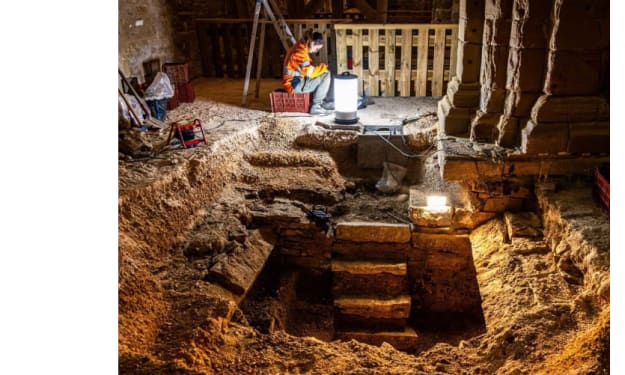
A subterranean staircase and burial strata dating back approximately 1,500 years were discovered during a project inside the Church of Saint Philibert in Dijon, France. The stairs were discovered by restoration workers inside the church when repairs were being made, and the excavation soon ensued.
By Francis Dami2 days ago in History
Wild Card Weekend Recap: What Happens Now?
I think I figured out why I love Wild Card Weekend so much. It's because it's the first playoff anything of the calendar year. The NFL season starts in the fall, and once upon a time, the champion was crowned either on or slightly before New Year's. The evolution of the NFL schedule has resulted in the playoffs starting just into the New Year, and currently, the final week of the season falls on the first weekend of the New Year, with Wild Card Weekend coming a week after that. So yes, chronologically, the NFL's Wild Card Weekend serves as the first playoff anything of the calendar year.
By Clyde E. Dawkins4 days ago in Unbalanced



Comments
There are no comments for this story
Be the first to respond and start the conversation.