
Father of Modern Science and the Battle for Truth
A Journey Through Discovery, Heresy, and the Dawn of a New Scientific Era”

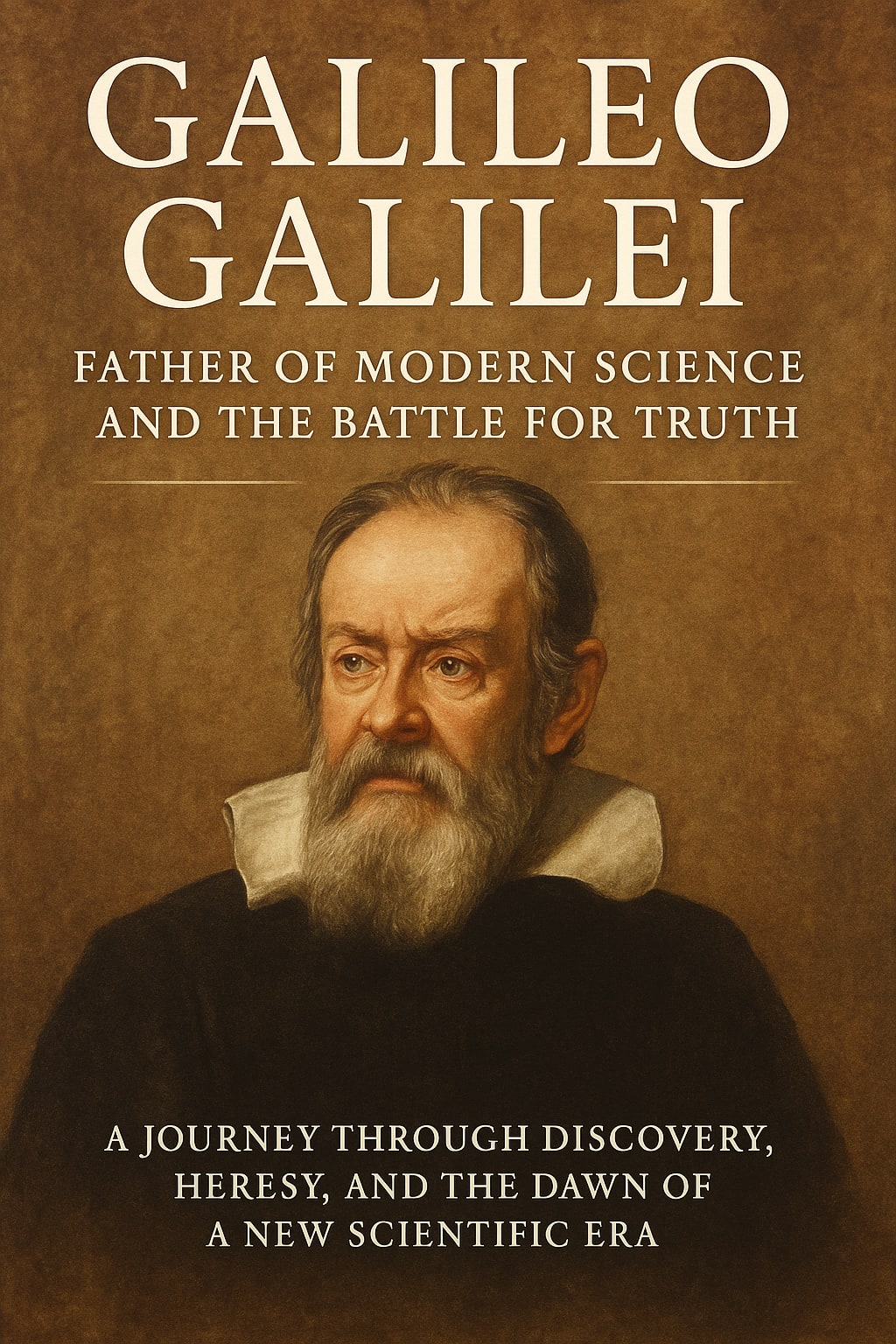
Galileo Galilei was born on February 15, 1564, in Pisa, Italy, during a time when Europe was undergoing seismic changes in thought, art, and science. Known as the “Father of Modern Science,” Galileo played a central role in shaping the scientific method and challenging centuries of established authority. His life was marked by discovery, intellectual rebellion, and personal struggle—culminating in one of history’s most famous clashes between science and religion.
Early Life and Education
Galileo was the eldest of six children in a moderately well-off but struggling noble family. His father, Vincenzo Galilei, was a musician and music theorist who instilled in young Galileo a deep appreciation for mathematics and experimentation. Though initially enrolled at the University of Pisa to study medicine, Galileo’s interests quickly shifted to mathematics and physics.
While still a student, Galileo began questioning the traditional Aristotelian views taught in universities at the time. He noticed inconsistencies between what was preached in lecture halls and what could be observed in the natural world. This skepticism would shape his scientific career.
Scientific Discoveries and Innovations
Galileo’s first significant contribution came in the form of improvements to the telescope. Although he did not invent it, he dramatically improved its magnification, eventually constructing a telescope that could magnify up to 20 times. With it, he peered into the heavens and made discoveries that would shake the very foundations of the scientific and religious worldview.
He observed the moons of Jupiter, which he named the Medicean Stars (in honor of his patrons, the Medici family). This discovery was groundbreaking: it was direct evidence that not all celestial bodies revolved around the Earth, contradicting the long-held geocentric model promoted by Aristotle and Ptolemy.
Galileo also observed that the Moon’s surface was rough and mountainous, not the smooth, perfect sphere that ancient scholars had claimed. He identified sunspots, showing that the Sun, too, was not immutable. His observations of the phases of Venus offered further support for the heliocentric model proposed by Copernicus, in which the planets orbit the Sun.
His detailed observations were published in Sidereus Nuncius (Starry Messenger) in 1610, which brought him international fame—and scrutiny.
The Battle for Truth: Galileo vs. The Church
Galileo’s support for the Copernican model of the solar system brought him into direct conflict with the Catholic Church, which upheld the Aristotelian and Ptolemaic geocentric worldview as church doctrine. At the time, the Church wielded enormous power, both politically and intellectually. To challenge its teachings was to challenge its authority.
In 1616, the Church officially declared the heliocentric model heretical. Galileo was warned not to teach or advocate for it. For a time, he complied—publicly. But privately, he continued his work, convinced that observation and mathematics told a different story.
In 1632, he published his most famous work, Dialogue Concerning the Two Chief World Systems, a brilliant discussion between fictional characters that argued for the Copernican model. Though he claimed neutrality, it was clear which side he favored. The Church was not amused.
In 1633, Galileo was summoned before the Roman Inquisition. Under threat of torture, he recanted his views and was forced to declare that the Earth did not move. Legend has it that as he left the court, he muttered, “E pur si muove”—“And yet it moves.” Whether true or not, the phrase became a powerful symbol of scientific defiance.
Galileo was placed under house arrest for the remainder of his life. He continued to write in secret, including his final work, Discourses and Mathematical Demonstrations Relating to Two New Sciences, which laid the groundwork for Newtonian physics.
Legacy and Lasting Impact
Galileo’s contributions to science were profound and far-reaching. He did not merely observe the world—he redefined the way we observe it. By championing systematic experimentation, empirical evidence, and mathematical analysis, he helped lay the foundation for the scientific method still used today.
He also made key advances in kinematics, studying the motion of objects. Through experiments, such as rolling balls down inclined planes, he formulated early versions of the law of inertia and acceleration due to gravity, challenging long-standing Aristotelian physics.
Galileo’s willingness to challenge authority and pursue truth through evidence made him a symbol of intellectual freedom. Though he suffered greatly for his beliefs, history vindicated him. The Church eventually acknowledged its error, and in 1992—more than 350 years after his trial—Pope John Paul II formally expressed regret for how the Church had treated Galileo.
Today, Galileo is remembered not just as a brilliant astronomer or physicist, but as a pioneer of truth. His life reminds us that progress often requires courage, that discovery demands curiosity, and that truth, once seen, cannot be unseen.
Conclusion: A Journey Worth the Struggle
Galileo Galilei’s story is more than a list of discoveries—it is a testament to the power of human reason in the face of fear, ignorance, and dogma. In the battle between tradition and observation, he stood firm, declaring that evidence must lead belief, not the other way around.
From the moons of Jupiter to the laws of motion, from telescopic lenses to trial before inquisitors, Galileo’s journey changed the course of science forever. He gave humanity new tools to understand the universe, and perhaps more importantly, the courage to ask questions.
In honoring Galileo, we honor the spirit of inquiry itself—the fearless pursuit of knowledge, no matter the cost. And that, truly, is the mark of a great scientist.
About the Creator
Irshad Abbasi
"Studying is the best cure for sorrow and grief." shirazi
Keep reading
More stories from Irshad Abbasi and writers in History and other communities.
Khalid ibn al-Waleed: The Unbreakable Commander
Khalid ibn al-Waleed, known as Sayf Allah al-Maslul (The Drawn Sword of Allah), remains one of the most iconic figures in Islamic military history. His life is a story of remarkable transformation, from a fierce opponent of Islam to one of its most loyal and brilliant military commanders. Renowned for his battlefield tactics, unwavering bravery, and undefeated record, Khalid’s journey is one of faith, strategy, and extraordinary leadership.
By Irshad Abbasi 7 months ago in History
Pablo Escobar: The Man Who Declared War on Colombia
Pablo Emilio Escobar Gaviria was born on December 1, 1949, in Rionegro, Colombia, and raised in the nearby city of Medellín. He grew up in a modest household, the son of a farmer and a schoolteacher. From an early age, Escobar showed ambition and defiance. He dreamed of power, wealth, and influence—dreams far larger than his surroundings. In a country struggling with inequality and limited opportunity, Escobar believed the rules were written to keep people like him down. Instead of trying to change the system, he chose to dominate it.
By The best writer a day ago in History
How Early Aircraft Failures Created Modern Flight Safety
When we look at modern aviation today with its redundant systems, strict regulations, and impressive safety record it’s easy to forget how fragile flight once was. Early aviation wasn’t built on confidence or certainty. It was built on risk. Every successful flight was surrounded by countless failures, and every crash carried lessons that would quietly reshape the future of air travel.
By Beckett Dowhan3 days ago in History




Comments
There are no comments for this story
Be the first to respond and start the conversation.