
The Father of Modern Science
The Life and Legacy of a Scientific Pioneer

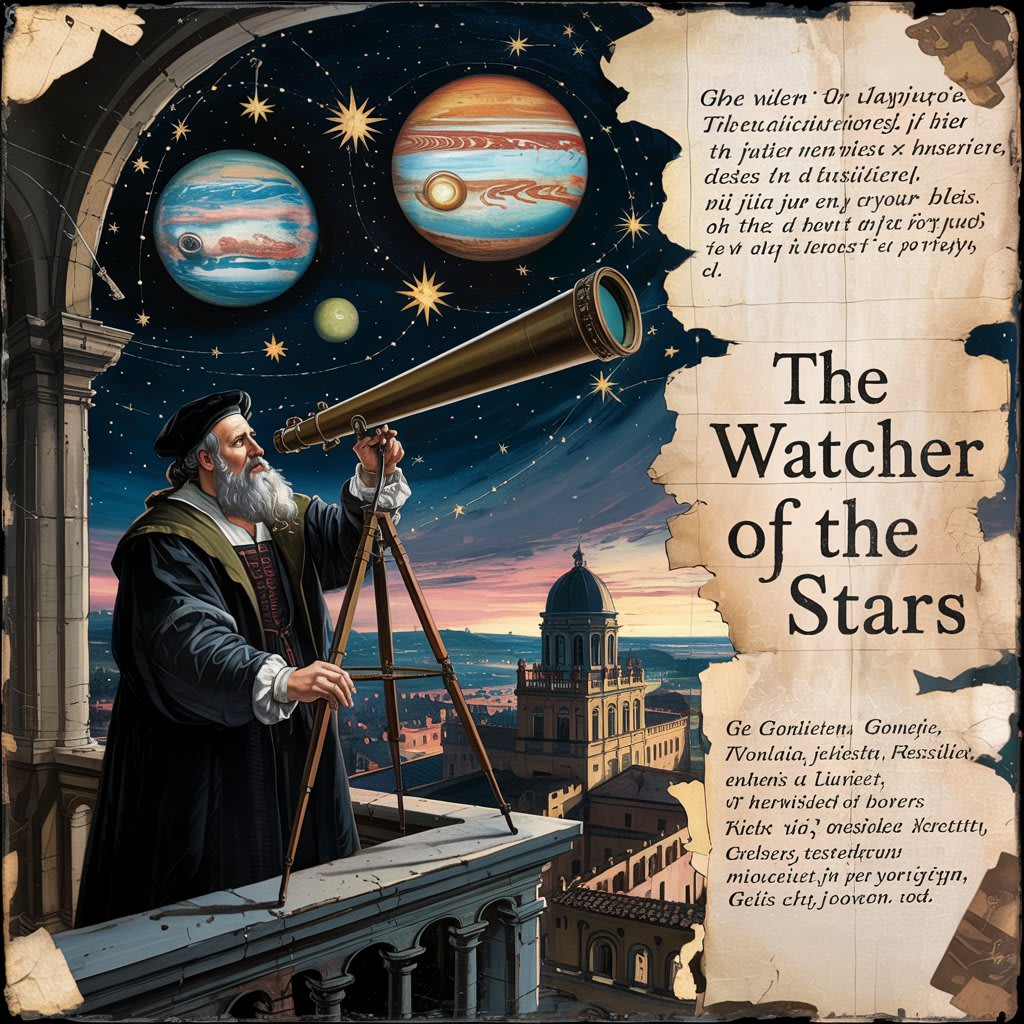
In the quiet city of Pisa, in 1564, a boy was born who would one day tilt the very axis of science. His name was Galileo Galilei—a man who would raise his eyes to the sky and, in doing so, challenge the greatest power on Earth.
As a child, Galileo was fascinated by the world around him. He would watch the swinging of chandeliers in the cathedral and wonder about their rhythm. While others saw simple beauty, Galileo saw patterns—mathematics hidden in nature. His mind questioned everything, from the fall of an apple to the movement of the stars.
Though his father wished for him to become a doctor, Galileo’s heart belonged to the pursuit of truth. He studied mathematics and natural philosophy, diving deep into the works of Aristotle and Euclid. But unlike others of his time, he didn’t just read the ancient masters—he questioned them.
One day in 1609, news of a mysterious invention from the Netherlands reached his ears: a tube that made distant objects appear closer. Galileo, intrigued, built his own version—then improved it. With this new instrument, the telescope, he pointed it toward the heavens. What he saw would shake the very foundation of belief.
Through the lens, Galileo discovered craters on the Moon—proof that it wasn’t a perfect, smooth sphere as the Church had taught. He saw sunspots dancing across the face of the Sun. Most shocking of all, he observed four small moons orbiting Jupiter—clear evidence that not everything revolved around the Earth.
These discoveries supported the theory of a Polish astronomer, Nicolaus Copernicus, who had dared to suggest that the Earth orbited the Sun—not the other way around. To many, this idea was heresy. But to Galileo, it was truth waiting to be seen.
In 1610, Galileo published his findings in Sidereus Nuncius (The Starry Messenger). He became an instant celebrity, praised by scholars and nobles alike. Yet not everyone was pleased. Powerful figures within the Catholic Church saw his work as a threat—not just to science, but to faith and authority.
Galileo, bold and unshaken, continued his work. In 1632, he wrote Dialogue Concerning the Two Chief World Systems, where he cleverly laid out arguments for the Copernican view. Though he presented it as a neutral dialogue between characters, his support for heliocentrism was clear—and dangerous.
The Church summoned him to Rome. There, under the watchful eyes of the Inquisition, Galileo was tried for heresy. The man who had once gazed at the stars with wonder was now forced to kneel and recant his belief that the Earth moved around the Sun.
Legend has it that as he stood up, he whispered defiantly, “E pur si muove”—“And yet it moves.”
Galileo spent the rest of his life under house arrest, his spirit confined but his mind unbroken. Even in his final years, blind and frail, he continued his experiments and writings, laying the groundwork for what would become modern physics.
His legacy outlived him. Long after his death in 1642, scientists like Isaac Newton would build upon his work. The Church, centuries later, would officially acknowledge its mistake. And the telescope—his window to the truth—would become one of the most important tools in humanity’s search for knowledge.
Galileo Galilei was not just a scientist. He was a rebel, a visionary, and a symbol of the eternal struggle between ignorance and enlightenment. He dared to challenge the heavens—and in doing so, brought humanity a little closer to the stars.
About the Creator
Farhan
Storyteller blending history and motivation. Sharing powerful tales of the past that inspire the present. Join me on Vocal Media for stories that spark change.
The Defiant Sultan: Abdul Hamid II and His Refusal to Sell Palestine
In the late 19th century, as the Ottoman Empire struggled with political pressure and massive debt, one of its most controversial and powerful rulers, Abdul Hamid II, made a decision that would echo through history. Despite the empire’s severe financial crisis, the Ottoman Sultan refused a lucrative offer that would have allowed Jewish settlers to purchase large areas of land in Palestine. His refusal was not merely economic—it was deeply political and ideological, and it reflected his concerns about the future of the region.
By Irshad Abbasi 8 days ago in History
The Politics of Playing Dress-Up
Well, to start off I'd like to say a happy world book day to all who celebrate. I know I haven't really posted anything on my socials about it but I'm not a jubilant kind of person. I lay low most of the time. Let's start off with a popular anecdote from the vaults...
By Annie Kapur7 days ago in Geeks


Comments
There are no comments for this story
Be the first to respond and start the conversation.