
Neil Armstrong’s Journey to the Moon
The untold story of the man who led us beyond Earth.

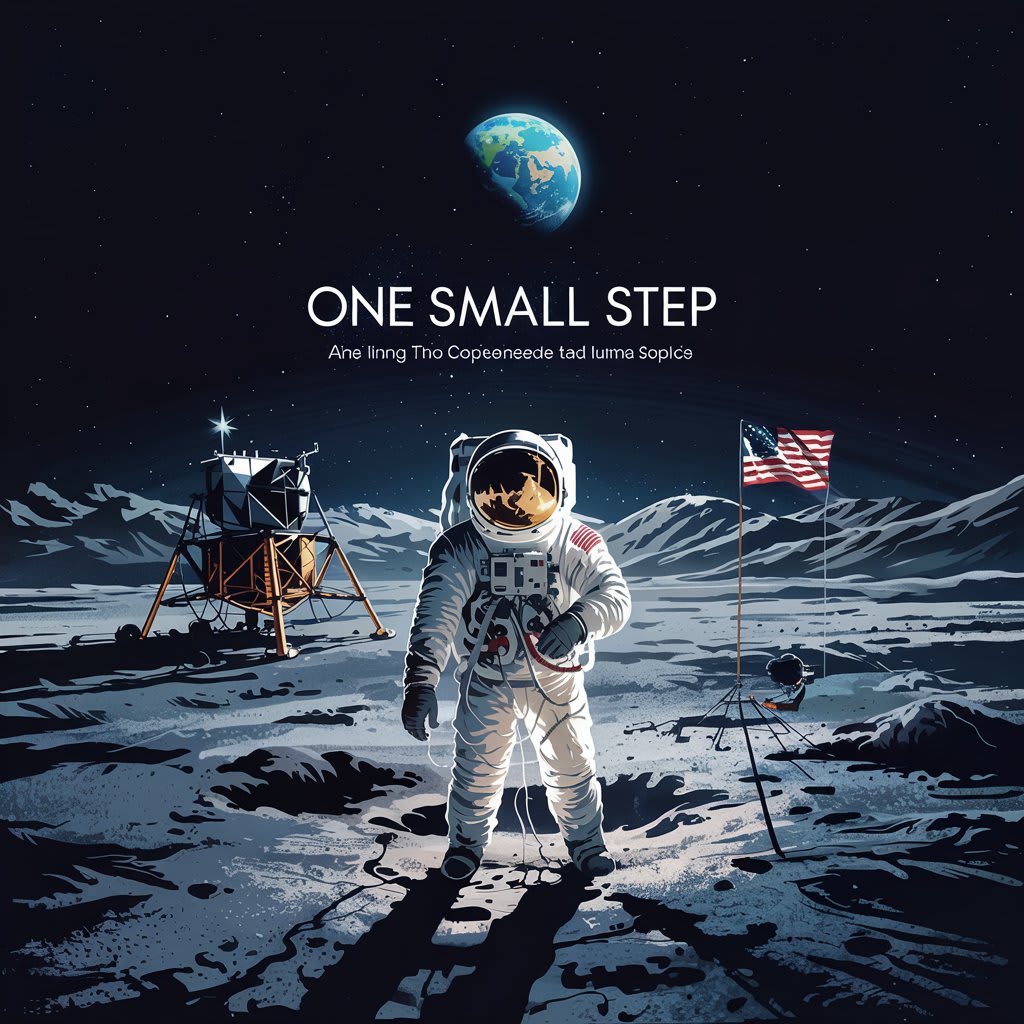
In the quiet town of Wapakoneta, Ohio, a boy with an insatiable curiosity about flight would one day soar farther than anyone had ever dreamed. Neil Alden Armstrong was born on August 5, 1930 — a child of the Great Depression, raised in a humble household where discipline, determination, and dreaming big were cornerstones of life.
From a young age, Neil was captivated by the sky. At just six years old, he took his first airplane ride, and that moment etched itself permanently in his mind. As a teenager, he earned his pilot’s license before he could legally drive a car. Flying wasn't just a hobby — it was a calling.
After high school, Neil studied aeronautical engineering at Purdue University under the Holloway Plan, which required him to serve in the Navy. During the Korean War, he flew 78 combat missions as a naval aviator, earning the respect of his peers for his calm demeanor and precise flying. After the war, he returned to finish his education and later joined the National Advisory Committee for Aeronautics (NACA), which would become NASA.
As a test pilot, Armstrong flew some of the most advanced aircraft of the era, including the X-15 rocket plane. But it was in 1962, when he was selected as an astronaut, that the path of his life shifted forever. The space race between the United States and the Soviet Union was heating up, and America needed heroes — calm, capable, brilliant minds who could withstand the mental and physical pressure of space travel.
Armstrong's moment came with Apollo 11 — the mission that would attempt to land a human on the Moon for the first time. Alongside Buzz Aldrin and Michael Collins, Armstrong trained tirelessly. He studied Moon geology, practiced maneuvers in simulators, and faced endless scrutiny from engineers and scientists who knew that one misstep could cost the crew their lives.
On July 16, 1969, the world held its breath as Apollo 11 launched from Kennedy Space Center. Four days later, on July 20, the Lunar Module Eagle separated from the command module and began its descent toward the Moon’s surface. As they approached their landing site, Armstrong realized the area was strewn with boulders. Taking manual control, he guided the Eagle to a safer spot — his heartbeat steady, his focus unshakable.
Then, history was made.
"Houston, Tranquility Base here. The Eagle has landed."
With those words, Neil Armstrong brought humanity to the doorstep of another world. Hours later, he descended the ladder and placed his left foot onto the dusty lunar soil.
"That's one small step for [a] man, one giant leap for mankind."
The world watched in awe. For the first time in history, a human being had stood on another celestial body. In that moment, Armstrong wasn’t just an astronaut — he became a symbol of what humans could achieve through courage, intellect, and perseverance.
Neil and Buzz Aldrin spent over two hours walking on the Moon, collecting samples, taking photographs, and placing experiments. They left behind the American flag and a plaque that read: "We came in peace for all mankind." It wasn’t just a mission for one nation — it was an achievement for all humanity.
After returning to Earth, Armstrong was celebrated as a global icon. Yet, despite the fame, he remained remarkably humble. He often deflected praise and emphasized the thousands of engineers, scientists, and workers who made the Moon landing possible. He understood that his "one small step" was built on the shoulders of many.
In the years following Apollo 11, Armstrong withdrew from public life, becoming a professor of aerospace engineering at the University of Cincinnati. He continued to serve in various roles, offering his expertise but never seeking the spotlight. He valued privacy and integrity over celebrity — a rarity in any age.
Neil Armstrong passed away on August 25, 2012, at the age of 82. His death marked the end of a remarkable chapter in human history, but his legacy lives on — not just in textbooks and documentaries, but in the hearts of those who dare to dream.
Armstrong proved that the limits of possibility are not defined by the laws of nature, but by the boundaries of imagination and the will to push beyond them. His life reminds us that quiet strength, relentless preparation, and humility are as important as courage in the face of the unknown.
The Moon still hangs in the sky, quiet and distant. But thanks to Neil Armstrong, it no longer feels so far away.
About the Creator
Farhan
Storyteller blending history and motivation. Sharing powerful tales of the past that inspire the present. Join me on Vocal Media for stories that spark change.
Muhammad Shah “Rangila”: The Colorful Emperor of a Fading Empire
Among the later rulers of the Mughal Empire, Muhammad Shah Rangila stands out as one of the most colorful and controversial figures in South Asian history. Known for his love of music, dance, art, and luxury, he earned the nickname “Rangila,” meaning “the colorful” or “the pleasure-loving.” While his reign brought a cultural revival in some ways, it also coincided with a period of serious political decline in the Mughal Empire.
By Irshad Abbasi about 8 hours ago in History
Why Didn't Anyone Tell Us
Men, move along. This is not for you. This is for the women. I was forty-five when I began menopause. It is pretty young for that to be going on in a woman’s life, but I had undiagnosed PCOS, my entire life. Thank you to all the gynecologists I had seen my entire life. That in itself should encourage women to keep seeking second opinions, especially when you are not getting correct answers or any at all.
By Alexandra Grant3 days ago in Humans


Comments
There are no comments for this story
Be the first to respond and start the conversation.