
The Evolution of Saint Nicholas' Legendary Companions
From Ancient Myths to Modern Festivities

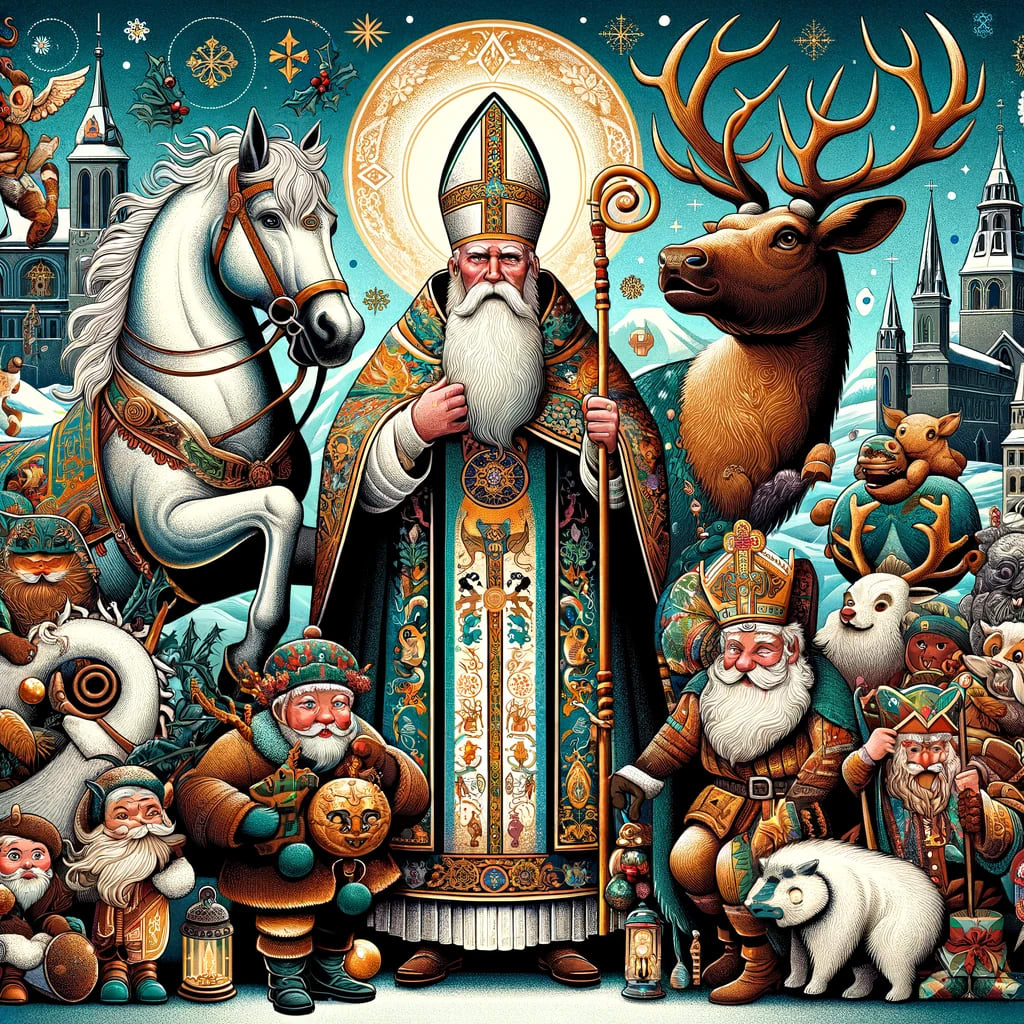
The Evolution of Saint Nicholas' Mounts
As the crisp air of winter heralds, the festive season, the legendary figure of Saint Nicholas takes center stage in collective consciousness. Known for his generosity and kindness, Saint Nicholas, a 4th-century Christian saint, has become a central figure in Christmas celebrations around the world. However, less examined, yet equally fascinating, is the evolution of his traditional mounts into legendary companions that now epitomize Christmas folklore's magic and diversity.
This intriguing transformation is not just a tale of reindeer and sleighs, but a rich narrative woven from history, culture, and mythology. Originating as a historical figure, Saint Nicholas' journey across time has seen him acquire an entourage that varies remarkably across different cultures. From his traditional horse to the reindeer synonymous with the modern Santa Claus, and even to more exotic companions in various folklores, each iteration of Saint Nicholas' mounts and companions reflects a distinct cultural adaptation of his legend.
I explore Saint Nicholas' historical origins. I will trace how his simple, singular image as a benevolent bishop evolved into a more complex and culturally diverse symbol. I will uncover the myriad ways different societies have reimagined Saint Nicholas' companions. This has transformed them from mere transport into integral characters in the holiday's spirit and narrative.
Saint Nicholas and the Roots of His Legend
To fully appreciate the transformation of Saint Nicholas' mounts into Christmas legends, it is essential to understand the historical figure at the heart of these tales. Saint Nicholas, born in the late 3rd century in the village of Patara, part of modern-day Turkey, was a bishop in Myra, a city in the ancient Greek district of Lycia. His life, though shrouded in legend, is celebrated for his acts of kindness, generosity, and miracles. These acts laid the foundation for his veneration as a saint.
Nicholas' reputation for secret gift-giving is perhaps the most enduring aspect of his legend. The most famous story tells of him providing dowries for three impoverished sisters, secretly delivering gold to their father to save them from destitution. This act of covert generosity not only exemplifies his character but also establishes the basis for his association with the tradition of secret gift-giving central to modern Christmas celebrations.
Saint Nicholas veneration was widespread across the Christian world by the Middle Ages. He was revered as the protector of children, sailors, and the wronged. Over time, numerous legends and miracles were attributed to him, further cementing his status as a figure of benevolence and wonder. These stories often emphasized his ability to traverse vast distances, a trait that would later contribute to the imagery of his magical journey on Christmas Eve.
Saint Nicholas' feast day, celebrated on December 6th, became a significant occasion in many European countries. Traditionally, this day was marked by children receiving gifts, a practice that eventually merged with Christmas celebrations. As Saint Nicholas intertwined with Christmas, his persona also fused with various cultural and folkloric traditions. This led to the emergence of different mounts and companions that reflected local customs and beliefs.
In Europe's cultural melting pot, where pagan and Christian traditions were often intertwined, Saint Nicholas' image evolved. This evolution was not just a religious transformation but also a reflection of social, cultural, and economic changes sweeping across Europe. Saint Nicholas of history, a figure rooted in Christian hagiography, took on mythic proportions. He absorbed elements of local folklore and pagan deities, which would eventually lead to the diverse and fantastical companions that accompany him in modern Christmas lore.
This historical overview sets the stage for understanding Saint Nicholas' companions' diverse manifestations. It highlights the deep historical roots of a figure who has become synonymous with Christmas. It provides a backdrop against which his legend's evolution can be better understood.
This journey through the evolution of Saint Nicholas' mounts is a journey through time and culture. It reveals not only the adaptability of legends but also the universal human desire to infuse traditional tales with local flavor and significance. This interplay has shaped the way we perceive and celebrate one of Christmas' most beloved figures.
The Evolution of Saint Nicholas' Mounts
As the crisp air of winter heralds, the festive season, the legendary figure of Saint Nicholas takes center stage in collective consciousness. Known for his generosity and kindness, Saint Nicholas, a 4th-century Christian saint, has become a central figure in Christmas celebrations around the world. However, less examined, yet equally fascinating, is the evolution of his traditional mounts into legendary companions that now epitomize Christmas folklore's magic and diversity.
This intriguing transformation is not just a tale of reindeer and sleighs, but a rich narrative woven from history, culture, and mythology. Originating as a historical figure, Saint Nicholas' journey across time has seen him acquire an entourage that varies remarkably across different cultures. From his traditional horse to the reindeer synonymous with the modern Santa Claus, and even to more exotic companions in various folklores, each iteration of Saint Nicholas' mounts and companions reflects a distinct cultural adaptation of his legend.
In this exploration, we delve into Saint Nicholas' historical origins. I will trace how his simple, singular image as a benevolent bishop evolved into a more complex and culturally diverse symbol. I will try to uncover the myriad ways different societies have reimagined Saint Nicholas' companions. This has transformed them from mere transport into characters integral to the holiday's spirit and narrative.
This journey through the evolution of Saint Nicholas' mounts is a journey through time and culture. It reveals not only the adaptability of legends but also the universal human desire to infuse traditional tales with local flavor and significance.
Diverse Saint Nicholas Companions
The companions of Saint Nicholas vary greatly across different cultures, each reflecting the unique traditions, folklore, and historical influences of their respective regions. These variations are not mere incidental details but are deeply rooted in the cultural fabric of each society, offering a rich tapestry of global Christmas lore.
In Central European folklore, particularly in countries like Austria, Bavaria, and Hungary, Saint Nicholas is often accompanied by Krampus, a horned, demonic figure. Krampus serves as a foil to Saint Nicholas' benevolence, dealing with naughty children while Saint Nicholas rewards the well-behaved. This stark contrast embodies the dual nature of reward and punishment prevalent in many traditional folklores. It reflects the region's medieval Christian heritage, which often juxtaposed saintly virtue against fearsome evil imagery.
In the Netherlands and Belgium, Saint Nicholas, or Sinterklaas, is joined by Zwarte Piet (Black Peter). Traditionally depicted as a Moorish companion, Zwarte Piet is a playful, mischievous character who assists Sinterklaas in distributing gifts and sweets to children. While Zwarte Piet has become controversial in recent years, sparking debates about racial representation, he remains an integral part of Dutch and Belgian Saint Nicholas celebrations, symbolizing the holiday's spirit of fun and merriment.
In other parts of Europe, such as Russia and Ukraine, Saint Nicholas traditionally appears alone. However, his role as a gift-giver during the Christmas season is often conflated with that of Ded Moroz (Father Frost), a Slavic winter wizard who travels with his granddaughter, Snegurochka (The Snow Maiden). Ded Moroz and Snegurochka embody the harshness and beauty of the winter season, bringing gifts and joy in the midst of the cold.
In some Scandinavian traditions, Saint Nicholas, or Santa Claus, is believed to reside in the North Pole or Lapland, where he is assisted by elves. These elves, playful and industrious, help Santa Claus make toys and prepare for his annual gift distribution. This portrayal, popularized by modern American and British Christmas culture, emphasizes the communal and collaborative spirit of the holiday season.
Each of these companions of Saint Nicholas, from the menacing Krampus to the jovial elves, plays a significant role in Christmas celebration in their respective cultures. They not only add a layer of richness and diversity to the Saint Nicholas legend but also serve as a reflection of the societal values, historical contexts, and imaginative expressions of different communities. The global variations in Saint Nicholas' companions illustrate the universal appeal of the Christmas season, a time of joy, wonder, and reflection, celebrated in a multitude of ways around the world.
Blending of Beliefs
The evolution of Saint Nicholas' companions across various cultures is a prime example of cultural and religious syncretism. This is where different belief systems and traditions converge and amalgamate. This blending is not a mere fusion of stories and characters but represents a deeper intertwining of religious practices, pagan rituals, and local folklore. This reflects the dynamic nature of cultural exchange and adaptation.
In the case of Saint Nicholas, syncretism roots can be traced back to early Christian efforts to integrate and transform pagan traditions. As Christianity spread across Europe, it encountered a rich tapestry of indigenous pagan beliefs and practices. In many regions, Christian missionaries adopted a pragmatic approach, seeking to Christianize local customs and festivals rather than eradicate them. This approach led to the integration of pagan symbols and deities into Christian narratives. This created a fusion of beliefs that was both familiar and new to the local populace.
Saint Nicholas, a Christian saint, became a vessel for this syncretism. His feast day, closely coinciding with the winter solstice, a time of significant pagan celebrations, naturally absorbed elements of these older traditions. In Northern Europe, for instance, elements of Norse mythology and the legend of Odin, who led a ghostly procession known as the Wild Hunt during the Yule period, merged with Saint Nicholas mythology. This blending gave rise to the image of a magical, gift-giving figure traversing the winter skies, a motif that echoes in the modern depiction of Santa Claus and his reindeer.
Similarly, Saint Nicholas' companions, such as Krampus and Zwarte Piet, reflect a syncretic blend of Christian and pre-Christian traditions. Krampus, with his demonic appearance, is a remnant of older pagan entities. This is a stark contrast to Saint Nicholas, symbolizing the Christianization of earlier, more primal beliefs. Zwarte Piet, too, embodies a complex synthesis of cultural influences, from medieval Moorish legends to Renaissance European interpretations of Christian saints' lives.
The syncretism evident in Saint Nicholas traditions also reflects socio-cultural changes over the centuries. As societies evolved, so did their religious practices and cultural expressions. The adaptation of Saint Nicholas and his companions adapt local customs and beliefs is not just a matter of folklore; it represents the ongoing dialogue between tradition and change, the sacred and the secular, the ancient and the modern.
In essence, the cultural and religious syncretism in the evolution of Saint Nicholas' companions illustrates human belief systems' fluidity and adaptability. It shows how cultural narratives are not static but constantly reshaped by different societies. This syncretism highlights traditional stories and characters' ability to transcend their original contexts. They gain new meanings and significance as they are woven into global cultures' diverse tapestry.
The Enduring Legacy of Saint Nicholas' Companions
The diverse companions of Saint Nicholas, emerging from a rich tapestry of cultural and religious syncretism, illustrate the dynamic evolution of folklore and tradition. From the horse to the reindeer, from Krampus to Zwarte Piet, these legendary figures embody the blending of pagan and Christian traditions. This reflects cultural narratives' adaptability across time and geography. Their enduring presence in Christmas celebrations around the world enriches the holiday season and reminds us of our shared human heritage. The story of Saint Nicholas and his various companions, in all their forms, captivate the imagination. It adds depth and wonder to the festive spirit and highlighting the universal joy of the holiday season.
About the Creator
Festive Fusion Finds
My insatiable curiosity about the world we live in and passion for uncovering its history and traditions drive me to explore the world we live in. I enjoy wandering through the pages of time, exploring how our world has been shaped by them.
Keep reading
More stories from Festive Fusion Finds and writers in History and other communities.
Kris Kringle
The Enigma of Kris Kringle As the holiday season approaches, Kris Kringle often appears in festive tales and traditions. But who is Kris Kringle? Commonly mistaken for another Santa Claus name, Kris Kringle's origins and identity are rich in cultural history and significance. Discover how Kris Kringle evolved from a traditional German 'Christkindl' to the beloved figure in modern Christmas lore. Through Kris Kringle's historical and cultural journey, I hope to shed some light on how this character symbolizes Christmas. This figure symbolizes the spirit of giving and joy throughout the world.
By Festive Fusion Finds2 years ago in History
The Year 1963 in Review: Facts, Trivia, and Historic Highlights
This quick read is a collection of fun facts, trivia, and historical events from the year 1963. Discover the year’s top news stories, most influential people, sports facts, grocery and other retail prices, entertainment trivia, and much more.
By Gregory DeVictor2 days ago in History


Comments
There are no comments for this story
Be the first to respond and start the conversation.