
The Epic Feuds That Nearly Tore America Apart (Before Twitter Tried to)
A saga of pride, blood, stubbornness, and the long American tradition of not letting things go.


There is a certain kind of silence in the Appalachian dawn. A silence so heavy you can feel it settle on your shoulders. Mist hangs in the hollers. Dogs bark in the distance. The river moves slow, like it’s remembering something it would rather forget.
America was built on dreams, yes... but also on grudges. Long-held, bone-deep grudges. Feuds that smoldered like coal seams until one spark... a pig, a fence, an insult, a line on a map... set them ablaze!
Tonight, The Iron Lighthouse shines its beam on those forgotten infernos. The feuds that almost carved this nation in pieces. The battles where pride mattered more than bullets. Statements like, "It's the principal of the thing" rang true. The grudges, often outlived their combatants.
Some of these feuds reshaped laws. Some reshaped landscapes. Some reshaped entire families. All of them remind us of one uncomfortable truth. Nothing burns hotter than the American sense of being right. With that said, let us begin...
I. The Hatfields & McCoys - A Pig, a River, and a Century of Hellfire
Everyone knows something about the Hatfields and McCoys. Few know the real story. Fewer still know the story started with a pig.
In the 1870s, Randolph McCoy accused Floyd Hatfield of stealing his hog. A big deal in those days, because a pig was practically a savings account on hooves. But it wasn’t just the pig.
Before that:
- A McCoy fought for the Union
- A Hatfield fought for the Confederacy
- Old Civil War wounds still bled in the hollers
- Whiskey flowed like water
- Pride stalked the roads like a wolf
- The Tug Fork River marked a border neither side respected
After the pig trial (which the Hatfields won thanks to a McCoy “traitor” testifying for the wrong side), tensions grew.
Then came:
- accusations of illicit romances,
- moonshine-fueled fistfights,
- ambushes,
- arsons,
- kidnappings,
- lawsuits that went nowhere,
- and finally a full-blown shoot out.
By the bloody end, 13 people were dead. Two states called in militias. The Supreme Court got involved and both families were exhausted, broke, and grieving. The feud ended not with a treaty… but just plain exhaustion.
And the lesson? Sometimes a nation is held together not by constitution or cannon, but by the fact that even feuding families eventually get too tired to reload.
II. The Pleasant Hill Corn War - The Most Violent Vegetable Disagreement in U.S. History
Illinois, 1894. The good people of Pleasant Hill were united in most things. Church, harvest festivals, barn dances and the like, but they drew a hard line in the soil when it came to corn rights. A dispute arose when two neighboring farms both claimed the same patch of fertile bottomland.
Witnesses say the feud began with some shouting, accusations of line-shifting, someone’s son pulling up someone else’s stalks, and one insult too many about “lazy plow hands.” There is nothing worse than an accusation of lethargy, followed by an epithet involving plow hands. (everybody has their threshold apparently lol)
By noon, forty men had gathered. By sunset, hundreds. Farm tools were raised like medieval weapons. Shotguns were produced and pitchforks gleamed in the light.
The sheriff tried to intervene, but when someone hit him with an ear of corn hard enough to knock his hat off, he retreated to “reevaluate the situation.”
The “war” ended only when a judge traveled in from another county and declared... “It is not worth dying over corn.” A bold claim in a state where corn is practically a religion.
Pleasant Hill eventually healed, but the story remains a reminder. Never underestimate the fury of a farmer whose crops have been touched.
III. The West Virginia Mine Wars - When Coal Country Became a Battlefield
This feud wasn’t between two families. In fact it was between workers, coal companies, private armies and the U.S. government. At its peak, it was the largest labor uprising in American history and the largest armed insurrection since the Civil War.
It began with miners living in conditions barely fit for mules:
- company housing
- company stores
- company money
- company rules
- and company violence if you complained
When miners tried to unionize, coal barons hired the Baldwin-Felts Detective Agency. Men who considered eviction a spectator sport.
In Matewan, West Virginia, tensions exploded after detectives tried to forcibly remove miners’ families from their homes. The mayor objected. The detectives objected to his objection. Guns came out and a gunfight erupted.
Ten men lay dead, including the mayor. The feud escalated into rolling battles across the hills. Sabotage and dynamite strikes. Whole towns started arming themselves and a final Battle at Blair Mountain. This epic confrontation included:
🔺 10,000 miners fought
🔺 3,000 deputies and hired gunmen and
🔺 the U.S. Army was called in with machine guns and biplanes.
Yeah, you heard that right... Machine guns and biplanes against coal miners!
The mine wars eventually ended with unionization, but only after blood had soaked the mountain soil. This wasn’t a feud. This was a fault line in the nation’s soul.
IV. The Georgia Water Feud - “My River, Not Yours”
In the early 1900s, the states of Georgia and Tennessee nearly came to blows, over a literal bend in the river. Georgia had long insisted that the border between the states had been drawn incorrectly. Most notably by a surveyor who had faulty equipment, poor vision, or too much moonshine depending on who you asked.
The mistake (if it was one) meant that Georgia’s northern border sat one mile too far south, cutting off access to the Tennessee River. A water source they desperately wanted.
For decades, Georgia petitioned Tennessee to adjust the line. Tennessee’s response?... "No." Eventually tensions boiled over when Georgia politicians threatened to end the National Guard, seize the river by force, or “correct the error unilaterally.”
Tennessee replied with its own militia readiness statements. The feud has never fully been resolved and is still technically ongoing today.
Yes... Two states have been arguing for more than 200 years over a river they both want and neither controls. It’s probably the most polite feud on this list, but it’s also the longest.
And let’s be honest; “That's my water!”... is about as American as it gets.
V. The Vermont Lumber Feud - The Grudge That Outlived the Forest
In 1880s Vermont, timber was wealth. Timber was survival. Timber was politics, family legacy, and pride all bundled into one. Two lumber families; the Rawlings and the Donovan clans, owned neighboring tracts that bordered a disputed ridge line.
Nobody wanted the ridge. Everybody wanted the trees on the ridge. So began a feud that would last three full generations.
It included:
- sabotage of logging equipment
- rival sawmills stealing each other’s workers
- re-planting trees on the other family’s land out of spite
- accusations of “trespass cutting”
- lawsuits
- fistfights in the snow
- two barns burned down
And an infamous Christmas dinner where both families refused to speak except through written notes passed by the youngest children.
By the time the feud ended, most of the forest had been harvested or burned. Both families were too exhausted (and too broke) to care who had been right.
Old Donovan supposedly ended the feud by saying, “There ain’t enough trees in this state to keep this stupid fight going.” And with that, Vermont sighed in relief.
VI. The Missouri Fence Feud - When Boundaries Become Battle Lines
Missouri, late 1800s. Law said livestock owners had to fence animals out of farms, not fence them in. Meaning, if your cows wandered onto your neighbor’s wheat field, it was technically the wheat’s fault.
Farmers hated this. Ranchers loved it. Then tempers ignited into a dumpster fire, before dumpsters were a thing.
Fence cutters traveled by night, clipping wire from ranches and bragging about “freeing the land.” Ranchers retaliated by posting armed guards. Shots were exchanged. Horses were stolen. One man built a fence so ridiculously tall, that locals called it “Noah’s Ark for cows.”
The conflict grew so violent that the state legislature eventually changed the law. But by then, dozens of families had moved, quit farming, or sworn never to speak again.
The lesson here? Good fences make good neighbors, but bad fences make great historical chaos.
VII. What These Feuds Reveal About America
These stories aren’t just about:
- pigs
- corn
- rivers
- trees
- fences
- payrolls
- or pride
They’re about the American temperament. A temperament forged in stubbornness, independence, fierce loyalty, raw emotion, equal measures of honor and pettiness, and the unshakeable belief that “I’m right, even if I die proving it.”
America didn’t just grow through cooperation. It grew through conflict, negotiation, stubbornness, and the gradual realization that living together is better than fighting forever. These feuds show us how fragile communities can be. How pride can outmuscle reason, how humanity leans toward chaos and how people cling to principle even, when principle is a pile of firewood soaked in kerosene.
But they also show us something deeper. Every feud eventually ends. Sometimes through courts, treaties, dead crops or families get tired of burying the dead.
America is a nation of passionate, stubborn souls, who can burn hot, but who ultimately choose to lay down their weapons and build something together. When the feuds subside, the nation remains. And maybe that’s the real miracle at the end of the day.
About the Creator
The Iron Lighthouse
Where folklore meets freeway. A guide to the strange heart of the American backroads...
Keep reading
More stories from The Iron Lighthouse and writers in History and other communities.
The Great American Heists You’ve Never Heard Of...
Midnight on the frontier came quietly... soft wind, a lone lantern flickering on a porch, a distant coyote harmonizing with the stars. Towns slept with their doors locked and their hopes tucked under thin quilts. But not everyone slept.
By The Iron Lighthouseabout a month ago in History
The Night Walk of Justice
During the golden age of the Islamic Caliphate, when Umar ibn Al-Khattab (RA) was the leader of the Muslim world, the city of Madinah was known for its peace, discipline, and justice. Umar (RA) was not only a powerful ruler but also a humble servant of Allah who feared accountability more than authority.
By The best writer 5 days ago in History
The Hard Ways Trump Could Try to Take Greenland
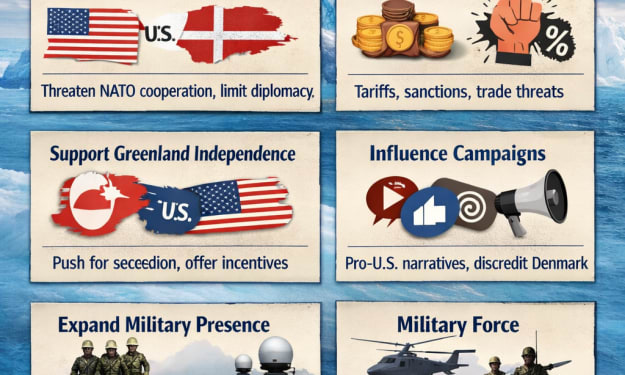
When Donald Trump was president of the United States, he shocked the world by saying he wanted to buy Greenland. Many people laughed, but others took the idea seriously. Greenland is a huge island in the Arctic. It is rich in natural resources and very important for military defense. Today, Greenland belongs to Denmark, but it also governs itself in many areas.
By sehzeen fatima2 days ago in History


Comments
There are no comments for this story
Be the first to respond and start the conversation.