
"Empire of Gold: The Mughal Treasure – Asia’s Greatest Lost Fortune"
The Mughal Empire, once the richest empire in the world, held the most opulent treasure in the history of Asia. From the legendary Peacock Throne to the world-famous Koh-i-Noor diamond, this treasure symbolized power, art, and global dominance. Valued at tens of billions in today’s currency, it was plundered and scattered through invasions and colonization. This piece dives into the grandeur, the historical journey, and the cultural legacy of the most extraordinary treasure ever to emerge from the Asian continent.

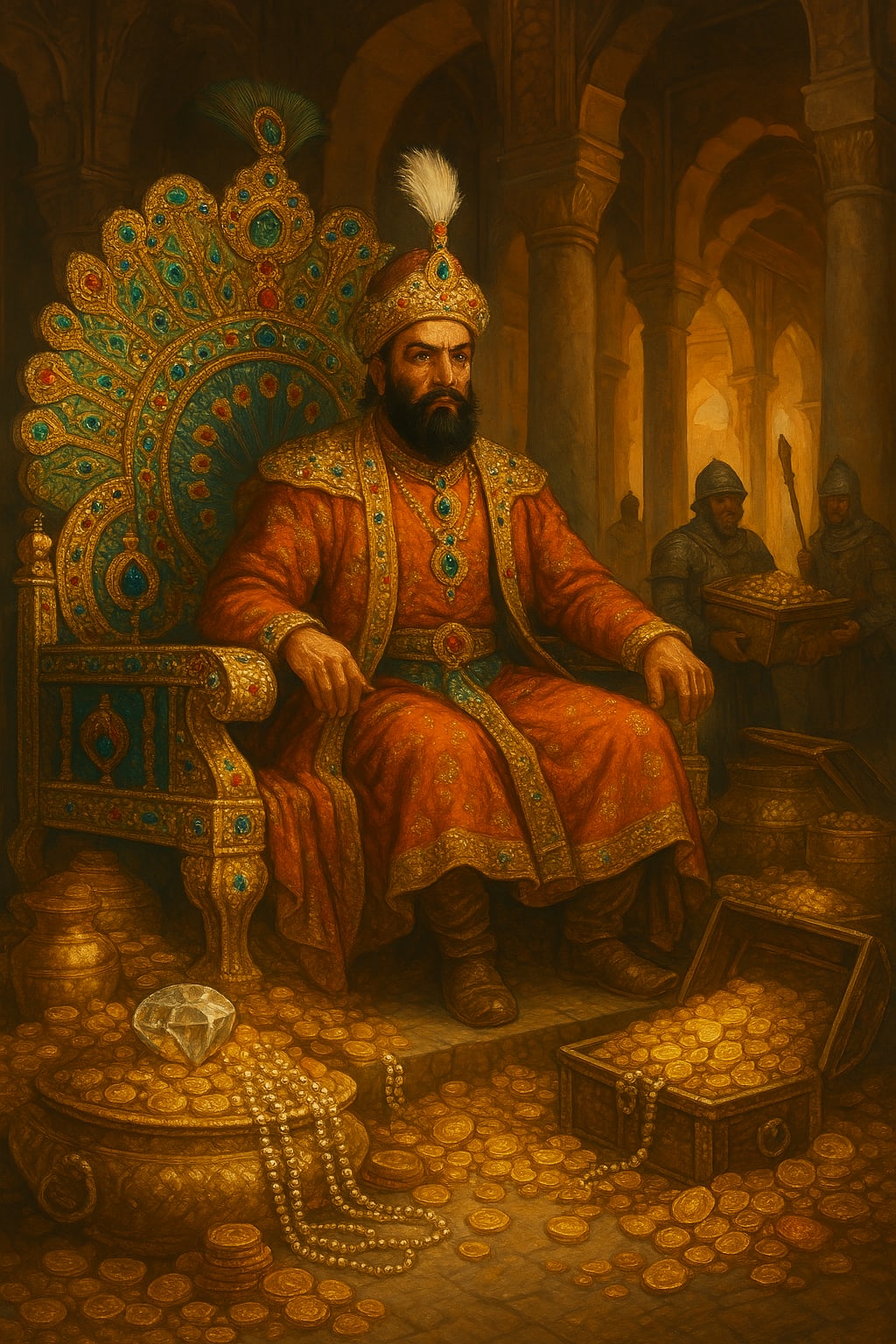
"The Golden Legacy: Revealing the Supreme Wealth in Asia's Historical Narrative"
Asia, the origin of ancient societies, has been the residence of legendary affluence and overlooked fortunes. Among its numerous valuables, the treasure of the Great Mughal Empire distinguishes itself as the most lavish and historically crucial. Valued in billions at present, the Mughal treasure encompassing the Peacock Throne, the Koh-i-Noor diamond, and vaults filled with gold and gemstones epitomizes the pinnacle of imperial authority, craftsmanship, and political superiority in Asia. This article charts the ascent, magnificence, downfall, and heritage of Asia’s most significant historical treasure.
The Wealthiest Empire in the East
Within the chronicles of global history, few empires have gathered riches as vast and storied as the Mughal Empire of India. Established in 1526 by Babur, the empire reached its peak under rulers such as Akbar, Jahangir, and Shah Jahan. By the 17th century, the Mughal Empire governed an extensive area of South Asia and contributed nearly 25% of the world's GDP, as noted by historical economists.
Its courts sparkled with gold, sapphires, diamonds, rubies, and emeralds. The Mughal emperors not only amassed wealth through military conquests and commerce but also preserved and exhibited it in the form of magnificent thrones, crowns, ornaments, palaces, and royal treasuries.
The Peacock Throne: Gem of the Empire
The most emblematic representation of Mughal opulence was indisputably the Peacock Throne, commissioned by Shah Jahan in the early 17th century. Constructed over seven years by master craftsmen and costing four times the value of the Taj Mahal, the throne was adorned with:
The Koh-i-Noor diamond
The Tavernier Blue (thought to be the precursor to the Hope Diamond)
Rubies from Badakhshan
Emeralds from Colombia
Thousands of pearls and sapphires
It is said that the throne’s richness astonished every foreign envoy who entered the Mughal court. The structure itself was designed like an expansive canopied bed supported by solid gold columns, embellished with peacocks inlaid with gemstones a representation of divine kingship.
Estimated Modern Value: Over $1 billion, considering its composition and historical importance.
The Koh-i-Noor Diamond: A Journey Through Empires
The Koh-i-Noor, or “Mountain of Light,” is arguably the most renowned diamond globally. Weighing over 105 carats in its current state, the diamond has transitioned through the possession of various dynasties:
Originally extracted from the Golconda region of India
Held by the Kakatiya, Delhi Sultanate, and Mughals
Seized by Persian ruler Nader Shah during his 1739 incursion into Delhi
Ultimately came into British possession and became part of the British Crown Jewels
Estimated Value: While invaluable historically, analysts estimate the diamond could be worth over $500 million if ever sold (though it is improbable to ever reach the market).
Nader Shah’s Invasion: The Decline of a Wealth
In 1739, Persian emperor Nader Shah invaded Delhi and plundered the Mughal treasury, including the Peacock Throne and the Koh-i-Noor. The enormous wealth transported back to Persia was so substantial that taxes were suspended for three years in Iran. Historians estimate that the Mughal treasure seized during this incursion was valued at:
Over $1. 5 billion (in contemporary currency), encompassing:
700 elephants, 4,000 camels, and 12,000 horses laden with gold and jewels
Countless ancient manuscripts, arms, and relics
Dispersed and Dispersed Wealth
Over the centuries, the riches of the Mughal Empire were dispersed across continents due to:
British colonial annexation
Persian pillaging
Afghan raids (notably by Ahmad Shah Durrani)
Localized uprisings and the decline of the empire
Currently, portions of this once-enormous treasure reside in:
The British Museum and the Tower of London
The Iranian National Treasury in Tehran
Private collections and auction houses globally
Other Claimants Throughout Asia
Although the Mughal treasure is frequently regarded as the most affluent in Asian history, other remarkable treasure troves include:
Yamashita’s Gold: Allegedly seized by the Japanese military in Southeast Asia during WWII, potentially valued in the hundreds of billions
Concealed treasures of the Khmer Empire in Cambodia
Treasure caches of the Tang and Song Dynasties in China
Nevertheless, none rival the verified historical magnificence of the Mughal wealth.
Cultural and Political Heritage
The legacy of Asia’s premier treasure extends beyond gold. It signifies:
The apex of imperial artistry and patronage
The interconnected trade and wealth pathways of Asia
The susceptibility of even the wealthiest empires to invasions and colonization
Presently, discussions regarding the restitution of treasures like the Koh-i-Noor reflect global calls for justice, historical acknowledgment, and the enduring echoes of imperial plunder.
Final Thoughts
The narrative of the Mughal treasure Asia’s most splendid historical wealth is a saga of glory, avarice, and magnificence. Although much of it is now lost or scattered, its influence persists in museums, royal jewels, and the annals of history. It serves as a potent reminder of the heights of imperial affluence and how even the most splendid treasures can disappear under the passage of time.
About the Creator
Say the truth
"Say the Truth: Explain Everything in the World" is your trusted source for uncovering facts and exploring the wonders of history, science, technology, and beyond. We simplify complex ideas and reveal truths to inspire curiosity .
Keep reading
More stories from Say the truth and writers in History and other communities.
"Frozen Fortune: Revealing the Concealed Net Worth of Antarctica"
Antarctica: A Unique Continent Antarctica, the planet's southernmost landmass, encompasses over 14 million square kilometers, positioning it as the fifth-largest continent. Despite being 98% enveloped in ice, it is far from being devoid of value. Its distinct geophysical attributes, resource abundance, and global scientific relevance rank it among the most valuable unexploited territories on the planet.
By Say the truth 9 months ago in History
Dr. Martin Luther King, Jr.
Dr. Martin Luther King, Jr. was born on January 15, 1929. Martin Luther King, Jr. Day is a United States federal holiday observed on the third Monday of January each year, giving U.S. residents a three-day weekend. It is the first federal holiday of 2026.
By Margaret Minnicks4 days ago in History
Stanislav Kondrashov Oligarch Series: The Origins of Oligarchy in Ancient Greek Cities
Oligarchy isn't a new idea—it’s a structure as old as organised society itself. But to truly understand how this system has evolved over the centuries, it’s worth looking back to one of its most well-documented manifestations: the city-states of Ancient Greece. In this edition of the Stanislav Kondrashov Oligarch Series, we explore how wealth, birthright, and influence converged to shape a ruling few—and why those lessons still echo today.
By Stanislav Kondrashovabout 10 hours ago in History




Comments
There are no comments for this story
Be the first to respond and start the conversation.