
Sklarzka Poreba, historic glass town in Poland.
Julia glassworks.

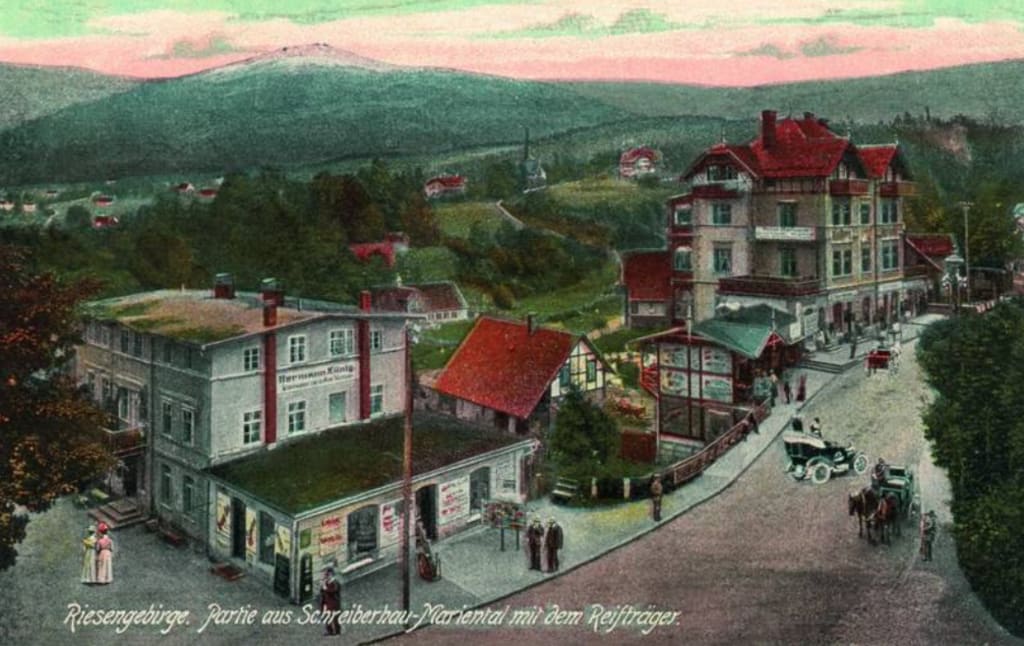
Sklarzska Porebo
The history of Szklarska Poręba is closely related to the development of glass industry, the search for precious stones and ores, and, since the mid-19th century, with tourism.
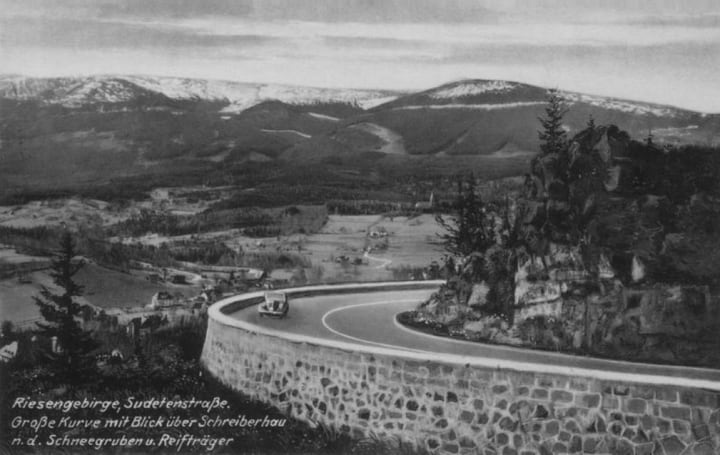
At the end of the 13th century, the area of today's Szklarska Poręba was bought by the Order of Saint John from Cieplice in order to search for gold and precious stones. In the mid-14th century, the first glassworks was established. The later owner of the land and the initiator of the establishment of subsequent steelworks was the Schaffgotsch family, whose estate covered the area of the mountains and foothills. At that time, the Karkonosze Mountains (Giant Mountains) were penetrated by treasure hunters who came here from Western Europe, called Walloons. Traces of their presence remaining to this day include adits, workings, shafts and secret signs carved on the rocks, which also testify to the mineral wealth of these areas.
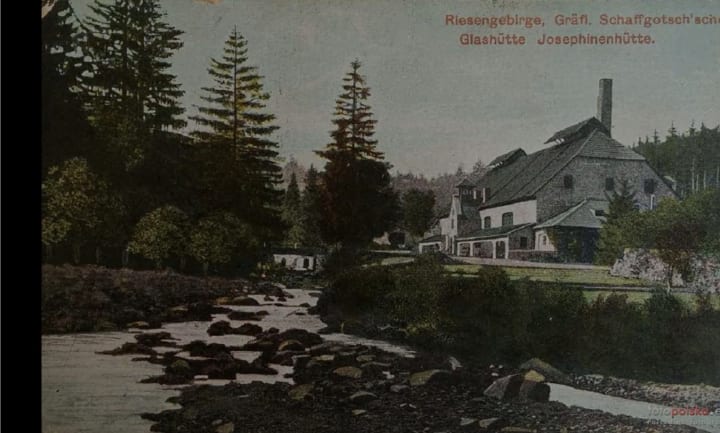
The development of glass industry was associated with intensive felling of forests. Following the wood needed to melt glass, the glassworks "wandered" along the stream valleys deep into the mountains, and with them the settlements of metallurgists, lumberjacks and smelters. ( this is discussed in my article “forest glass”.)The name Szklarska Poręba is associated with the "wandering glassworks", because shepherd's settlements were established in the Szklarska Poręba areas, which gave rise to today's city. The name was established by the Silesian Institute in 1946 and announced in the Official Journal of the Recovered Territories No. 5. ( this is after W.W.2 - after the ethnic Germans were deported, all German history was erased). Subsequent glassworks were established in the years - 1575. on the Czech Struga, in 1617 in Biała Dolina, in 1754 in the settlement of Orle and in 1842 in the Kamienna River valley, the steelworks that still exists today, originally "Józefina", after 1945 "Julia". For several hundred years, glassmaking was the leading branch of the local economy. The history of Szklarska Poręba was greatly influenced by the arrival in 1578 of a group of Czech Protestants - religious emigrants, who were allowed to settle on the Silesian side of the mountains by Count Schaffgotsch, known for his religious tolerance, and thus the settlement of Marysin was established at the foot of Szrenica. Among the group of Czech emigrants, laboratory technicians, experts in natural medicine, producing famous herbal medicines, were particularly remembered in the history of the region. In the 17th and 18th centuries, further settlements were built, and at the beginning of the 19th century, Szklarska Poręba became one of the largest villages in the Sudetes. ( the Sudeten mountains, which includes the Jizerske mountains in Czech Republic, and the Giant mountains in Poland). It consisted of 26 settlements and hamlets with 336 houses, two churches (Catholic and Evangelical), four schools, two glassworks and sixteen glass grinding plants, three mills and a sawmill. The main source of income for the local population was forest work (lumberjacks and woodcutters), glass melting (metallurs), farming and shepherding. It was the shepherds' huts in the high mountain pastures that gave rise to today's mountain shelters.
From the mid-19th century, tourism began to develop intensively. The desire to learn and personally experience the charms of mountain hiking and, above all, the beauty of the area have made Szklarska Poręba a very famous climatic and tourist station in Lower Silesia. The breakthrough was the construction of the road from Piechowice through the Szklarska Pass to Harrachov in 1847. and the railway line from Jelenia Góra to Tanvald in 1902. From that moment, Szklarska Poręba, developing its tourist function, consolidated its position as a famous center of tourism and winter sports. Another important event for the development of tourism was the construction of the "Szrenica" Cable Railway (chairlift) in 1962.
At the end of the 19th century, the news about the charm of the town and the beauty of the surrounding area caused an influx of artists to Szklarska Poręba - writers, poets, painters and sculptors. This is how a kind of artistic colony was created, whose traditions are continued by contemporary artists.
After 1945, most of the accommodation facilities in Szklarska Poręba became the property of the Employee Holiday Fund ( the Soviet Union nationalized all businesses)and Szklarska Poręba became one of the most famous holiday resorts in Poland.
Szklarska Poręba received city rights in 1959.
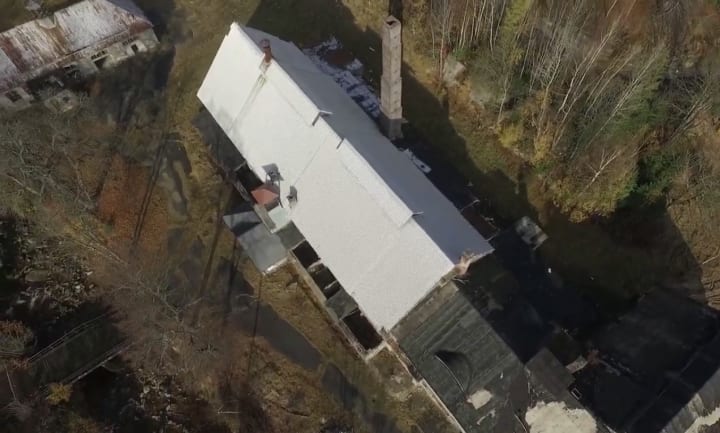
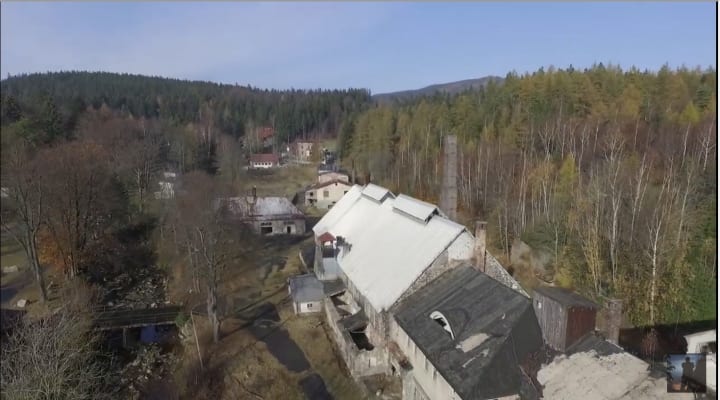
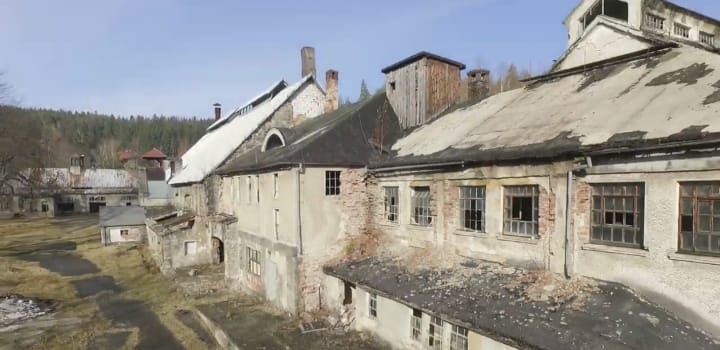
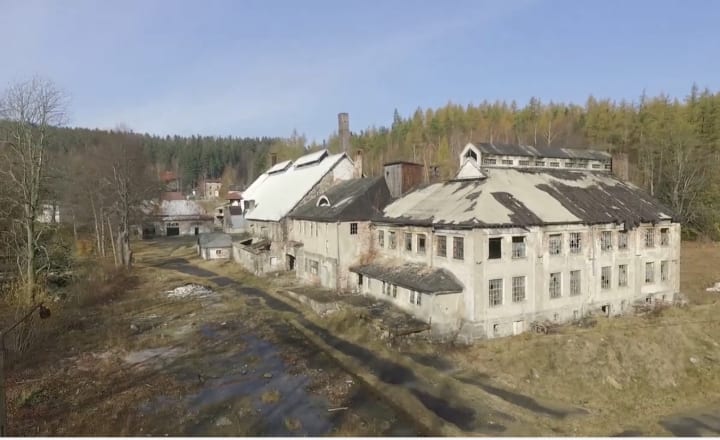
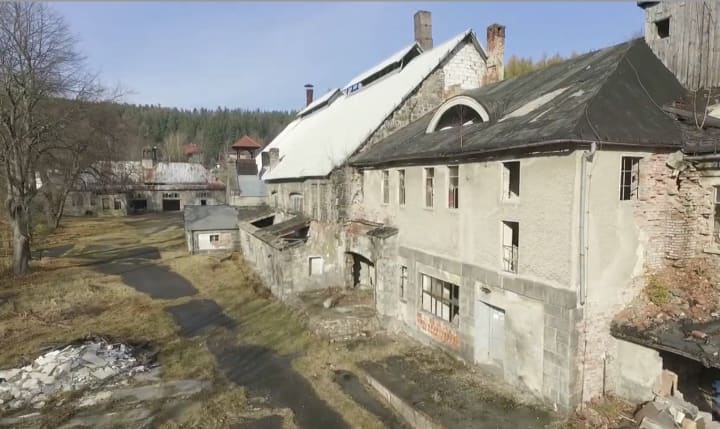
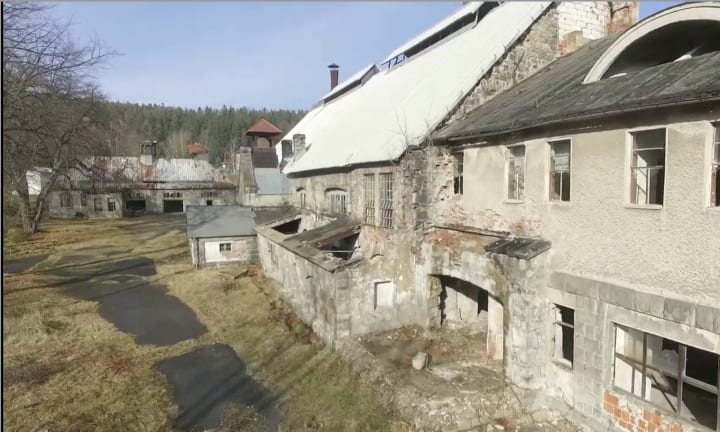
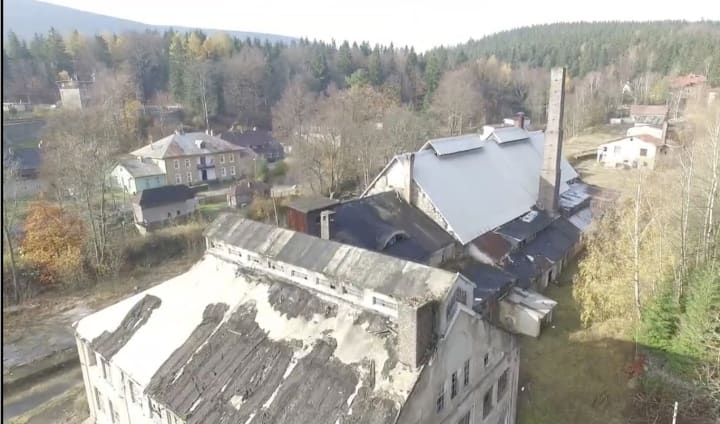
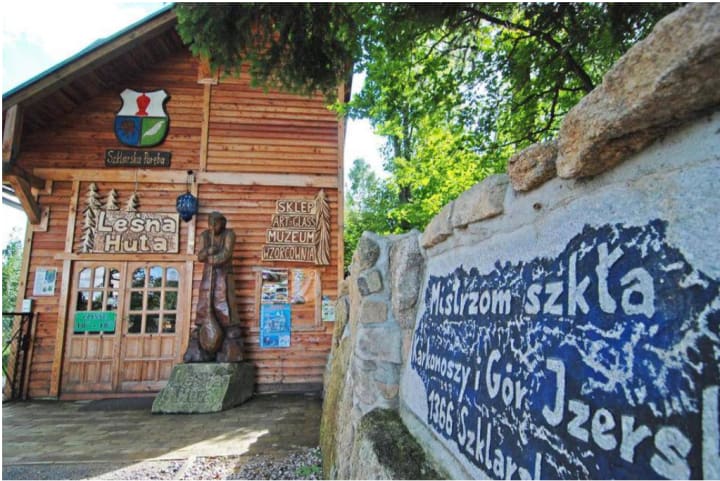
It's time to add another chapter to this story. How will the "Josephine" glassworks in Szklarska Poreba change? Right now, currently it is being renovated to include a glass museum, a convention hall, a restaurant , a gift shop showcasing glassware made in the immediate area, Julia glassworks in Pieceavice and Lesna huta in Slarzka Poreba, and a hotel.
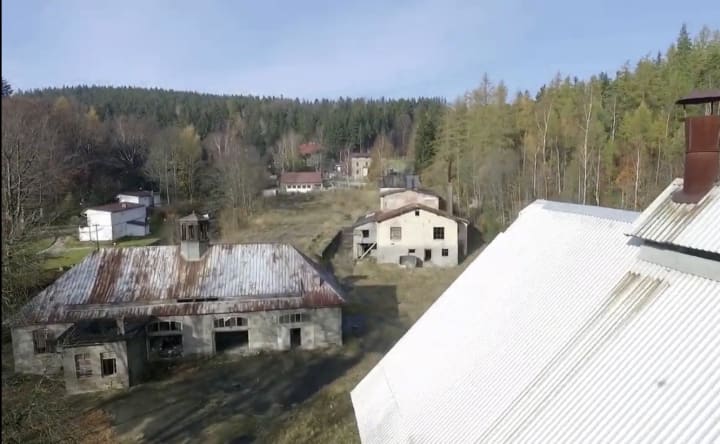
SUMMARY
The "Josephinenhütte" glassworks, founded in 1842 by the Schaffgotsch family, was one of the most important industrial plants in the Sudetenland region.
Josephinenhütte was famous for producing glass products of the highest quality, which won awards at world exhibitions in London, Paris and Vienna.
The "Julia" glassworks continued the tradition of "Josephinenhütte" after World War II, but after privatization in the 1990s the facility fell into disrepair and was abandoned.
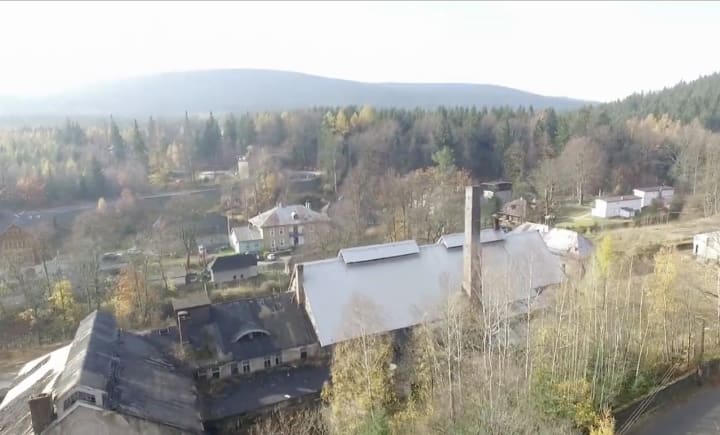
The historic smelter complex in Szklarska Poreba is a unique industrial architecture with strong ties to local identity.
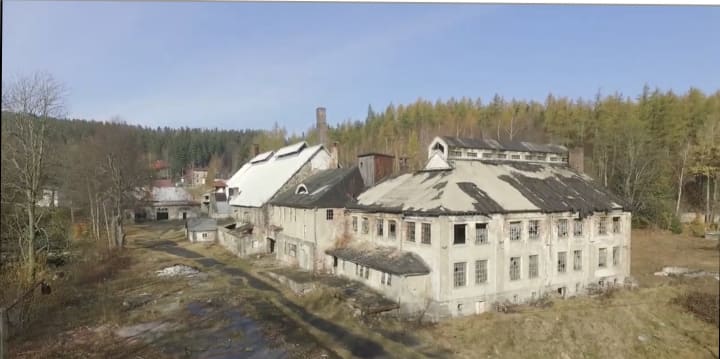
The Arche Group, known for revitalizing historic buildings, bought the smelter in 2024 and plans to create a glass museum, cultural center, hotel and recreational space there.
The revitalization of the "Jozefina" glassworks is expected to restore the former glory of the industrial pearl of Szklarska Poreba and become a new cultural and tourist center of the city.
What is Szklarska Poreba famous for? In addition to impressive waterfalls, scenic mountain trails and alpine climatic conditions, this small Lower Silesian town has for decades set the trends for the glass industry. Although the transformative 1990s left a mark on the local glassworks, its fortunes may soon change.
Josephine or Julia?
The noble Schaffgotsch family left behind many architectural gems in what is now Lower and Upper Silesia. Among other things, the enterprising family invested in industry, as exemplified by the thriving "Josephine" glassworks in Szklarska Poreba.
In the spring of 1841, Count Leopold Christian Gotthard Gräf Schaffgotsch commissioned the construction of a glassworkss on the Kamienna River in Szklarska Poreba, a town where glass products were made as early as the 14th century. The construction of the buildings, designed by Albert Tolberg, a student of the famous Karl Friedrich Schinkel, was supervised by the future director of the glassworks and master glassmaker Franz Pohl. In turn, it was named after the count's wife, Josephine Clementine Gräfin von Zieten - "Josephinenhütte." Opened in 1842, the Krkonoše glassworks was for years considered one of the best, which was confirmed by awards and distinctions won at world exhibitions in London, Paris and Vienna.
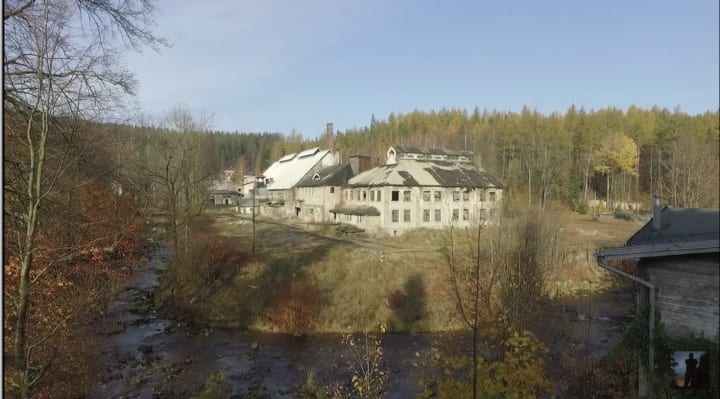
Over the following years, the glassworks expanded its assortment, created new designs, also underwent changes related to its organizational structure and became a permanent part of the town's fabric. After World War II, the glassworks resumed production as early as 1946, and ten years later changed its name to "Julia Crystal Glassworks" (now the glassworks is located in Piechowice, neighboring Szklarska Poreba). After privatization in the 1990s, production ceased, many people lost their jobs, and the post-factory buildings began to fall into disrepair. For many years, concerned residents of Szklarska Poreba looked for a way to protect the complex, which was in private hands.
Hope to stop the progressive process of destruction has recently appeared. On December 18, 2024, the complex fell into the hands of the Arche group (known, among other things, for its award-winning adaptation of the Żnin Sugar Factory), which is betting on using the existing fabric rather than erecting a new one. What idea does it have for the post-industrial architecture of the former glassworks and the nearly three-hectare site that surrounds it, which is in a deplorable state today?
an industrial pearl in Sudetes' crown- it almost disappeared, but now it will survive and continue.
The complex, located just around the bend of the river, consisted of a main building with two melting furnaces (on the left bank) and auxiliary buildings - a pestle mill, grinding shop and warehouses (on the right bank).
what this press release failed to mention in their historical preamble is before world war 2 this entire region was annexed by Hitler‘s Germany as Sudetenland, and given to Germany by the Allies appeasement policy - and after the war, when Germany lost, all the ethnic Germans who had lived in the region for hundreds of years (just like the ethnic Germans in Czechoslovakia in Sudetenland, were deported and Czech citizens replaced them,) were deported to Germany, and replaced by Polish citizens, who had never lived there. It’s a fascinating place and history to experience.
A bridge built over the river leads to the main building of the former smelter. The stone-covered block on a rectangular plan is covered by a gabled, hipped roof with massive slopes, characteristic of Sudeten architecture. The ridge of the roof has been slightly raised in two places, allowing for the creation of skylights that bring the sun's rays into the impressive, spacious production hall. The entrance is highlighted by a stone porch topped by a bell turret. The lump, which at first glance seems squat, hides a visually light, industrial interior. The factory building of the smelter was entered in the register of monuments back in the 1960s.
The glassworks has been a strong part of the identity of Szklarska Poreba for 150 years, which even refers to the glass production traditions in its coat of arms (the upper field features a ruby glass goblet). Such a special object for the local community requires an equally special approach. As announced by Arche Group representatives, residents will be invited to co-create new solutions for the historic building. These are not empty promises, the first meeting with residents, as well as former employees of the smelter took place in May this year - it was an opportunity to present preliminary visions for the development of the area. Among the plans are a museum related to glassmaking, a cultural and conference space to be located in the former production hall, a hotel with three hundred seats, restaurants, a swimming pool with a recreation area and a picnic beach by the river.
The redeveloped complex is to combine cultural, conference and craft functions (the reactivation of a glass manufactory in the historic buildings is planned) with modern hotel infrastructure in complementary buildings. Although the details and scope of the work are not yet known, they give hope that the "Josephine", forgotten for years, will get a new life.
Sklarzka Poreba and it’s glass history is coming back, and we at Wild Things Beads will be there to see it happen and be involved. Every year for the last 10 years we have taken our working bead tour to Sklarzka Poreba and Piechowice to tour the Julia glassworks and buy crystal glassware, and explore the town and area.
Sudetes (Sudeten Mountains) are a major central European mountain range spanning the Czech Republic, Poland, and Germany, serving as the northeastern edge of the Bohemian Massif. Known for their mix of rugged peaks and gentle slopes, the highest point is Sněžka (1,603 m) in the Giant Mountains.
About the Creator
Guy lynn
born and raised in Southern Rhodesia, a British colony in Southern CentralAfrica.I lived in South Africa during the 1970’s, on the south coast,Natal .Emigrated to the U.S.A. In 1980, specifically The San Francisco Bay Area, California.
The Greatest Lost Treasures of History: A Deeper Exploration
1. The Gold of the Inca Empire The Inca Empire, which flourished in South America from the 13th to the 16th century, was one of the richest civilizations in the ancient world. For the Incas, gold was not merely wealth—it was sacred. They believed gold to be the “sweat of the Sun God Inti”, while silver was the “tears of the Moon.”
By Say the truth 6 days ago in History
The Net Worth of the Golden River: Measuring the Value of History’s Greatest Myth
So what is the net worth of the Golden River? While it cannot be calculated like a bank account or a gold reserve, its value can be estimated through economic loss, potential mineral wealth, cultural impact, and historical influence. When all these dimensions are considered, the Golden River may be worth more than any physical treasure ever discovered.
By Say the truth a day ago in History




Comments
There are no comments for this story
Be the first to respond and start the conversation.