
The easter island
The story of Easter Island and how it became what we know today

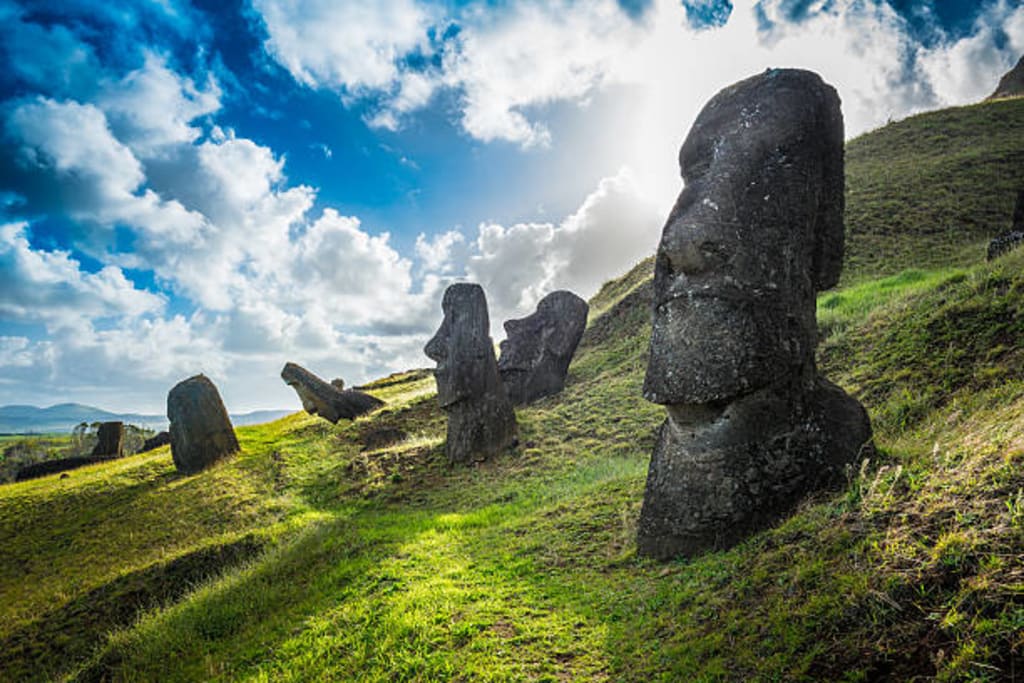
Easter Island, known as Rapanui to its early inhabitants, stands as a remarkable testament to human ingenuity and isolation in the vast expanse of the southern Pacific Ocean. Located approximately 1,200 miles from its nearest neighbor, Pitcairn Island, and 2,300 miles west of Chile itself, Easter Island captivates the imagination with its iconic moai statues and rich archaeological heritage. Carved centuries ago by a now-vanished civilization, these monumental figures continue to intrigue and inspire, offering glimpses into a society that thrived amidst the challenges of its remote island home.
Despite its modest size of just 63 square miles, Easter Island is renowned for its collection of 887 monumental stone statues, known as moai, which were painstakingly carved between the 13th and 15th centuries. These statues are distinguished by their striking features: elongated noses, broad chins, rectangular ears, pronounced brows, and deeply set eyes, often with nostrils that curl like fishhooks.
Initially believed to be mere heads protruding from the ground, excavations in May 2012 uncovered that these statues possess full bodies buried beneath the surface. The largest moai towers impressively at 33 feet in height and weighs a colossal 90 US tons, while an incomplete statue, estimated to have reached 70 feet in height and 297 US tons, underscores the monumental scale of these ancient sculptures.
Crafted primarily from tuff, a compacted volcanic ash, 834 out of 887 moai gaze inland, suggesting their role as guardians or sentinels overseeing the island's inhabitants and settlements. A notable exception is found at Ahu Akivi, a revered site for the Rapa Nui people, where a unique moai named Tukuturi kneels in a human-like pose, distinguished by its smaller size and striking red Puna Pua stone.
The logistical challenge of how these colossal statues were transported across the island has captivated scholars for centuries. Upon their arrival in 1722, European explorers encountered a small local population of 1,500 to 3,000 individuals, prompting inquiries into how such a community managed to erect and position hundreds of statues across the landscape. Various hypotheses emerged, including fanciful theories of extraterrestrial intervention, though the stone material used for the moai originates from Easter Island itself, sourced from an extinct volcano in the northeast.
In the 1980s, attempts to replicate the ancient islanders' techniques revealed the extraordinary feat of moving a 10-ton replica statue, initially deemed impossible. Subsequent experiments decades later demonstrated how ropes and walking motions could plausibly simulate the movement of full-sized moai over distances of up to 330 feet, aligning with Rapanui folklore that attributes the statues' transportation to mystical "walking" powers.
The island's capacity to sustain such monumental creations also raises intriguing questions about its historical population dynamics. Recent studies suggest that up to 17,500 people could have comfortably inhabited Easter Island at its peak. Approximately 19 percent of its terrain supported extensive sweet potato fields, a staple crop alongside seafood and fish, highlighting the islanders' resourcefulness and agricultural expertise.
However, the decline in Easter Island's population coincided with European contact and colonization, challenging earlier narratives of environmental overexploitation. Instead, the islanders faced tragic consequences, including devastating South American slave raids during the 19th century that decimated half the population. Furthermore, European traders inadvertently introduced diseases that exacerbated population decline and cultural disruption, reshaping the island's social fabric irreversibly.
This poignant history reshapes perceptions of Easter Island's enigmatic moai, revealing a civilization that thrived creatively but ultimately faced external pressures. The enduring legacy of these monumental statues continues to captivate imaginations worldwide, inviting contemplation of human resilience and the enduring mysteries of the past. These statues, crafted with meticulous craftsmanship, symbolize both the ingenuity and fragility of an ancient society navigating a challenging environment. They stand as cultural symbols for the Rapa Nui people, reflecting a cautionary tale of environmental sustainability and societal collapse. As archaeological discoveries shed new light on Easter Island's past, the moai remain silent witnesses to human achievement and the consequences of hubris, prompting reflection on our shared human journey and the lessons learned from the rise and fall of civilizations.


Comments
There are no comments for this story
Be the first to respond and start the conversation.