
The Eagle Soars
From Dagestan’s Mountains to UFC Glory — The Unbreakable Journey of a Champion

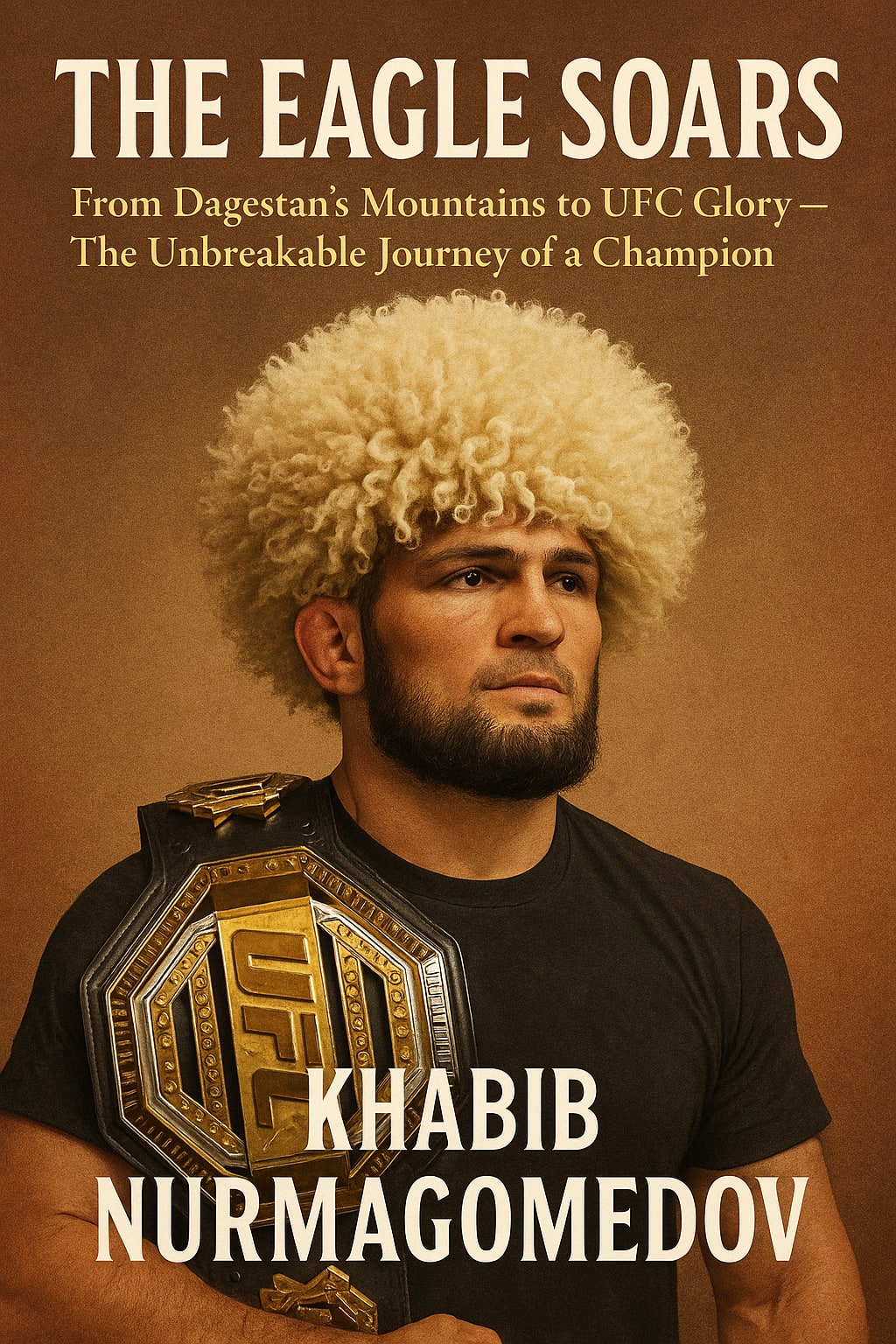
In the rugged, wind-carved mountains of Dagestan, a boy was born into a legacy that few could carry. Khabib Abdulmanapovich Nurmagomedov grew up in the small village of Sildi, under the watchful eye of his father, Abdulmanap—a revered wrestling coach and a man whose life mission was to craft warriors of unshakable character and discipline. It was not just sport in that house—it was tradition, identity, and survival.
From as early as age three, Khabib was introduced to grappling and wrestling. By six, he trained in judo. At nine, he was wrestling bears—literally. Abdulmanap believed adversity was the greatest teacher. And adversity was plenty in the North Caucasus, where poverty and political unrest shadowed many families. But Khabib’s household was rich in purpose and pride.
The young Dagestani boy showed not only physical toughness, but something rare: an unyielding mental discipline. He didn’t party, didn’t drink, didn’t chase fame. He studied. He trained. He prayed. He listened. And by his teenage years, he was feared across Russia’s amateur wrestling circuit. His father's philosophy was taking root—one of restraint, humility, and honor. Not just to win—but to dominate with respect.
By the time Khabib entered the professional MMA world, he was already an undefeated Sambo world champion and an expert grappler. In 2012, he signed with the UFC. The American audience barely noticed the quiet fighter from Dagestan with the unpronounceable name. That would change.
Khabib’s UFC debut was explosive. With relentless takedowns and control that smothered even the most skilled strikers, he dismantled opponent after opponent. Fight by fight, the aura of invincibility grew. He didn’t just win—he broke the will of his opponents. Fighters would enter the cage full of bravado, and leave it shattered, gasping for air under the weight of his pressure.
But Khabib wasn’t chasing fame. He fought for purpose. He fought for his family, for Dagestan, for his father’s legacy. His faith—Islam—was the compass guiding every step. He would raise his finger to the sky in every victory, crediting God, never himself. In a world of trash talk and spectacle, Khabib was an outlier: a man of silence, ferocity, and faith.
Everything changed on April 7, 2018, at UFC 223, when Khabib defeated Al Iaquinta to become the undisputed UFC Lightweight Champion. He fulfilled the dream Abdulmanap had mapped out decades earlier. Yet, even with the title, he remained grounded. His message didn’t change. His work ethic didn’t falter. The belt didn’t change the man—it reflected him.
But perhaps the most defining moment of his career came in 2018, when he faced Conor McGregor—MMA’s most polarizing figure. McGregor mocked his religion, his father, and his people in a promotional build-up filled with venom. Khabib, as always, remained composed. And inside the Octagon, he delivered a masterclass in dominance, submitting McGregor in the fourth round. The post-fight brawl that followed was regrettable—but to many, understandable. Khabib defended his honor, his family’s dignity, and Dagestan’s pride.
Yet his greatest challenge wasn’t in the cage. It came in 2020, when Abdulmanap died due to COVID-19 complications. The loss shattered Khabib. Father and son had built every step of the journey together—and now, the man who had trained him from cradle to champion was gone. Still mourning, Khabib returned to the Octagon one final time, against Justin Gaethje.
At UFC 254, Khabib fought with sorrow, but supreme focus. He submitted Gaethje in the second round, and then collapsed to the mat in tears. It wasn’t victory—it was farewell. In the post-fight interview, he shocked the world by announcing his retirement. He promised his mother he would not fight without his father, and Khabib—true to his word—walked away from the sport at 29-0, undefeated.
But his story didn’t end there.
Khabib transitioned into mentorship, coaching fighters like Islam Makhachev, his childhood friend, and guiding a new generation of Dagestani athletes. He purchased an MMA promotion, Eagle FC, and used his platform to uplift his community. Rather than basking in fame, he chose to build legacy.
Khabib’s journey isn’t just about fighting. It’s about discipline over ego, values over victory. In a sport flooded with noise, he let his silence speak volumes. In a world eager for attention, he reminded everyone that honor is the loudest truth.
Today, Khabib remains a symbol of pride—not only for Dagestan, but for millions around the world who see in him what is possible with unwavering belief, faith, and resilience.
The eagle no longer soars in the cage—but his wings still cast a long, unshakeable shadow.
About the Creator
Irshad Abbasi
Ali ibn Abi Talib (RA) said 📚
“Knowledge is better than wealth, because knowledge protects you, while you have to protect wealth.
Keep reading
More stories from Irshad Abbasi and writers in History and other communities.
From Kicking Stones to World Cups
Long before floodlights beamed down on sold-out stadiums and billions tuned in for the World Cup final, football — or something like it — was already part of human history. The story of football is a tale of culture, passion, rivalry, and unity. It transcends time, language, and borders. But how did it all begin?
By Irshad Abbasi 10 months ago in History
Secrets of the Devil’s Waters
The first time the Bermuda Triangle revealed its secrets, it wasn’t with flashing lights or monstrous waves—it whispered. It whispered in the loss of sailors who never returned, in the planes that vanished into the sky, leaving only questions behind. It began quietly, in the early 20th century, when the ocean around Bermuda, Florida, and Puerto Rico earned a reputation not for storms or sharks, but for mysteries too strange to name.
By imtiazalam3 days ago in History



Comments
There are no comments for this story
Be the first to respond and start the conversation.