
The Dragon's Legacy
A Journey Through the Ancient and Modern History of China

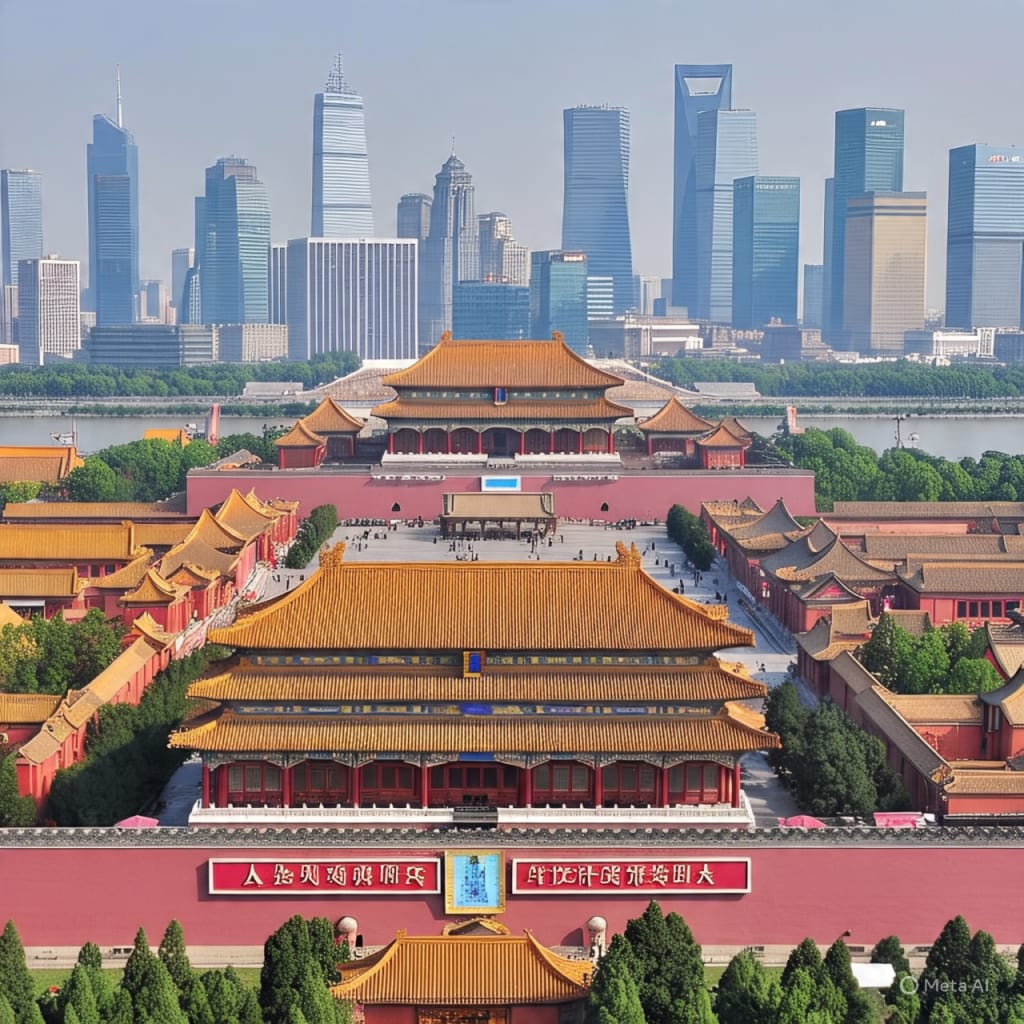
China, one of the world's oldest civilizations, boasts a history that stretches back over 5,000 years. From the mystical days of emperors and dynasties to its current status as a global superpower, China’s journey is a tale of resilience, innovation, and transformation. The nation’s vast history is marked by the rise and fall of great dynasties, groundbreaking inventions, philosophical revolutions, foreign invasions, and a dramatic modernization that reshaped the global political and economic landscape.
Ancient Foundations: The Cradle of Civilization
China’s recorded history begins with the semi-mythical Xia Dynasty (c. 2070–1600 BCE), considered the first Chinese dynasty. Although historical evidence is scarce, the Xia established early forms of governance and agriculture. This was followed by the Shang Dynasty (c. 1600–1046 BCE), which left behind written records on oracle bones, revealing a society governed by powerful kings, a pantheon of deities, and a strong reliance on bronze tools and weaponry.
The Zhou Dynasty (1046–256 BCE) introduced the Mandate of Heaven — the belief that rulers were divinely chosen but could be overthrown if they failed to govern justly. This era also saw the rise of China’s most influential philosophers, including Confucius and Laozi. Confucianism, with its emphasis on morality, social harmony, and hierarchy, would profoundly shape Chinese society for millennia.
The Warring States and Imperial Unification
Following the decline of the Zhou, China descended into a period of chaos known as the Warring States Period (475–221 BCE). However, this turbulent era ended when the state of Qin, under the leadership of Qin Shi Huang, unified China for the first time in 221 BCE. Declaring himself the First Emperor, he established the Qin Dynasty and centralized power, standardizing currency, measurements, and writing systems. He also initiated the construction of the Great Wall to fend off northern invaders.
Though the Qin Dynasty was short-lived, it laid the groundwork for the Han Dynasty (206 BCE–220 CE), often regarded as a golden age in Chinese history. During the Han era, China expanded westward through the Silk Road, opening trade with the Roman Empire and other distant lands. Technological innovations like papermaking, the seismograph, and advanced metallurgy flourished, as did Confucian ideals in state governance.
Dynastic Cycles and Cultural Heights
The centuries that followed witnessed the rise and fall of powerful dynasties, each contributing to China’s cultural and political evolution. The Tang Dynasty (618–907) was a cosmopolitan empire known for its poetry, art, and openness to foreign cultures. The capital, Chang’an (modern-day Xi’an), became one of the largest and most vibrant cities in the world.
The Song Dynasty (960–1279) saw remarkable advancements in science and technology, including the invention of gunpowder, the compass, and movable-type printing. However, it eventually succumbed to invasions by the Mongols, who established the Yuan Dynasty (1271–1368) under Kublai Khan.
After reclaiming rule, the native Ming Dynasty (1368–1644) embarked on great maritime voyages led by Admiral Zheng He and fortified the Great Wall. The Ming also oversaw a flourishing of literature and the arts. This was followed by the Qing Dynasty (1644–1912), the last imperial dynasty, which expanded China’s borders to their greatest historical extent but struggled with internal corruption and external threats by the 19th century.
The Fall of Empire and the Rise of Revolution
By the late 1800s, China was in decline. The Opium Wars with Britain exposed the Qing’s military weakness, resulting in humiliating treaties and the ceding of Hong Kong. Internal uprisings, such as the Taiping Rebellion, further destabilized the nation. Intellectuals and reformers began to call for modernization and an end to imperial rule.
In 1912, the Qing Dynasty collapsed, and the Republic of China was born under Sun Yat-sen. However, the republic was short-lived, plagued by warlordism and Japanese invasion. In 1949, after a brutal civil war, the Communist Party led by Mao Zedong emerged victorious, founding the People’s Republic of China.
Communist Rule and Modern Transformation
Under Mao, China underwent radical social and economic reforms, including land redistribution, collectivization, and the Cultural Revolution — a chaotic period that sought to purge traditional and capitalist elements from Chinese society. These policies, though transformative, led to widespread suffering and economic stagnation.
Following Mao’s death in 1976, Deng Xiaoping took power and introduced market-oriented reforms. Under his leadership, China opened its economy, encouraged foreign investment, and began a period of unprecedented growth. Cities like Shenzhen were transformed from fishing villages into global tech hubs within decades.
China in the 21st Century
Today, China stands as the second-largest economy in the world, a technological powerhouse, and a key player in global affairs. It has launched ambitious infrastructure projects like the Belt and Road Initiative, expanded its influence across Asia, Africa, and Europe, and made strides in space exploration and artificial intelligence.
Despite this rise, China faces significant challenges: managing political dissent, addressing environmental degradation, navigating tensions with the West, and balancing rapid modernization with its rich cultural heritage.
Conclusion: A Civilization Reborn
China’s history is a vast tapestry woven with threads of glory, strife, innovation, and resilience. From the ancient wisdom of Confucius to the skyscrapers of Shanghai, the country has continually reinvented itself while preserving its cultural core. As it charts its path into the future, China remains rooted in the legacies of its past — a dragon that never sleeps, constantly evolving with the times yet eternally proud of its origins.
About the Creator
NIAZ Muhammad
Storyteller at heart, explorer by mind. I write about life, history, mystery, and moments that spark thought. Join me on a journey through words!
Keep reading
More stories from NIAZ Muhammad and writers in History and other communities.
The Lion of Samarkand
In the dust-laden plains of 14th-century Central Asia, amidst tribal warfare and the crumbling remnants of the Mongol Empire, a boy was born in the city of Kesh — a town not far from the legendary city of Samarkand. His name was Timur, later known to the world as Tamerlane. Born into the Barlas tribe, Timur would rise from humble beginnings to carve an empire that stretched from Delhi to Damascus and shook the foundations of the known world.
By NIAZ Muhammad8 months ago in History
Early March 2026: 4 Goals Accomplished
It's early March and I've now accomplished my 4th writing goal for the year of 2026. Before diving into the behind-the-scenes of it... why not tell you up front what that accomplishment was? I was published in a 2nd publication for this year. Published in Helix Literary Magazine out of Central Connecticut State University. You can read it for free right now!
By Stephen Kramer Avitabile7 days ago in Writers


Comments
There are no comments for this story
Be the first to respond and start the conversation.