
Malcolm X and the Courage to Become
What his life teaches us about truth, dignity, self-respect, and transformation

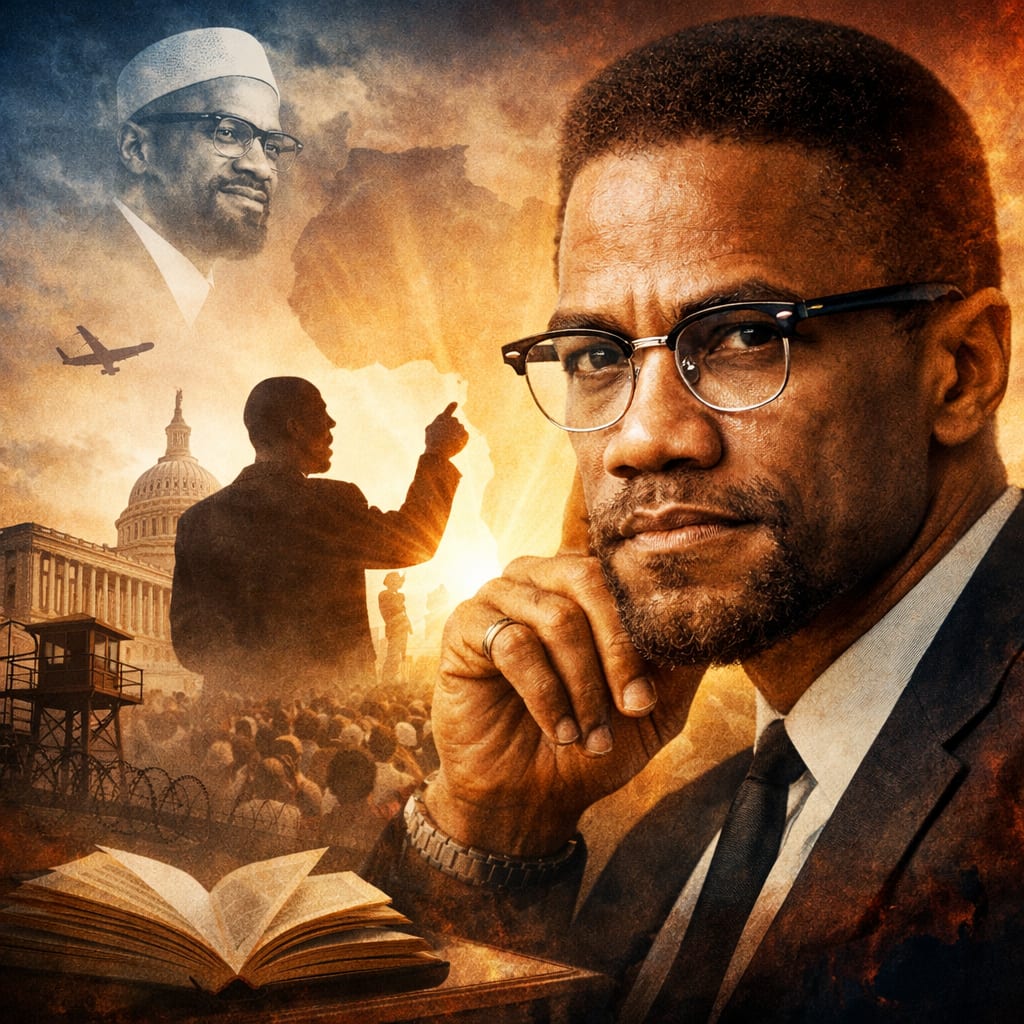
Malcolm X and the Courage to Become
What his life teaches us about truth, transformation, dignity, and the power of human awakening
An essay exploring Malcolm X as a revolutionary thinker whose life embodied truth, discipline, personal transformation, and the ongoing struggle for human rights.
Malcolm X and the Courage to Become
Malcolm X remains one of the most powerful, complex, and transformative figures in American history. His name still carries force. For some, it evokes defiance. For others, discomfort. For many, it represents a voice too sharp, too honest, and too unwilling to soften the truth for the comfort of others. Yet Malcolm X was far more than the narrow image history often tries to hold him inside.
He was not only a civil rights leader.
He was not only a critic of racism.
He was not only a man of anger, as he was so often portrayed.
He was a thinker. A builder of consciousness. A man who turned pain into discipline, discipline into clarity, and clarity into a voice the world could not ignore.
To write about Malcolm X is to write about transformation. It is to write about what can happen when a human being refuses to remain defined by the worst thing that has happened to them—or the worst thing they have done.
Born Malcolm Little in 1925, he entered a world already shaped by violence, injustice, and racial terror. His father, a minister who supported Black empowerment through the teachings of Marcus Garvey, was targeted by white supremacists and died under suspicious circumstances. His mother later suffered emotional collapse and was institutionalized. Malcolm’s childhood was marked by loss, instability, and the brutal message that Black life was disposable in the eyes of American society.
That message followed him into adolescence. Like many who grow up in systems designed to break rather than protect them, Malcolm was pushed toward survival in whatever form survival could take. He entered the world of hustling, crime, and eventually prison. It would have been easy for society to write him off there. In fact, many did.
But prison became the place where Malcolm began reconstructing himself.
That transformation is one of the most powerful parts of his story. While incarcerated, he turned toward education with relentless hunger. He read widely and intensely. He studied history, religion, politics, language, and philosophy. He copied dictionaries by hand. He trained his mind with the same force others had once used to try to confine his future. In that sense, Malcolm X became living proof that education is not merely information. It is liberation. It is self-recovery. It is a way of reclaiming one’s own mind from a world that profits from confusion.
When he emerged from prison, he was no longer the man who had entered it.
As a minister and national spokesperson for the Nation of Islam, Malcolm X became one of the most electrifying speakers in the country. He spoke with precision, boldness, and fearless clarity about racism, white supremacy, Black identity, and self-determination. He challenged a nation that wanted the appearance of peace without the work of justice. He rejected the idea that oppressed people should be endlessly patient while being denied their humanity. His words struck many as dangerous because they were direct. He named what others softened. He exposed what others tried to hide.
This is part of why Malcolm X continues to matter. He understood that oppression is never only political. It is psychological. It is social. It is spiritual. Systems of domination do not merely control bodies; they distort identity. They teach people to doubt their worth, mistrust their own perception, and internalize the lie that they are somehow less human. Malcolm challenged that entire structure. His message of Black pride was not superficial symbolism. It was a radical act of restoration. He was calling people back into dignity.
In this way, Malcolm X was not only fighting external injustice. He was helping rebuild inner foundation.
What makes his legacy even more profound, however, is that he did not remain fixed. He continued to evolve.
After leaving the Nation of Islam, Malcolm embarked on a pilgrimage to Mecca that became a turning point in his life. There, he encountered Muslims of many races and cultures worshipping together in a way that expanded his understanding of human possibility. This experience did not erase his awareness of racism, nor did it weaken his commitment to justice. Instead, it deepened and widened his vision. He began speaking more globally about human rights, solidarity, and the possibility of brotherhood beyond racial division.
This matters because it reveals one of the bravest dimensions of Malcolm X: he was willing to change in public.
That kind of transformation requires courage. Many people are willing to defend an idea. Fewer are willing to outgrow one. Malcolm X did not cling to identity for the sake of consistency. He followed truth as he encountered it, even when that truth required him to revise himself. That willingness to evolve is one of the most human and admirable things about him.
It is also one of the reasons his legacy remains so alive.
Malcolm X reminds us that becoming is not betrayal. Growth is not weakness. Revision is not hypocrisy when it is guided by deeper understanding. In a world that often punishes people for changing, his life offers a different model: one in which integrity means staying loyal not to old language, but to living truth.
His assassination in 1965 ended his life at only thirty-nine years old, but it did not end his influence. If anything, it made his unfinished evolution even more haunting. One cannot help but wonder what more he might have built, written, or awakened had he lived longer. Still, even within the short span of his life, Malcolm X altered the moral and intellectual landscape of America. He forced the nation to confront truths it would rather have ignored. He called people to self-respect, self-education, and clear seeing. He refused to dress injustice in softer words.
That refusal is part of his enduring power.
Malcolm X should not be remembered as a flattened historical symbol or reduced to a single season of his life. He should be remembered as a man of fierce intelligence, extraordinary discipline, and profound transformation. He was forged in suffering, sharpened by study, and expanded by experience. He teaches us that a human being can come from devastation and still become a force of clarity. He teaches us that dignity can be reclaimed. He teaches us that truth may first sound dangerous in a world built on denial.
More than that, he teaches us that real courage is not only the courage to resist.
It is also the courage to become.
Author’s Note
Malcolm X remains one of history’s clearest examples that transformation is not a side note to human life—it is the heart of it. His legacy invites us to confront injustice, reclaim dignity, and remain open to the deeper truths that change us.
—Flower InBloom
About the Creator
Flower InBloom
I write from lived truth, where healing meets awareness and spirituality stays grounded in real life. These words are an offering, not instruction — a mirror for those returning to themselves.
— Flower InBloom
Keep reading
More stories from Flower InBloom and writers in History and other communities.
The Map of Remembering
The Road That Remembered Us A Mystical Adventure About the Journey Every Soul Is Walking No one remembers the moment the journey begins. Not really. We like to say it begins with birth. With the first breath. With the cry that tells the world we have arrived. But the old travelers say the journey begins much earlier. It begins the moment a soul agrees to forget.
By Flower InBloomabout 8 hours ago in Fiction




Comments (3)
COOL
HUGS
He is my hero. When I was a kid, I did not like school. He taught me to read and read and read. And he taught me to research. I earned a PhD and see the world in a different way. The other person who taught me to read was Bruce Lee who loved reading and even wrote poems.