
The Draco Standard: Rome's Whistling, Hissing, Nightmare
A battlefield weapon combing fear, sound, and chaos to unnerve the fiercest warriors.

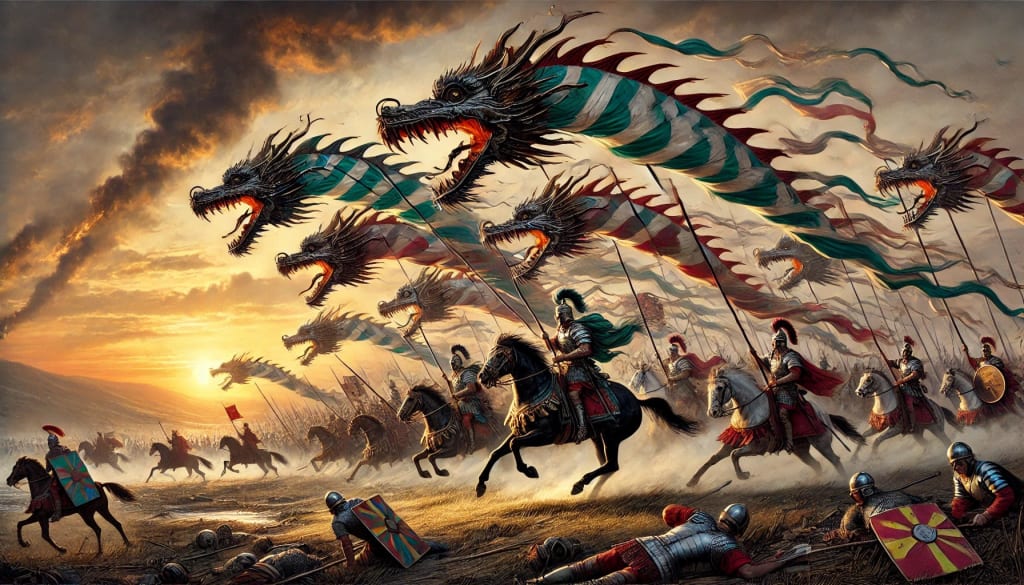
The Draco Standard: Rome’s Whistling, Hissing Nightmare
A battlefield relic combining sound, fear, and chaos to unnerve even the fiercest warriors.
I earn a commission from qualifying purchases made through affiliate links on this page. Your support through these links helps me continue creating valuable content.
Cold Steel 95BOASK Lightweight 89 Inch Long Medium Carbon SK 5 Steel Boar Hunting Spear with Ash…
For 200 years, the boar spear reigned supreme as the hunting tool of choice in the dark forests of Europe, and made…amzn.to
If you thought cavalry charging at full speed wasn’t terrifying enough, let me introduce you to Rome’s answer to “psychological warfare”: the Draco Standard. This metal-mouthed, wind-powered monstrosity wasn’t just a battlefield banner — it was a sonic weapon that turned the art of intimidation into a performance piece. Adopted from the Sarmatians and Dacians, this “dragon kite” combined the aesthetics of chaos with the acoustics of terror, because nothing screams “civilization” like a hissing, flapping death-sock waving in the wind.
The Draco wasn’t just a visual spectacle; it was designed to make noise — the kind of sound that sticks in your brain and makes you reconsider all your life choices. A tool of psychological warfare, it amplified the Roman cavalry’s already-formidable presence into something otherworldly. Who could focus on holding a line when a snake-headed monstrosity was bearing down on you, hissing like a demonic banshee?
Tech Specs: What Is a Draco?
Construction: A bronze or iron dragon head, with a hollow mouth for airflow, mounted on a wooden pole. The dragon’s head was often intricately crafted, making it both functional and symbolic.
Body: A long fabric or leather “tail,” functioning as a windsock to produce sound. The materials varied depending on the unit’s wealth, with elite forces opting for vibrant, durable cloth.
Sound Mechanism: Air entered the dragon’s mouth as the cavalry charged, exiting through the tail, creating a whistling or hissing noise akin to a snake on steroids. Some accounts suggest that additional design features amplified the sound, turning it into an eerie shriek.
Height: Approximately 2–3 meters tall, extending up to 4.5 meters when fully deployed (6.5–10 ft), enough to signal a unit and scare the living daylights out of anyone in its path.
Pure Postulation : The Draco’s Dog-Like Imagery and Pagan Legacy
Some variations of the Draco Standard, particularly those with extended ears or stylized features, bore a striking resemblance to a hound’s face. This uncanny resemblance invited comparisons to mythical “hounds of hell” in later Christian interpretations of Roman and pagan symbology. To pagan Romans, such designs may have symbolized loyalty, ferocity, and the divine favor of gods like Mars or Mithras, often associated with war and protection.
As Christianity rose, these dog-like dracos became symbols of infernal powers, connecting the imagery to Satan and his demonic hordes. The hiss of the Draco was reimagined as the howls of hellhounds, and the cavalry’s relentless advance invoked visions of chaos unleashed upon the earth. This transformation is part of a broader cultural shift where the once-majestic Roman military symbols were reinterpreted as harbingers of damnation, solidifying Rome’s place in Christian theology as the embodiment of the fallen, sinful world.
The combination of height, sound, and movement created a battlefield presence that was nearly impossible to ignore. To Roman allies, it was a symbol of power and unity. To their enemies, it was a reminder that the Romans weren’t just here to fight — they were here to dominate.
Modern Sonic Weapons and the Echoes of the Draco
While the Draco Standard faded into history, the use of sound as a weapon has not. Modern military forces, like the United States Marines, have taken the psychological impact of noise to a new level. During raids or standoffs, heavy metal music, played at ear-splitting volumes, is often used to disorient and demoralize enemies. Songs from bands like Metallica and AC/DC have blasted insurgent strongholds, drowning out communication and overwhelming resistance. This tactic is eerily reminiscent of the cacophony caused by the draco’s hiss — a modern echo of ancient battlefield chaos. Though separated by millennia, the intent remains the same: to dominate the enemy’s mind before the battle even begins.
Historical Accounts of the Draco Standard
Ammianus Marcellinus (4th Century CE): This Roman historian described the draco as “gleaming with terrifying magnificence, its scaly body undulating in the wind,” likely leaving no doubts about its nightmare fuel potential. (Res Gestae, Book 16)
Sarmatian Origin Myth: The Sarmatians, from whom Rome “borrowed” the draco, used it not only as a standard but as a ward against spirits. The whistling sound, according to their lore, represented the dragon’s rage, meant to scare both mortals and otherworldly foes. (Herodotus, Histories, Book 4)
Vegetius (5th Century CE): In De Re Militari, Vegetius mentions how the draco was a “marker of charge velocity,” but we know the real reason: it made enemy soldiers wonder if their time had come. (Epitoma Rei Militaris, Book 3)
Battle of the Catalaunian Plains (451 CE): The Roman and Gothic forces reportedly flew draco standards, their hissing sounds mingling with the screams of the dying. It’s unclear if it was the dragons or the chaos that made Attila consider retiring. Accounts suggest the noise was so pervasive that it became a symbol of the Roman-Gothic alliance’s determination to halt the Huns’ advance.
Dacian Rebellion (101–102 CE): Dio Cassius describes the draco as “a serpent of war” whose hiss was heard across the battlefield, likening it to the cries of the Dacian falx-wielding savages. (Roman History, Book 68) The sound reportedly unnerved even seasoned Roman soldiers, who weren’t sure if they were facing men or monsters.
Trajan’s Column (113 CE): The carved reliefs on Trajan’s Column depict Roman soldiers carrying draco standards into Dacia, underscoring its use as both a rallying point and a psychological weapon during the emperor’s campaigns.
The Notitia Dignitatum (5th Century CE): This administrative document lists numerous Roman military units, many of which are identified by their use of the draco as a primary standard, cementing its importance in late Roman warfare.
Byzantine Continuation (6th Century CE): Procopius, in his accounts of Byzantine warfare, notes that the draco remained in use as a battlefield marker, showing its longevity as a tool of terror and coordination.
Herodian’s Histories (3rd Century CE): Herodian writes about the Parthians’ reaction to the Roman draco, describing their fear of the eerie sound it produced, which they interpreted as supernatural. (Roman History, Book 5)
Zosimus (5th Century CE): In his New History, Zosimus recounts how the draco was used in a cavalry charge against the Visigoths, emphasizing the psychological impact of its sound and appearance. (Historia Nova, Book 4)
Alaric’s Siege of Rome (410 CE): Accounts from Roman chroniclers mention the use of draco standards as symbols of defiance against the besieging Visigoths, their ominous presence intended to boost Roman morale.
The Battle of Adrianople (378 CE): Roman cavalry standards, including the draco, were carried into this disastrous engagement, with its distinctive sound marking the desperate charge against the Gothic forces.
Tacitus’ Germania (1st Century CE): While Tacitus does not describe the draco specifically, his commentary on Roman cavalry tactics suggests the use of visual and auditory tools, like standards, to intimidate and disorient enemies. (Germania, Chapter 6)
Battle of the Milvian Bridge (312 CE): Although the Chi-Rho symbol dominated this battle, Constantine’s forces still carried draco standards as part of their Roman military tradition, blending old and new symbols.
Eusebius’ Ecclesiastical History (4th Century CE): Eusebius, writing about Constantine’s reign, notes the enduring presence of draco standards in military parades and battles, even as Christian symbols began to eclipse them.
The Sound of Savagery
How Far Could the Draco Be Heard?
The eerie hiss of the draco standard was not just a close-range effect; it could be heard from remarkable distances. With a sound range comparable to 85–100 decibels (similar to a jackhammer), the draco’s noise was capable of traveling up to 1.5 to 2 kilometers (approximately 0.9 to 1.2 miles) in open terrain under ideal conditions. This meant that enemy forces could often hear the advancing Roman cavalry long before they saw them, amplifying the psychological dread. Factors such as wind direction and flat terrain further enhanced the sound’s reach. Combined with the thunderous approach of 1,000 cavalry horses, the draco’s hiss became an unmistakable precursor to chaos.
The Sarmatians, known for their ruthless cavalry charges, pioneered the draco’s sound as both a war cry substitute and a spirit-channeling device. The noise, amplified by wind and fear, was said to mimic the howls of an enraged dragon, ensuring their enemies felt the full weight of existential dread. According to Sarmatian oral traditions, the draco’s hiss was not just a tool but a living embodiment of their war gods — a spirit unleashed upon the battlefield to guarantee victory.
By the time the Romans adopted the draco, it had become more than a tactical implement. It was a symbol of dominance, a way to announce their presence and shake the resolve of their enemies before the first blow was even struck. Roman cavalry units carrying the draco were often the first to engage in battle, setting the tone with a terrifying charge. Vegetius noted that the draco’s ability to “signal the speed of the charge” was crucial in coordinating attacks, but it’s hard not to suspect that its primary purpose was to sow chaos.
The draco’s sound reportedly reached such a pitch during full-speed charges that it could drown out commands from enemy officers. By modern standards, the sound has been compared to wind tunnels or high-pitched mechanical whistles, reaching decibel levels equivalent to jackhammers (85–100 dB). Imagine the effect of dozens of these standards screaming simultaneously — it would have made communication impossible and disoriented even the most seasoned warriors. Combined with the thunder of hooves, the clanging of Roman armor, and the shouts of soldiers, the battlefield must have been an overwhelming cacophony — a sensory assault designed to break morale as much as bodies.
So, next time you hear a whistling wind, think about this: a thousand Roman cavalrymen once rode into battle under screaming dragon kites, proving that even in ancient times, warfare wasn’t just about killing — it was about branding. The draco standard didn’t just lead armies; it led psyches into despair. Whether it’s a hissing windsock or a symbol of divine wrath, the draco remains one of history’s most fascinating — and terrifying — inventions.
I receive commission for the Amazon ads in this article.
About the Creator
Jesse Shelley
Digital & criminal forensics expert, fiction crafter. I dissect crimes and noir tales alike—shaped by prompt rituals, investigative obsession, and narrative precision. Every case bleeds story. Every story, a darker truth. Come closer.
Keep reading
More stories from Jesse Shelley and writers in History and other communities.
The Whisper of Seleucia
I. The Scrolls That Drank Light In the heat-shimmered alleys of Seleucia-on-Tigris, where oxen groaned in tongues older than coin, a hunched figure arrived barefoot, his robe the color of wet ash. The guards at the Eastern Gate joked about his eyes—clouded like boiled milk—and how he smelled like stale cloves and river moss. He carried no gold, no seal of passage.
By Jesse Shelley9 months ago in History
Hidden Void Discovered Inside the Great Pyramid of Khufu
For centuries, the Great Pyramid of Khufu in Egypt has fascinated historians, archaeologists, and travelers from around the world. Built more than 4,500 years ago during the reign of Pharaoh Khufu, the pyramid is the largest and oldest of the three pyramids of Giza. Despite decades of research and exploration, many secrets of this ancient structure remain hidden. Recently, scientists revealed one of the most intriguing discoveries yet — a large hidden void inside the pyramid that had remained unknown for thousands of years.
By Irshad Abbasi 3 days ago in History



Comments
There are no comments for this story
Be the first to respond and start the conversation.