
The Whisper of Seleucia
Historical Dark Fantasy | Esoteric Realism | Short Fiction

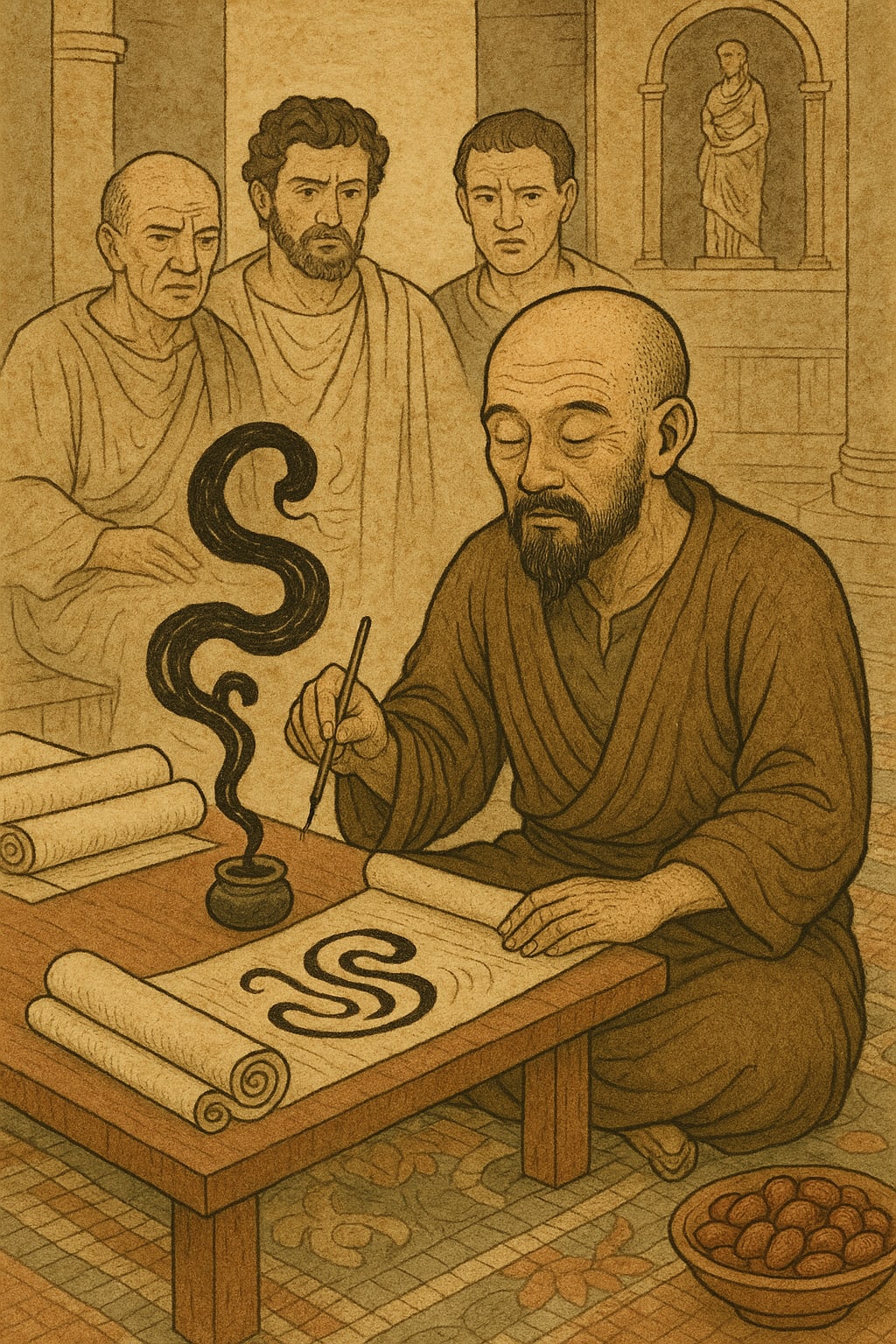
I. The Scrolls That Drank Light
In the heat-shimmered alleys of Seleucia-on-Tigris, where oxen groaned in tongues older than coin, a hunched figure arrived barefoot, his robe the color of wet ash. The guards at the Eastern Gate joked about his eyes—clouded like boiled milk—and how he smelled like stale cloves and river moss. He carried no gold, no seal of passage.
But he brought scrolls.
Each wrapped in ox sinew. Each humming faintly, if you listened too long.

🛒 Affiliate Disclosure: This post contains affiliate links. As an Amazon Associate, I earn a commission from qualifying purchases at no additional cost to you.
👁️ Step inside the surveillance-soaked nightmare of 1984 —Orwell’s prophetic masterpiece where thought is treason, love is forbidden, and Big Brother isn’t just watching… he’s rewriting your memories. Narrated with eerie precision, this audiobook is as chillingly relevant today as ever. Don’t just read it—hear it whisper through your earbuds like a telescreen in your skull. 🕶️📡

He said nothing as he entered the Scholar’s House, brushing past stunned tutors. He sat cross-legged on a cracked mosaic of Persephone, set down his lacquered case, and began counting.
One. Two. Three. Four. Five. Six. Seven.
Again.
One. Two...
When a Greek professor of medicine asked in half-decent Parthian who he was, the man smiled and replied in Old Sogdian.
None understood.
But he wrote with ink that crawled.
II. Of Wind and Compasses
They called him the Scroll Mumbler and mocked him until their dreams changed. Until generals began waking up weeping. Until men who sat near him began bleeding from the ears while laughing.
He told no one his name. But a Hellenized Babylonian librarian found a passage in a crumbling Chinese codex.
"Zhao-Fa: wind-walkers of the Han court.
Weather diplomats. Dream saboteurs.
Their ink listens. Their compasses are lies made manifest."
In whispers, they said he was one of these—sent not to kill, but to redefine fate. To make Rome undo itself.
He never made threats. He merely muttered,
“The wind no longer believes in you.”
III. The Officer Who Forgot Himself
Gaius Terentius Varro was a Roman of the wrong rank in the wrong place. Assigned to supply chains east of Ctesiphon, he once tried to drown himself in date wine but forgot how water worked.
When the merchant offered him a scroll “to untangle knots,” he accepted.
A week later, his caravan reports were late. Then wrong. Then deliberately confusing.
He told traders to avoid known Roman paths.
He told scouts the maps had changed.
He told a Bactrian princess that Rome was collapsing, and she believed him.
Then three tribal uprisings erupted like boils.
No warning. No cause. No sense.
The legions faltered. Orders went missing. Fortresses were found abandoned, filled with ash and crushed lotus petals.
Gaius was found in the bathhouse.
His mouth stuffed with silk thread, his tongue pinned with pine needles.
A small compass, cracked and spinning madly, lay in his palm.
IV. Echoes in the Bazaar
The merchant vanished. No one recalled him leaving.
Only a rumor remained, coiled like a viper in the mouths of beggars and spice-sellers:
“The dragon came not to fly, but to whisper.
And the Empire that cannot hear... burns.”
A whisper in a storm.
A scroll with no author.
And a city that still, on certain nights, dreams in languages no longer spoken.

🏛️ Terminology & Esoteric Lexicon
A reference guide for “The Whisper of Seleucia”
Unpacking the myth-poisoned language of East-West subversion during Rome’s twilight haze.
Seleucia-on-Tigris
A once-great Hellenistic city founded by Seleucus I in 305 BCE. By 120 CE, it was under Parthian control and acted as a vibrant Silk Road melting pot—blending Greek, Roman, Parthian, Zoroastrian, and Eastern influences. Its decline mirrored the metaphysical unraveling of empire.
Zhao-Fa (造法) — “Makers of Method”
A fictional Han dynasty shadow sect based loosely on real Chinese metaphysical traditions. Zhao-Fa agents were “weather diplomats” who used ritual compasses, ink-based sabotage, and qi-aligned sabotage to destabilize enemies without direct war. Mythic in tone, practical in effect.
Weather Diplomat
A poetic term for a sabotage specialist trained in qi harmonics, space-time feng shui, and psychological contagion. The diplomat doesn’t fight—he redirects the path of destiny through symbols, ink, and whispers.
Qi Harmonics (氣律)
The vibrational flow of fate across terrain, bodies, and decisions. Manipulating this unseen current through compass rituals or coded maps allows for shifts in loyalty, perception, or even memory. Believed to govern not just wind and water—but intent.
Sympathetic Ink
Ink made from mineral powders, charred herbs, and fluid meditations. Used in dream-scrolls. Said to react to breath or emotional proximity, and sometimes moves ever so slightly across parchment when left alone.
Dream Scroll (夢策)
Scrolls meant not to be read—but dreamed. Infused with symbolic triggers (scent, texture, ink), these were tools for indirect suggestion or destiny redirection. Used by commanders or diplomats to “soften” a mind before contact.
Necromantic Pine Needles
In Han magical traditions, pine needles could trap or redirect a spirit. Used in rituals to prevent a soul from returning—or to gag the tongue of the dead. In this story, they are placed inside a Roman officer’s mouth as a curse of silence.
Crushed Silk Thread (絹結)
Used in Han necromancy to bind intention or breath. When used ritually, silk is believed to trap spiritual residue or spoken word. Crushed and packed into a corpse’s mouth, it silences beyond death.
Directional Compass (指南銅盤)
An early Chinese geomantic compass, often used by feng shui practitioners. When damaged, such compasses were believed to “point toward catastrophe.” In The Whisper of Seleucia, one spins erratically in a dead man’s hand—a final omen.
“The Wind No Longer Believes in You”
An esoteric curse implying a complete severing from fate’s path. Wind in Eastern metaphysics carries qi and divine instruction. If it rejects you, your choices dissolve into meaninglessness. Similar to a Roman losing the favor of Fortuna.
Tigris Markets
Bustling bazaars near the riverbanks, where Parthian nobles, Roman soldiers, and Han merchants traded ideas and poisons alike. These were crossroads of language, illusion, and spycraft.
Ctesiphon
The Parthian capital near Seleucia. A seat of imperial rivalry and religious power. It formed the cultural and political backdrop for many failed Roman campaigns—and the perfect staging ground for psychological warfare.
Ox Sinew Binding
Scrolls tied with dried muscle to preserve contents and symbolically bind intention. Believed to protect the knowledge within and prevent premature unraveling—literal or metaphysical.
Boiled-Eye Syndrome (colloquial)
A trader’s term for visionaries, madmen, or scribes who “stare too long into the wrong maps.” Often applied to those who seemed blind but knew too much. The merchant in the story has these pale, clouded eyes.
Persephone Mosaic
A crumbling floor tile of the goddess of transitions—hinting at initiatory liminality. Her silent presence in the scholar’s hall underscores that knowledge and descent are linked.
Roman Logistics Officer
An imperial functionary posted in distant provinces. Tasked with tax and supply management, these men were often isolated, jaded, and easily seduced by secrets. Ideal vectors for sabotage.
Ash-Filled Fortresses
Burned-out or abandoned Roman garrisons, often found after intelligence disruptions. Local rumor attributes their fall to desertion, sabotage, or divine withdrawal. Ash often replaces explanation.

👁️ Step inside the surveillance-soaked nightmare of 1984 —Orwell’s prophetic masterpiece where thought is treason, love is forbidden, and Big Brother isn’t just watching… he’s rewriting your memories. Narrated with eerie precision, this audiobook is as chillingly relevant today as ever. Don’t just read it—hear it whisper through your earbuds like a telescreen in your skull. 🕶️📡
About the Creator
Jesse Shelley
Digital & criminal forensics expert, fiction crafter. I dissect crimes and noir tales alike—shaped by prompt rituals, investigative obsession, and narrative precision. Every case bleeds story. Every story, a darker truth. Come closer.
Keep reading
More stories from Jesse Shelley and writers in History and other communities.
Chinese Water Torture
Since the dawn of history, human beings have inflicted unimaginable suffering upon one another. Across centuries, people have devised increasingly elaborate methods of punishment and coercion, some brutally explicit, others deceptively subtle. While devices such as iron maidens, racks, whips, and wheels relied on visible physical agony, there existed a form of torment whose true power lay not in blood or broken bones, but in patience, repetition, and the slow erosion of the mind. This method came to be known as Chinese water torture.
By Xbox Account10 minutes ago in History
Saddam Hussein: Rise, Rule, and Fall
Saddam Hussein was born on April 28, 1937, in a small village near Tikrit, Iraq. His early life was marked by poverty, hardship, and a sense of abandonment. His father died before he was born, and his mother remarried soon after. Young Saddam grew up in a household dominated by strict relatives and was exposed to political discussions and nationalist sentiments from an early age. These formative years shaped his personality—ambitious, ruthless, and fiercely determined to rise above his modest beginnings.
By The best writer about 2 hours ago in History




Comments
There are no comments for this story
Be the first to respond and start the conversation.