
🕯️ The Curse of Beauty: The Dark Side of Japan’s Ancient Rituals
In the slow-moving shadows of Japan’s imperial courts, beauty wasn’t a virtue—it was a burden, a duty carved into the flesh. Women were taught to erase their identity and become walking art. But Beauty didn’t elevate them—it imprisoned them.

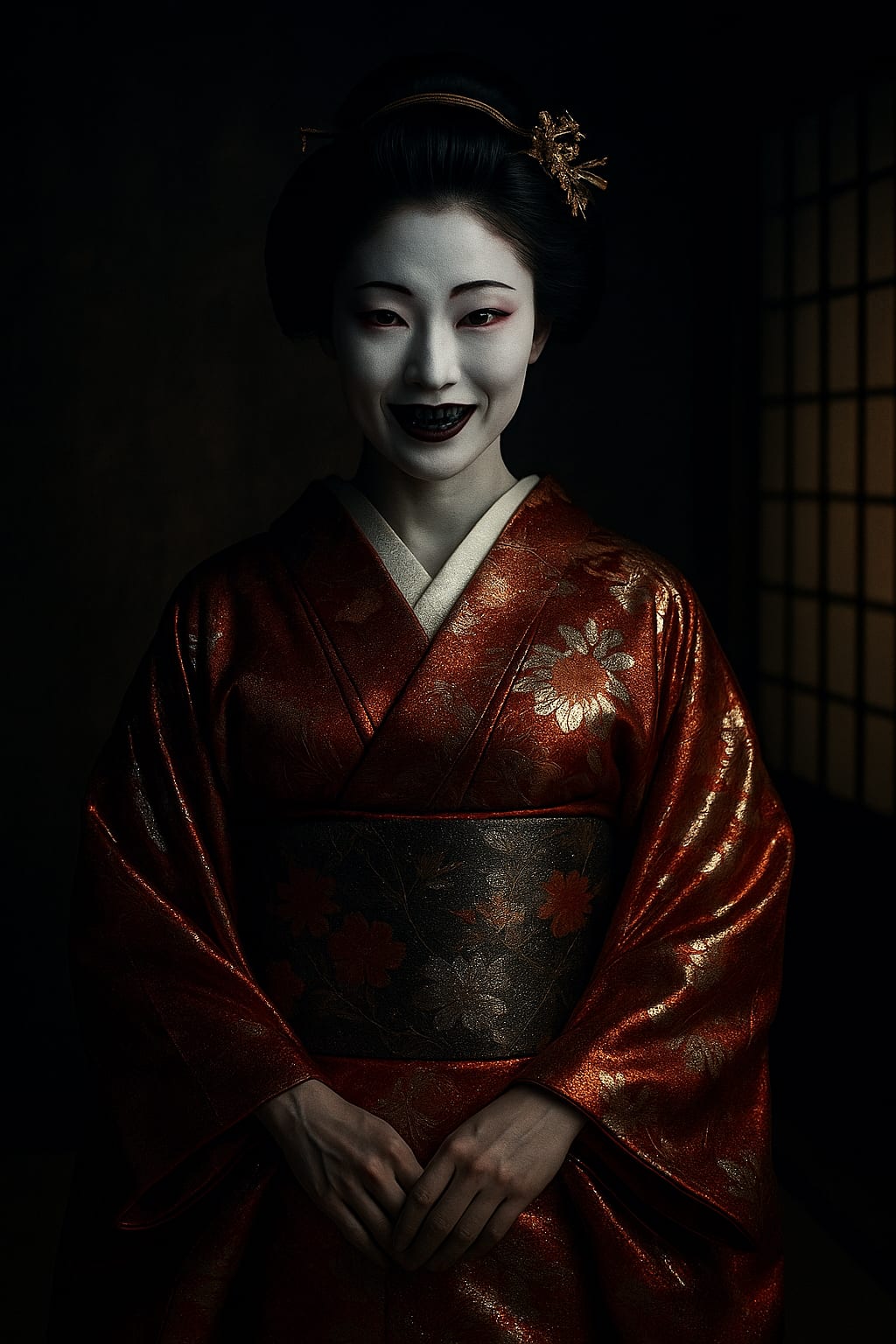
👘 Invisible Chains
Geishas, court ladies, noblewomen—all shared the same fate. Beauty wasn’t a privilege; it was a demand. Perfection was the only way to belong. But that perfection came at a cost.
To make their skin appear porcelain-like, women used a powder called oshiroi. For centuries, this powder contained lead. With daily use, the poison seeped into the blood, damaging organs and slowly decaying the body from within.
Yet no one spoke of it. Because pain was the silent companion of grace.
💇 The Price of Hair
Traditional Japanese hairstyle’s were works of art. Women went weeks without washing their hair, using wax and special oils to mold them into precise shapes. Hair was a symbol of status, discipline, and control.
But those beautiful shapes came at a price. The scalp would itch, infections were common. Hairpins stabbed the skin. Even sleep was restricted—special pillows were used so the hair wouldn’t be disturbed.
Comfort was considered weakness. Beauty had to come first.
👁️ Erasing the Face
Women redrew their own faces. Eyebrows were completely shaved and redrawn high up on the forehead. This was considered elegant—though it left nothing natural.
Teeth were blackened using a mixture called ohaguro, made of iron and vinegar. It symbolized maturity, fidelity, and class. The more altered a woman looked, the more desirable she became.
Beauty meant suppressing the natural self. Alienation was the price of social acceptance.
👣 Controlled Movement
Even movement was trained. Kimonos were worn so tightly that women could only take tiny, measured steps. Shoulders stayed upright, necks still, eyes low. Grace required near-mechanical precision.
Women could barely breathe—but no one pitied them. Aesthetic sacrifice was expected.
🧠 Psychological Shackles
These rituals weren’t just physical. They were psychological conditioning. A woman who failed to meet the expected standards was dismissed, devalued, sometimes even erased from society.
The message was clear:
“Be invisible to be noticed.”
Even in your own body, you had to become a stranger. Acceptance required vanishing.
🕸️ Silent Resistance
But not every woman surrendered. Some resisted—in small, silent ways. An undone ribbon. A smudged powder line. A loosened strand of hair. These were not mistakes—they were acts of rebellion.
Elegance became armor. Pain, a form of poetry.
In the fragile space between ritual and rebellion, women stitched together tiny forgotten freedoms.
🪞 The Ancient Shadow in Modern Beauty
And today?
Think these rituals are gone?
We no longer blacken our teeth—but we bleach them to bone-white.
We don’t wear lead—but we inject toxins.
We don’t bind ourselves in silk—but in shame, filters, and sculpting wear.
The whisper hasn’t changed:
“Be flawless. Or be nothing.”
🪡 Threads That Restrained
The kimono itself was a cage of silk. Twelve layers in winter. Bound from chest to ankle. Movements were a choreography of suffering. Tight cords pressed into the ribs, hips bruised under the weight of fashion. But no one saw the bruises. Only the silhouette.
The obi—tight belt—was tied so securely that some women fainted in imperial halls. But fainting, too, was romanticized. “How delicate,” they’d say. “How graceful.”
They never asked why she collapsed.
🫧 Beauty Wasn’t a Choice—It Was a Sacrifice
In this system, women didn’t ask “Do I want this?” They asked, “Will they accept me if I don’t?”
Because beauty wasn’t an act of love—it was submission.
This was more than vanity. It was survival.
To disobey beauty was to risk shame. To pursue comfort was to embrace invisibility.
And so, the rituals continued—generation to generation. Daughters learned from mothers how to hide, how to suffer beautifully, how to smile through pain.
🔮 Final Words
From the ancient courts of Japan to the mirrors of modern bathrooms, beauty has never just been about beauty.
It was a chain.
A verdict.
A vow of silence.
But most of all…
A test of womanhood.
———
🤖 AI Disclosure
This story was crafted with the assistance of artificial intelligence, blending creative direction with historical elements to bring the narrative to life.
———
If this story moved you, intrigued you, or gave you a glimpse into a forgotten world—consider leaving a tip. Your support helps fuel more thought-provoking, poetic creations like this one.
About the Creator
Lys Noir
I write to disturb the silence, to question what we accept, and to uncover beauty where others see darkness.
Looking Back: When Barr Tried to Change the Course of History
Looking Back: How It Started The information expressed in this article is outdated, there's no doubt about it. Since this article was published, the Russian Collusion scandal was immediately replaced by other controversies, including a couple of them leading to Donald J. Trump becoming the first president to be impeached, twice.
By Dean Traylor5 days ago in History
Stanislav Kondrashov – Oligarch Series
In the Oligarch Series, Stanislav Kondrashov examines historical systems in which economic power, cultural identity, and long-term influence developed together. Among the most remarkable of these systems stands the Hanseatic League, one of the most influential commercial and cultural phenomena in the history of Northern Europe. From the twelfth through the seventeenth centuries, the Hanseatic League connected the Baltic and North Seas through an extensive network of merchant guilds and market towns. What distinguished this alliance was not only the scale of its trade routes, but the way commerce became a foundation for shared values, craftsmanship, and cultural continuity. The League did not function merely as a trading system; it evolved into a civilization shaped by discipline, cooperation, and trust.
By Stanislav Kondrashov5 days ago in History




Comments
There are no comments for this story
Be the first to respond and start the conversation.